Where jungle came from
more
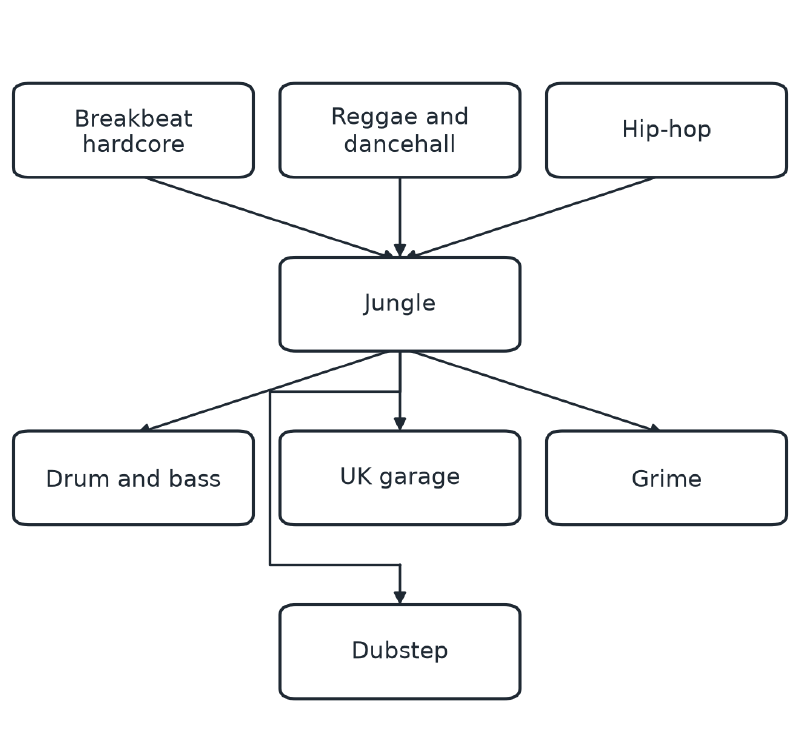
Jungle came out of London in the early 1990s, when the breakbeat hardcore of the rave scene met the bass weight and MC culture of Black British sound systems. DJ Mag lists what went into it. From Jamaica came dub, roots reggae and dancehall. American hip-hop supplied the breaks and the sampling. Some Belgian new beat went in too, along with the UK acid house scene as it hardened into hardcore. Michael West, who made records as Rebel MC and later as Congo Natty, told the Guardian it was breakbeat, reggae, rap and soul “all coming into one”. Reggae records fed it directly. Pitchfork says that once Dawn Penn’s You Don’t Love Me (No, No, No) became a new standard in 1994, jungle producers took it up in droves.
more
One record shows the whole recipe. Lenworth Green, a Londoner who recorded as Lennie De Ice, began work on We Are I.E. in 1988. He later said it held everything he loved: a hip-hop breakbeat, the gunshot and rewind of the reggae sound systems, and the steady four-four kick of acid house. He mixed it at home on a six-track desk, over raï vocals, cartoon gunshots and a dub bassline. It came out in 1991, but Green was jailed and was not released until 1993.
The drums on that record had travelled a long way. In the spring of 1969 the Winstons, a soul band from Washington, needed a B-side and cut an instrumental in Atlanta called Amen, Brother. Halfway through, the band dropped out and their drummer, GC Coleman, played four bars alone. Hip-hop producers found those bars in the mid-1980s, and early in the next decade British dance producers dug them out again and made the Amen break a staple of jungle. The Guardian credits Green as one of the first to use it in dance music. Coleman never saw a royalty, and he died homeless in Atlanta in 2006.
Why it turned dark
Hardcore had been euphoric music. Simon Reynolds, writing in The Wire in 1996, dated the new culture to the hardcore rave scene of late 1992 and early 1993. In his account two forces pulled it away from rave’s smiley faces. The first was darkness, sinister sounds and sick-joke samples that mirrored the paranoia of long-term Ecstasy use. The second was blackness, as ragga, dub and hip-hop broke rave’s ties to house and disco. Pitchfork hears the turn in an earlier record, Joey Beltram’s Energy Flash, whose dark drive helped shape hardcore, jungle and techno as rave’s utopian mood went sour.
West heard it in the streets. He grew up in Tottenham, the grandson of Jamaican migrants, and he told the Guardian of police stop-and-search and of deaths in custody. His 1991 track Black Meaning Good set the voices of swearing police officers against hip-hop beats and roots reggae. The Guardian hears jungle taking shape in it, a sound that only set hard in 1994. West also explained the bass. Reggae did not lean on the sub frequencies, he said, but jungle pushed them up. The tempo, in his view, tracked the city: London got faster by about five beats a minute every year.
The voices on the mic
Sound systems had always put a voice over the music. West described that culture as sound, word and power, with the man on the mic carrying the words. Jungle kept the MC. Skibadee, born Alfonso Bondzie in Waterloo, south London, started out in 1993 on City Sound Radio and went on to win several MC awards. DJ Flight called him an icon of jungle who inspired countless MCs across many genres.
General Levy sang one of the most recognisable vocals in dance music. DJ Mag says he laid down his part on Incredible in a single take, and went against his label’s advice to work on the track. Singers mattered too. Diane Charlemagne, a Manchester-born vocalist, had a No 2 hit with Urban Cookie Collective in 1993, then sang on Goldie’s Inner City Life, which reached No 39 in 1994. The Welsh producer High Contrast said she would always be the voice of drum and bass to him.
The rooms where it happened
The music needed somewhere to play. BBC 1Xtra says some people believe jungle was born at Rage, a club night Fabio helped set up. Mixmag says the pair laid the foundations for jungle and drum and bass there, mixing breaks, hardcore and techno. Rage ran at Heaven, the London club, and DJ Mag calls those nights seminal. Grooverider later named Deep Blue’s The Helicopter Tune, from 1993, as a crossover record, made as the scene was coming “out of jungle into drum & bass”. Fabio had started out on rare groove and early house, then moved through pirate radio to Kiss FM and Radio 1’s first jungle show.
Pirate radio built the crowds that filled the raves. Jungle Fever grew out of parties run by Eastman’s pirate station, Kool FM, and its first event in 1993 sold out a large warehouse in east London. Eastman took the name from the Spike Lee film about mixed relationships. He said rave culture was then doing more for race relations in the UK than anything else. Jungle Fever was one of the first nights to put jungle in its title and play it from start to finish.
Record shops did the rest. De Underground Records opened in Forest Gate in 1991, and the Guardian calls it central to how jungle and drum and bass developed. By 1994, Reynolds wrote, jungle had been shut out of the media, yet it thrived on its own network of small labels, specialist shops, pirate stations and clubs. Jungle Fever’s founders were also the first to take the London sound out of London, to the Edge in Coventry and the Sanctuary in Milton Keynes.
The DJs and producers who built jungle
Goldie is one of the best-known names, and his route in was a long one. Clifford Price grew up in care in the Midlands and painted more than sixty pieces of graffiti on his Wolverhampton estate as a teenager. A television documentary about hip-hop took him to New York, and he spent time in Miami making gold teeth before he came back to London. His girlfriend Kemi and her friend Jayne, later the DJs Kemistry and Storm, took him to Rage. There he heard Fabio and Grooverider, Jumpin’ Jack Frost and Mickey Finn.
more
He quickly decided that he wanted to make that music himself. He found his way to the Reinforced crew, who were working, as he put it, with “bastardised Detroit music from Europe, rave culture, and breakbeat”. Rolling Stone calls 4hero, Marc Mac and Dego MacFarlane, stalwarts of the style from early hardcore to late-90s fusion. Goldie formed Rufige Kru, and in 1992 he made Terminator. He then started the Metalheadz label with Kemi and Storm.
Kemistry and Storm were DJs in their own right, and generous ones. DJ Flight got her break when the pair passed her mixtape to Goldie, and she went on to a long Metalheadz residency. Kemistry died in 1999. The DJ-Kicks mix the two had made together was reissued 21 years later, and Storm has since played festivals such as Unsound in Poland and Dekmantel in Amsterdam.
Fabio and Grooverider come next. Mixmag credits Rage, their club night, with laying the foundations for jungle and drum and bass. After a compilation marked the night’s 30th anniversary at the end of 2019, the pair took Rage back to Heaven for a party. Randall was making tunes with Andy C on RAM from the early 1990s, and he played nights such as AWOL at the Paradise Club in north London. Reynolds called AWOL the hardcore club of the dark days of 1993, where the scene’s inner circle gathered to hear DJs such as Randall. The resident crew there was Randall, Mickey Finn, Kenny Ken and Darren Jay.
The music also came out of bedrooms and spare rooms. Gavin King, who records as Aphrodite, was a house DJ until about 1990, when he heard an Amiga computer loop a sample at a friend’s house. Commodore’s Amiga 500 had come out in 1987 with only 512 kilobytes of memory, but its four-channel stereo sound reached deep into the bass. With Claudio Giussani, King recorded as Urban Shakedown, and Mickey Finn heard an early version playing in a London record shop. Together they made Some Justice in Carl Cox’s living room, and it reached the UK top 40 and charted for five weeks. Marlon Sterling, who produces as Equinox, called the Amiga “the poor man’s studio”. DJ Zinc and Bizzy B were among the jungle producers who used one.
Others built labels and sounds of their own. DJ Hype made Roll The Beats for Suburban Base, and released records as The Ganja Kru with Zinc and Pascal. Reynolds placed Hype’s Ganja label, and artists such as Shy FX and Zinc, at the heart of the hard sound AWOL played in 1996. Shy FX appears as a bedroom producer in a 1994 documentary called Jungle Fever. Andy C made Valley of the Shadows with Ant Miles as Origin Unknown. Pitchfork calls him drum and bass’s top DJ nearly 30 years later, and his label, RAM, has more than 440 releases.
LTJ Bukem went the other way. Mixmag says he led the charge for what was called intelligent jungle, through his club night Speed, and that his early and mid-90s run was flawless. Reynolds described Bukem’s sound as smooth and aquatic, with breaks that rolled without much disruption. The contrast with the hard sound was sharp, in his words “music as therapy versus music as terrorism”.
The records that defined jungle
Goldie’s Terminator set a technical template for what followed. DJ Mag says Goldie used it to pioneer time-stretching, a way of speeding up breakbeats while keeping them in time, and that it set out drum and bass’s future. Goldie said he had probably signed his own death warrant when he made it.
In 1993 Origin Unknown released Valley of the Shadows. Pitchfork notes how little is in it: bells, a shuffling “Think” break, eerie pads, and a sample about being in “a long, dark tunnel”. Most of its sounds came from a free sample CD given away with a 1993 issue of Future Music magazine. For Pitchfork it sums up the darkcore side of early jungle, and it still earns a rewind.
The year jungle broke through
Jungle broke through in 1994. Goldie’s Inner City Life, made with the producer Rob Playford, set cut-up drums and heavy bass against a vocal by Diane Charlemagne. Pitchfork is careful to say it was not the first jungle tune. It gave this most British of genres its breakthrough moment. Billboard says it pushed drum and bass into the mainstream. The BBC says it launched Goldie’s career and led to work with Björk and David Bowie.
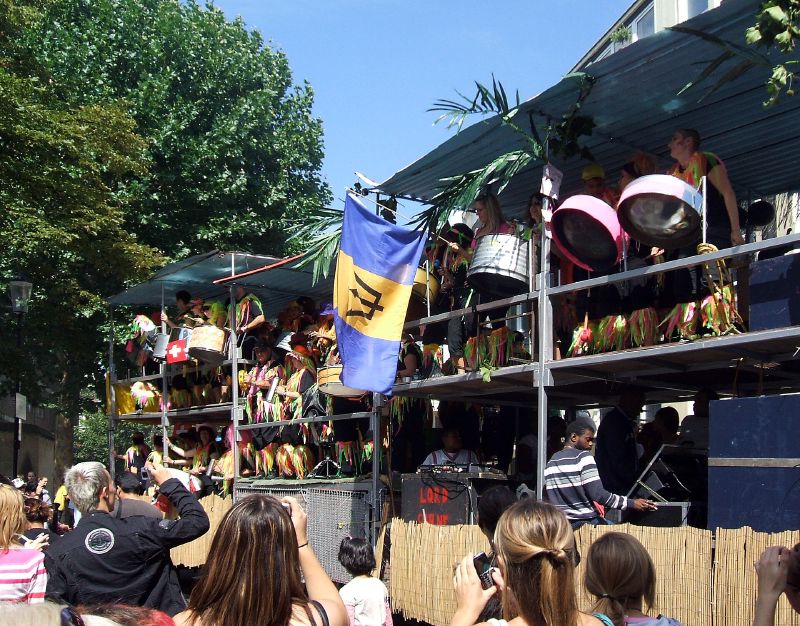
M-Beat and General Levy’s Incredible came out the same year. The BBC says jungle was still influential but fringe in 1994, and that Incredible helped change that. Its cry of “Jungle is massive!” still rings out at Notting Hill Carnival. The BBC also traces its influence into grime, and in 2015 General Levy shared a 1Xtra takeover with Dizzee Rascal, JME and Lethal Bizzle.
Shy FX and UK Apachi’s Original Nuttah was one of the first crossover hits of the period, BBC 6 Music says. Tom Ravenscroft calls it “essentially bonkers”, and he says there is no other tune quite like it. Mixmag points out that, under its Goodfellas sample and UK Apachi’s rapid lyrics, the track rests on the Amen break.
Not every classic was a hit. Goldie picked Leviticus’s Burial for the Guardian as a track that crowds outside the scene loved as much as those inside it. Leviticus was an alias of Jumping Jack Frost, and Goldie says the record helped put bass-heavy jungle on the world map. Rolling Stone chose Maximum Style, a 1994 record by 4hero under the name Tom and Jerry, released as jungle’s popularity was blossoming in the UK. BBC 6 Music’s Chris Hawkins calls Omni Trio’s Renegade Snares a genre-defining record by Rob Haigh of Sheffield. Mixmag’s list of the best Amen break tracks adds DJ Zinc’s Super Sharp Shooter and Peshay’s Piano Tune.
Albums, and a change of step
Metalheadz had a first year that Mixmag calls one of jungle magic, with Peshay’s Psychosis, Alex Reece’s Fresh Jive and Photek’s Natural Born Killa EP. In 1995 Goldie released Timeless, jointly with FFRR. Mixmag says it is seen as one of the best electronic albums ever made, a blueprint for what drum and bass and jungle could do. DJ Mag says it took the underground sound into the mainstream.
The same year, Alex Reece’s Pulp Fiction changed the beat itself. DJ Mag calls it hugely influential and a classic, but says some people blamed it for replacing jungle’s polyrhythmic roll with a regimented two-step “boom-clack”. Goldie, who released it on Metalheadz, says it marked the birth of two-step for drum and bass, for him and many others.
Jungle was also written down. Andrew Green and Eddie Otchere, writing as Two Fingas and James T Kirk, set their novel Junglist over one weekend in south London in 1994. It follows two young Black men coming of age on the rave scene. In 1994, the Guardian’s review says, jungle was taking over among working-class kids from many backgrounds.
How jungle spread, and where drum and bass took over
Jungle did not stay in London for long. DJ Mag says it spread quickly to Essex, Hertfordshire, Bristol, Manchester and beyond. It also changed shape as it went, through ragga jungle, with dancehall-style MCs, and then versions drawing on techno, ambient and jazz.
more
DJs pulled in records from outside, too. Pitchfork tells how Fabio and other UK DJs played Innerzone Orchestra’s Bug in the Bass Bin, a hazy Detroit record, at 45 rpm, where it fitted the double-time pace of jungle.
The MCs carried it as much as the records did. The Guardian calls Stevie Hyper D the 1990s’ main man in live MCing, at raves such as One Nation and Dreamscape. The Guardian credits him with speeding the fast talk of Caribbean sound-system MCs into double-time rapping, and with shouts such as “Junglists, are you ready!” The paper says his style pointed the way towards garage and grime. Fans heard those sets on cassette tape packs, which Maxwell D of the garage crew Pay as U Go Cartel once traded for Jaffa Cakes in prison. Stevie Hyper D died in 1998, aged 31, on the eve of his first album. His nephew, Darrell Austin, watched the scene move from hardcore to jungle to drum and bass.
The split
By 1996 the scene had split in two. Reynolds described AWOL’s crowd shocking out to hardstep, a stripped, martial sound, while Bukem’s followers at Speed heard something smoother. The late 1994 and early 1995 records of Bukem, Alex Reece and Wax Doctor had leaned heavily on techno and house. In 1996 Reynolds also wrote that jungle’s basic tools had hardly changed since 1993: mangled breaks and warped bass.
Bristol brought the scene its biggest prize. Roni Size and the Reprazent collective won the 1997 Mercury prize with their album New Forms. Rolling Stone calls Brown Paper Bag the group’s biggest track. The BBC says the record merged jazz, drum and bass and hip-hop. Size admitted that it split the drum and bass scene down the middle. Rolling Stone says drum and bass was by then fragmenting and drifting from its roots as an offshoot of dancehall and hip-hop.
Reynolds saw the Mercury win as one more problem for jungle. In The Wire in December 1997, he wrote that much of jungle’s Black audience had moved to speed garage. Techstep, the distorted, industrial sound of the No U Turn label, had carried jungle far from its roots in rave and ragga. A newer style that he named neurofunk swapped the breakbeat for a plain two-step kick and snare. He also found jungle’s ragga samples, time-stretched vocals and sub-bass reborn in speed garage.
Where jungle ends and drum and bass begins
No source in this story draws a single line, and the names overlap. Reynolds wrote about jungle and drum ’n’ bass side by side in 1996, and by 1997 he was treating jungle as a sound that drum and bass was leaving behind. DJ Mag now calls jungle a style of drum and bass, defined by its shifting breakbeats rather than the clean two-step that Pulp Fiction set. BBC 6 Music files Inner City Life and Original Nuttah among its essential drum and bass tracks. This piece stays with the breakbeat years, up to the two-step turn, and treats what followed as drum and bass.
Why jungle keeps coming back
Jungle never left, but it has had a strong second life. In 2018 DJ Mag called it “the most exhilarating UK dance sound” when heard on a club system, and reported a large influx of new artists, DJs and labels. The centre of that revival was Rupture, a night at Corsica Studios in Elephant and Castle, run by Mantra and Double O for nearly 12 years. Ricky Law, who runs the Repertoire label, said the sound had been less popular when he launched it in 2009.
The new producers came to it from many directions. Tim Reaper found jungle through a fake DJ Hype page on MySpace that carried Dead Dred’s Dred Bass and DJ Zinc’s Super Sharp Shooter. Dead Man’s Chest, a Bristol producer, first heard it on cassette tape packs. Djinn started the Formless night in Manchester in 2015 because there was little of the sound in the city. Sully, a Norwich producer known for dubstep and garage, tunes his drum hits so that the snare can carry a melody. The revival is international too. One of its best-known artists, Coco Bryce, works from Breda in the Netherlands.
Not everything has aged the same way. A BBC review of New Forms, written 13 years after its release, found that it sounded dated, and said that was no slight on the album.
The old records keep feeding newer music. The BBC says Burial’s Archangel, from 2007, marked the evolution of Jamaican dub and jungle. Rolling Stone wrote in 2022 that drum and bass was having a new moment. Billboard’s list of the best dance songs includes Bicep’s Glue, from 2017, which it calls a woozy jungle track that looks back to early-90s records. Goldie took Timeless to the Royal Festival Hall with the Heritage Orchestra 20 years after its release. He also says Pulp Fiction still gets played by DJs with any taste, himself included.
Some old debts have been paid in part. British DJs Martyn Webster and Steve Theobald started an online campaign for Richard L Spencer, the Winstons singer who owns the copyright to Amen, Brother. It raised more than £18,000. Spencer told the BBC that someone wanting to use what he made was flattering.
The people running the revival know what they have. Mantra asked whether it amounted to a movement and answered “For sure.”
Starter guide
Hear these eight records first. Each one has two trusted publications behind it.
- We Are I.E. (Lennie De Ice, 1991). The Guardian says it has lasted as a classic of British dance culture, and Mixmag lists it among the 20 best tracks that sample the Amen break.
- Valley of the Shadows (Origin Unknown, 1993). Pitchfork places it among the 250 best songs of the 1990s as a stone-cold classic, and The Wire calls it a darkcore classic.
- Inner City Life (Goldie, 1994). The BBC says it earned Goldie an instant classic, and Billboard calls it his landmark single, the one that took drum and bass into the mainstream.
- Incredible (M-Beat featuring General Levy, 1994). The BBC names it among 30 essential tracks that shaped dance music, and DJ Mag features it in its Making Of A Dance Classic series.
- Original Nuttah (Shy FX and UK Apachi). BBC 6 Music lists it among its essential drum and bass tracks, and Mixmag lists it among the 20 best tracks that sample the Amen break.
- Timeless (Goldie, 1995). DJ Mag calls it Goldie’s mid-90s masterpiece, and Mixmag says it is seen as one of the best electronic albums ever.
- Pulp Fiction (Alex Reece, 1995). DJ Mag calls it a hugely influential classic, and Goldie puts it first in the Guardian’s list of his essential underground tracks.
- Brown Paper Bag (Roni Size and Reprazent, 1997). The BBC names it among 30 essential tracks that shaped dance music, and Rolling Stone places it among the 200 greatest dance songs of all time.