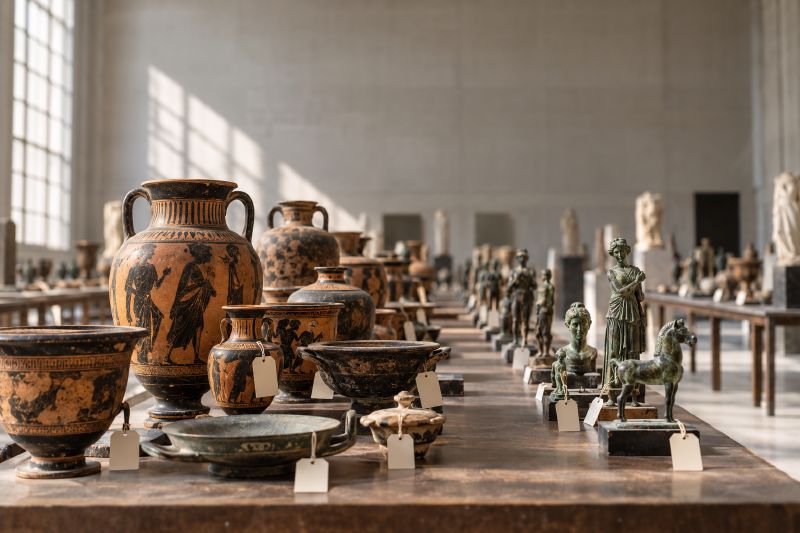
Police in Rome laid out 5,361 vases, bronze statues and frescoes at a national museum, a haul worth about €50 million and the largest recovery of looted antiquities in history by their own count. Every piece had come from Swiss warehouses belonging to the Basel-based dealer Gianfranco Becchina. Becchina walked away from the raid a free man. The charges against him had already expired.
What the raid found
Investigators traced the hoard to Becchina and his wife, Ursula Juraschek, whom prosecutors accused of running a trafficking network that reached from Italian “tombaroli”, the local term for tomb raiders, through to dealers and buyers worldwide. The warehouses held detailed inventory records, photographs and receipts documenting the trade. Carabinieri general Mariano Mossa called it the biggest such recovery ever made, by quantity and by quality. The works dated from the eighth century BC to the third century, and might be shown to the public before going back to museums in the south of Italy.
The paper trail showed how the network operated. Dealers forged provenance documents and invented ownership histories for looted pieces, so that a museum or private collector buying in good faith would have no obvious reason to doubt them. David Gill, an archaeological heritage professor who has tracked the case, said the recovered records would likely point investigators toward objects already sitting in major museum collections, and add them to Italy’s repatriation list.
Why prosecution never landed
Police said the charges against Becchina had lapsed, so he stayed free. By the time the haul went on show, there was no case left to bring against him.
Switzerland also served smugglers passing through rather than based there. British antiquities restorer Jonathan Tokeley-Parry disguised looted Egyptian pieces as cheap souvenirs and shipped them through Zurich airport’s duty-free zone, where they drew no customs attention. A Swiss accomplice in his network created false paperwork making Egyptian finds appear to have come from Germany instead, giving them a clean paper trail before they ever reached a buyer. Tokeley-Parry was eventually convicted in England and sentenced there, and separately convicted in absentia in Egypt, but the Swiss leg of his supply chain was never the point where the case broke.
A market that asked few questions
For decades, American museums and private collectors bought antiquities at auction or through dealers under what amounted to an unspoken rule: don’t tell, don’t ask. Sellers offered scant or misleading information about where a piece had come from, and buyers mostly took it at face value, more concerned with whether an object was genuine than with how it had reached the market. Renzo Canavesi, who lived in Switzerland near the Italian border, had been identified as the previous owner of a statue that stood for years as the centrepiece of the J. Paul Getty Museum’s Greek and Roman collection, before Italian officials identified it as looted from Sicily.
That posture began to change only once foreign governments could produce hard evidence, not merely suspicion, that specific museum pieces had been stripped from archaeological sites. Once they did, the results followed fast. The Getty alone returned 47 objects to Italy, including that centrepiece statue, and the Metropolitan Museum of Art gave back 21 pieces, among them a Greek vessel it had bought in 1972 for a then-record $1 million. Across every case, no museum admitted wrongdoing, and Italy agreed in turn to send other antiquities to the same institutions on long-term loan.
Becchina’s case shows what the trade looked like: not a series of one-off thefts, but a network running from tomb raiders to buyers worldwide.