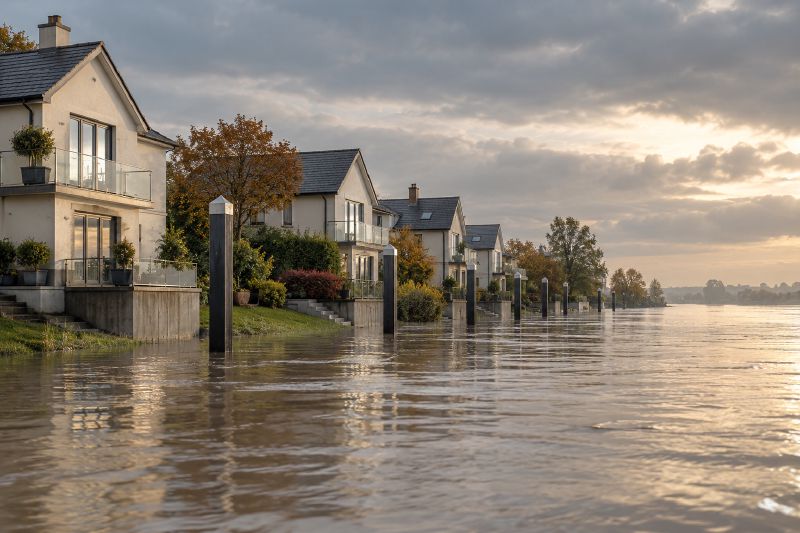
The amphibious houses at Maasbommel float because each one sits on a hollow concrete box. When the River Maas rises, the box lifts off the riverbed and carries the house up with it. A vertical pile keeps each house anchored in place, and the BBC reported the homes can cope with the water table rising by up to four metres.
What a flood looks like from inside
Most days the houses look like ordinary waterfront homes. They rest on the riverbed, a few centimetres above the water, on a concrete box about two metres high. Power and water reach them through flexible pipes.
Cees Westdijk, who bought one with his wife to live near the water, told the BBC they barely notice when the area floods. He still warned that the houses do not replace dykes and other conventional defences.
Why a village on the Maas tried it
Maasbommel sits in Gelderland, about 60 miles east of Amsterdam, and from the south you can reach it only by a small ferry. The area floods. In 1993 and again in 1995, high water forced tens of thousands of people from their homes.
The development has 46 brightly painted two-storey houses with curved roofs. Only 12 of them float all the time. The rest are the amphibious kind that rise only when the river does. Its designer, Ger Kengen of Factor Architects, told the Guardian it was the first amphibious scheme in the Netherlands, built to put flood-prone land to commercial use. The first homes were finished in 2005.
Dura Vermeer developed the houses, and they started at 260,000 euros. Chris Zevenbergen of the company told the BBC that demand was high. Officials from New Orleans, flooded in August 2005, visited to see how the homes work.
The wider Dutch bet on water
The pressure behind the idea is land and sea. Dutch scientists predicted sea levels could rise by up to 110cm by 2100. The government estimated the country would need 500,000 new homes over two decades.
The architect Koen Olthuis of Waterstudio uses the same hollow-box principle for his “watervilla” designs. In those, the concrete hull doubles as a basement, and the house slides up its mooring posts as the water rises. “In a country threatened by flooding,” he told the Guardian, “the safest place to be is actually on the water.”
The awkward detail is the one the Guardian reported in 2008. Since the first Maasbommel homes were finished, there had been no floods to test them.