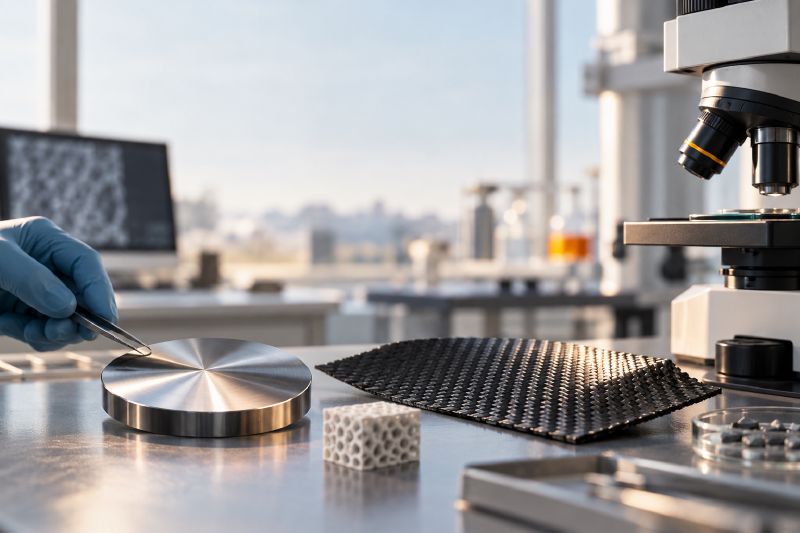
Materials science and engineering is the study of why a material behaves the way it does, and how to make it behave better. Michigan Technological University describes the aim as making materials stronger and lighter, among other things. The work runs from understanding why a part failed to inventing a material that did not exist before.
The University of Maryland puts the field where engineering meets physics and chemistry. Its reach runs from semiconductors and nanotechnology up to engineered materials for aircraft and medicine.
What do materials engineers work with?
The answer is nearly everything solid. Michigan Tech lists several families, from metals and alloys to polymers and composites. Newer work covers graphene and carbon nanotubes, and biomaterials such as surgical mesh.
The University of Washington’s department frames the method in two halves. Its engineers use the basic principles of chemistry and physics to understand a material’s structure and properties. Then they design the processes that turn that understanding into something a modern product can use.
The products that depend on it
Almost every engineered product depends on someone picking the right material, which is why Michigan Tech calls the field central to nearly all of them. Michigan Tech credits the field with artificial skin for burn victims, and with the medical scanners behind ultrasound and magnetic resonance imaging. It also points to composites that let mountain bikers climb faster, and to smaller, cheaper computer chips.
The University of Washington lists the problems its researchers chase now:
- devices that detect cancer early
- better batteries for electric vehicles
- plant-based materials
- materials for quantum computing
Its researchers also ask how biomass could help close the carbon cycle.
Maryland makes the same case in fewer words. It says the field touches nearly every part of daily life. The department places it at the centre of a triangle formed by nanotechnology, biotechnology and information technology.
What a working day involves
Michigan Tech’s list of everyday tasks is less glamorous than the breakthroughs, and more telling. Its engineers test materials and research their structure. They check whether a material meets the mechanical, electrical or chemical demands of a product, and they choose which material goes into it.
A good share of the work is detective work. When a part breaks, a materials engineer works out why and proposes a fix. The same people assess a product’s environmental impact and look for ways to cut it. Then come the parts of any professional job: managing projects, consulting other engineers, and writing proposals, budgets and reports.
Materials engineers rarely work alone. Michigan Tech says they work closely with engineers from other disciplines, and with chemists and physicists.
Where the graduates go
In most industries that make physical things. Michigan Tech names six sectors, among them aerospace and defence. The jobs range from designing new materials to forensic work on why a component failed.
The University of Washington reports an average starting salary of $75,000 for its recent graduates. Its alumni have gone to Boeing and NASA in aerospace, and to Intel and Microsoft in computing. A typical first job title is materials engineer or process engineer.
Most entry-level posts in the US ask for a bachelor’s degree from an ABET-accredited programme, according to Michigan Tech. The department also lists the skills it expects: problem solving first, then a grounding in mathematics and physical science.
A small field with a lot of output
Materials science is one of the smaller engineering disciplines, and Michigan Tech argues that size gives students more time in the laboratory. Small does not mean quiet. The University of Washington’s department says its researchers have reported 98 inventions and had 36 patents issued.
Washington lets its students specialise in six areas, from biomedical materials to data science.