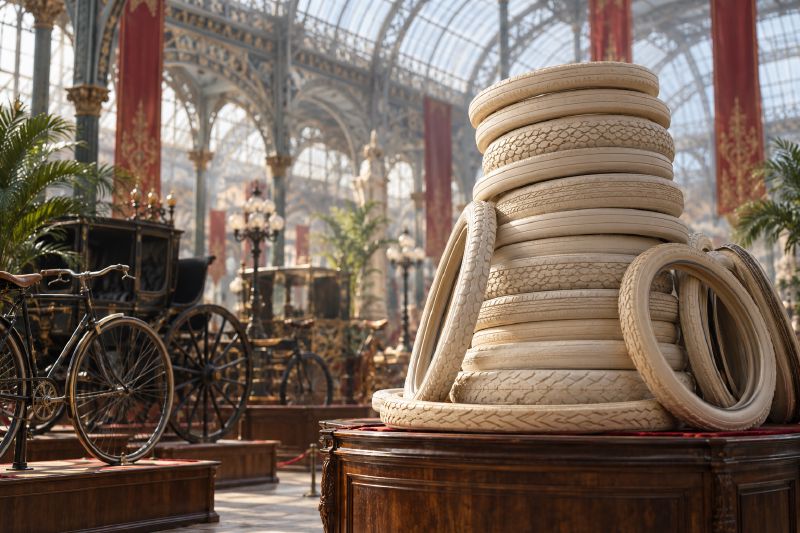
The Michelin Man is made of tyres because a pile of them once looked like a body. In 1894 the brothers Édouard and André Michelin, from Clermont-Ferrand in France, went to the Lyon Universal Exposition. The story goes that Édouard saw a stack of tyres on the Michelin stand and told André that with arms and legs it would make a man. Four years later, in 1898, the figure was first drawn.
His formal name is Bibendum, and the early versions would startle a modern brand manager.
A drinker who swallowed obstacles
The first Bibendum drank champagne. His tagline promised that the Michelin tyre “drinks up obstacles”, and the character became known as the “road drunkard”. In the early twentieth century he also chomped a cigar and wore a pince-nez. The Guardian points out that those props suited the small, wealthy group who could afford a car at the dawn of motoring.
He dropped the cigar and the pince-nez in 1920.
Why he is still white
Bibendum’s tyres stayed white because early tyres were pale. Black tyres arrived only in 1912, when manufacturers began adding carbon black as a preservative. So the figure still carries a trace of the product as it looked in 1898.
He grew rounder by the 1950s, and by the 1970s he had become a full cartoon. In 2000 he was named advertising icon of the century, BBC Stoke reported.
Gone, and back
Michelin has shelved him more than once. The BBC noted that Bibendum was taken out of the public eye in 1999, and that the company stopped all TV adverts featuring him in 2003. He returned in 2008 after a redesign that slimmed him down.
The design historian Alain Weill explained the staying power to The Guardian. Michelin stopped using him at different points, he said, but always came back, and the character lasted because the brand did.