Bottled water tends to hold more microplastic than tap water, according to a review of 21 studies published in 2022. Whether those particles harm the people who drink them is still an open question, and the World Health Organization lists the missing evidence as a set of gaps to fill.
So the finding is firmer on how much plastic is in the bottle than on what it does once swallowed.
What counts as a microplastic
The 2022 review uses the common definition: a plastic particle shorter than 5mm. There is no official lower limit, but the authors cite a proposal that puts it at 1 micrometre, with anything smaller called a nanoplastic.
Some of these particles are made small on purpose, such as microbeads in cleansers. Others come from larger plastic waste that sunlight, weather and microbes break down. The review lists polyethylene terephthalate (PET), the clear plastic of most drinks bottles, among the commonest types found.
Bottled against tap
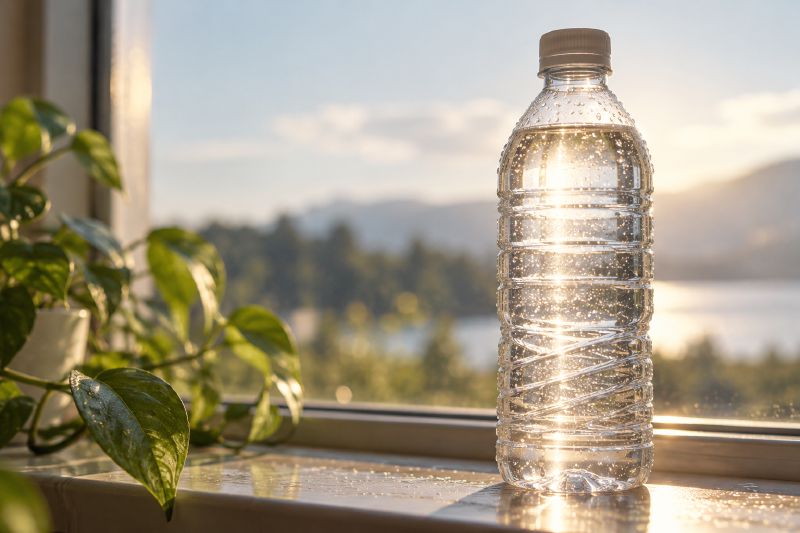
The review’s authors found more particles in bottled water than in tap water, and more as the particle size fell. Among bottled waters, the highest counts came from reusable PET bottles and from glass bottles, ahead of other packaging.
Tap water held fewer particles than the rivers and lakes it came from. The authors read that as a sign that treatment plants remove a large share of it.
Newer counts are much higher, according to Verywell Health. It reports that in 2024 a team at Columbia University used a two-laser technique called stimulated Raman scattering microscopy on three US brands. By its account, they found about 240,000 particles in a typical litre, between 10 and 100 times more than earlier estimates, and about 90% of them were nanoplastics.
Food & Wine reports that a 2025 review in the Journal of Hazardous Materials, covering more than 140 studies, estimated that someone who drinks only tap water swallows about 4,000 microplastic particles a year. Getting all of a day’s water from single-use bottles adds up to 90,000 more, by the same estimate.
Where the plastic comes from
Food & Wine says the 2025 review traced much of the plastic to the bottle itself, and in particular to the neck and the cap. Opening and closing a bottle again and again, squeezing it while drinking, and leaving it in the sun all raised the count in the work it reviewed.
What the evidence says about health
This is where the sources become cautious. The authors of the 2022 review say the results vary so much between studies that a general hypothesis on human health risk is hard to build. They call for one shared testing protocol, partly to serve the monitoring that new European rules have introduced.
The WHO reached a similar place in its own report on microplastics in drinking water. It examined the evidence on how often the particles occur, on possible health effects, and on how well treatment removes them. Its answer was a call for more research and a list of knowledge gaps to close before the health risk can be judged.
Arie Francis, a medical toxicologist at Stony Brook Medicine, told Verywell Health that there is no conclusive evidence yet that the plastics themselves are toxic.
What a drinker can change
The firmest advice in the sources is about the source of the water rather than the plastic’s effects. The 2022 review recommends tap over bottled water, both to cut exposure and to cut plastic waste. If a bottle is the only option, keeping it out of the sun and not squeezing it reduces shedding, according to Food & Wine’s account of the 2025 review.
Boiling does not help. Anna Marie LaChance, a chemical engineer at the University of Massachusetts Amherst, told Verywell Health that boiling kills bacteria but leaves the plastic in place.