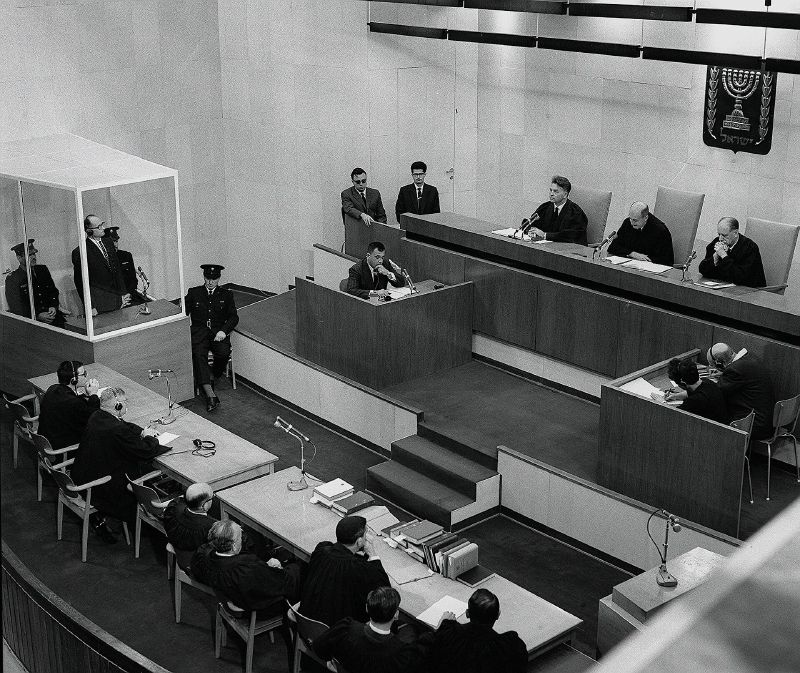
Stanley Milgram was 27, newly appointed to a professorship at Yale, when he began designing an experiment on obedience in 1960. Adolf Eichmann’s trial in Jerusalem opened in 1961, while Milgram was running his experiments. Eichmann had organised the mass deportation of Jews to Nazi death camps, and in the dock he said he had simply followed orders. Milgram wanted to know whether an ordinary person, told to hurt someone by a figure in authority, would do it too.
more
He built a version of that question he could run again and again. Each volunteer met two other people: a stern man in a lab coat, who ran the session, and a man cast as a “learner”. The volunteer was told the parts had been drawn at random, but the draw was fixed. Every volunteer became the “teacher”. The learner, in fact an accountant trained to act the part, sat in another room wired to what looked like a shock generator, and the teacher had to raise the voltage by 15 volts each time the learner answered a question wrong. The dial ran up to 450 volts, marked “XXX” rather than “lethal”. No one was shocked. The generator did nothing.
How far people went
Before running a single session, Milgram had a panel of psychologists predict the result. Their guess was that about a tenth of one per cent of volunteers, sadists and psychopaths only, would go all the way to 450 volts. Two-thirds did. Every volunteer reached 300 volts, which meant they believed they had given twenty separate shocks. They believed the doses could be fatal, and they could hear screaming from the next room.
Milgram then tried variations meant to make people stop. When the learner could be heard crying out and pleading through the wall, the number who reached the maximum fell by only one person. Moving the learner into the same room as the teacher brought the figure down further, but 40% still went all the way. What moved people to comply, Milgram argued, was the experimenter’s official position, signalled by his lab coat: he told each teacher he would take responsibility for what happened, and answered any hesitation with a fixed line, “You have no choice, you must continue.”
Why he thought they obeyed
The philosopher Hannah Arendt sat through the Eichmann trial and reached a strikingly similar conclusion from a different direction. She had expected a monster and found a hunched, unremarkable man instead, and named what she saw the banality of evil. Milgram cited Arendt directly when he wrote up his results, attributing the volunteers’ willingness to hurt a stranger to what he called “thoughtlessness”: obeying an order without weighing what it did to somebody else. He published the full account, a book called Obedience to Authority, in 1974.
Milgram ran his tests as a courtroom in Jerusalem heard Eichmann’s defence. What he found, in his own laboratory at Yale, was that a majority of ordinary people would follow authority to destructive limits.