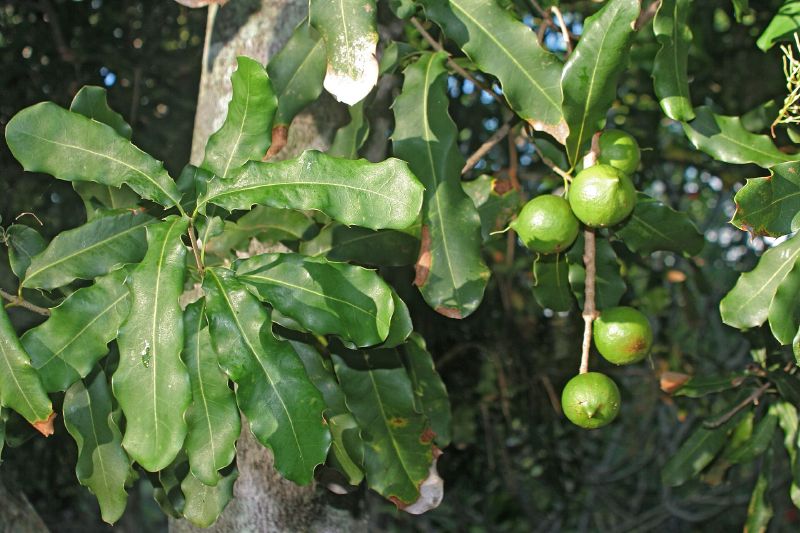
Macadamia is an Australian tree, but the crop the world grows is Hawaiian. Seed from Queensland reached Hawaii in the late 19th century, and Hawaii was where the nut first became a commercial crop, in the 1930s. World production is still dominated by cultivars bred there, some of them from the first generation released. Genetic work suggests most of those cultivars descend from one small wild population, perhaps one tree, near Gympie in Queensland.
more
A rainforest tree that became a crop in a century
The genus grows wild only in the subtropical rainforest of eastern Australia. Two of its four species, Macadamia integrifolia and Macadamia tetraphylla, give an edible kernel. The other two, M. ternifolia and M. jansenii, produce small bitter nuts that are high in cyanogenic glycosides.
The earliest record of Europeans growing the plant is a tree planted in Brisbane in 1857, according to a genome study in Nature Communications. Orchards followed in Australia in the mid-1800s. The study’s authors note that macadamia became a global nut crop after only about 100 years of domestication, which they describe as unique.
How Hawaii took the lead
Historical records show two shipments of seed from Queensland to Hawaii in the late 19th century. W.H. Purvis sent the first, and R.A. Jordan brought the second and planted it in Honolulu. Most of Hawaii’s early seedlings probably came from Jordan’s nuts. Craig Hardner, a horticultural scientist at the University of Queensland, told ABC News the records suggest that sample produced perhaps six trees.
What turned those trees into an industry was grafting. Reliable grafting arrived in the mid-1930s, and Hawaiian growers then picked the best trees from their seedling orchards to test and release as cultivars. The first of those came out in the 1950s. Grafting lets a grower copy a single good tree into an orchard of thousands, which is why so little variety came along.
The industry spread worldwide from the 1970s. By 2022, Modern Farmer listed Australia, South Africa, Kenya and the United States as the biggest producers.
Tracing the crop back to Mooloo
Catherine Nock, a plant scientist at Southern Cross University, led a 2019 study that compared Hawaiian orchard trees with wild Australian ones. Most of the Hawaiian plants traced back to a single population on private land at Mooloo, in the Gympie region. The gene pool was narrow enough that the team thinks one tree may be the source.
Nock told ABC News the narrowness came as “a bit of a shock”. She added that the Hawaiian cultivars make up about 70% of orchard trees worldwide. The Nature Communications study reached a similar answer by another route. It sequenced the Hawaiian cultivar ‘Kau’ and resequenced 112 accessions, pointing to Mount Bauple in south-east Queensland as the origin.
What the narrow start cost
A crop with little genetic variety is more exposed to disease and to a changing climate. Ian McConachie, who founded Australia’s Macadamia Conservation Trust in 2007, estimates that about 60% of trees planted in Australia and 80% planted elsewhere share a very limited genetic base.
The Smithsonian notes that the wild trees are far more varied, and breeders could use them to widen the crop. Even Australia’s own early plantings show what was lost. Three trees planted in the first decades of settlement, including an 1858 tree thought to be the first cultivated macadamia, matched no wild sample. Hardner read that as diversity that existed at settlement and has since gone from commercial growing.
The wild trees are running short
McConachie estimates that about 90% of wild macadamia trees have gone since European settlement. Only about 200 Macadamia jansenii trees survive in the wild, all in Bulburin National Park, and bushfires came within 10 kilometres of them in 2018.
The trust and the producer Macadamias Australia are planting an arboretum of trees grown from wild cuttings, which McConachie calls an “insurance population”. In 2022 its nursery held the first 38 of a planned 640 saplings. Denise Bond, the trust’s executive officer, told ABC News that each new wild population found is a stepping stone linking the rest.
The genes the orchards left behind in Queensland are the ones breeders may need next.