The Sorbonne began as a place for students to sleep. In 1257 Robert de Sorbonne, a chaplain to the French king, founded the first hostel for students of the University of Paris, and his surname stuck to the whole institution. The university it came to name was already a few decades old by then.
more
The university came first
The school that became the University of Paris grew up inside the compound of Notre-Dame cathedral. The canons who served the cathedral lived there, and so did a cathedral school that trained the diocese’s priests and drew scholars from across Europe. Writing in The Conversation, a historian of medieval religion counts Thomas Aquinas and Albertus Magnus among those who studied or taught in its early centuries.
Three decisions turned that crowd of masters and students into a university:
- In 1200 King Philip Augustus placed all students under the jurisdiction of the church.
- In 1215 the papal legate in Paris issued statutes that set out the course of study and who could teach.
- In 1231 a papal bull, Parens scientiarum, let the university write its own statutes.
The result was one of Europe’s first universities, on the bank opposite the cathedral. Because a papal representative had created it, the church governed it. Its students ranked as junior clergy, which put them beyond the reach of the city’s secular courts.
That status did not keep the peace. In 1229, after the city guard killed several students, the students staged a mass protest. Later disputes turned on the cost of living.
The university also changed the city around it. Its masters and students needed food, drink and lodging, and together with the clergy they made up a large share of the population and trade of medieval Paris. A hostel for students met one of those needs directly.
How a hostel became a byword
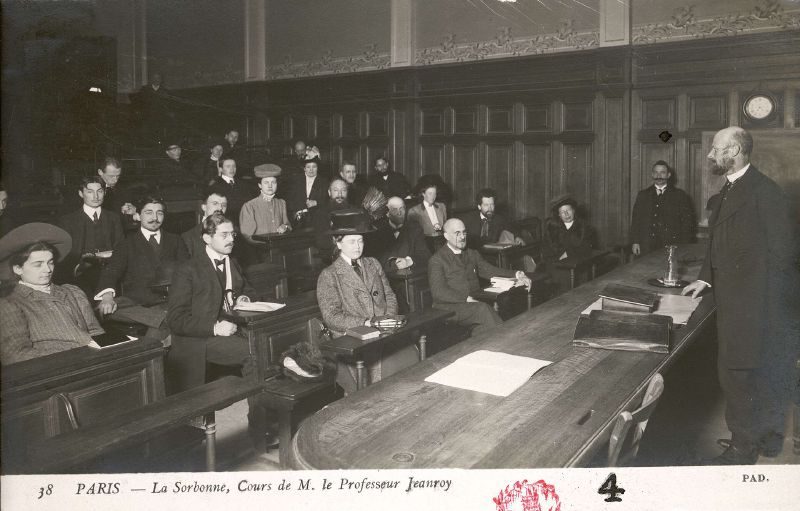
Robert de Sorbonne’s foundation gave the students somewhere to live, and over time his name came to stand for the university itself. Times Higher Education notes that “the Sorbonne” is the popular name for what was officially the University of Paris.
The name carried weight well beyond France. Times Higher Education credits Victor Hugo, who romanticised radical students in Les Misérables, and the student protests of 1968 with making the “Sorbonnards” icons of idealism and Parisian glamour. The Conversation lists Marie Curie, Simone de Beauvoir and Elie Wiesel among its later students.
The name that outlived its university
Officially, the Sorbonne stopped being a university in 1970. After the unrest of 1968, the University of Paris was split into 13 separate universities, a structure meant to cope with a fast-rising number of students.
The new institutions mostly went by numbers, such as Paris IV and Paris VII. Times Higher Education reported that this made them hard for academics abroad to tell apart, and that none had the pull of the old name. Some in French higher education blamed the loss of that name, in part, for France’s weak showing in world university rankings.
Almost 50 years after the break-up, two of the successors set out to merge and take the name back. Pierre and Marie Curie University, known as UPMC and France’s largest medical and science university, joined Paris-Sorbonne University, the humanities school known as Paris IV. The merged body was to be called Sorbonne University.
The two were not small. UPMC had about 35,000 students and Paris IV about 24,000. Jean Chambaz, the president of UPMC, told Times Higher Education that the merger was about joining science and medicine to the humanities, and not only about winning back a famous brand. He said the idea of a merger had first come up about 10 years earlier.
A chaplain’s legacy
Robert de Sorbonne built lodgings, not a university. Yet when two Paris universities went looking for a name the world would recognise, they reached for his.