An oscillating water column turns waves into power by using the sea as a piston. Waves enter a chamber that is open below the waterline, and the water surface inside rises and falls. That motion forces the trapped air through an opening, where it spins a turbine linked to a generator.
The water surface acts as a piston, and the turbine sits above the water.
A straw standing in the sea
Nicholas Ulm, a PhD student at the University of Hawai’i, describes the core of his team’s device as a straw floating upright in water. The opening at the bottom restricts each wave, so the water surface inside the straw reverberates.
He compares it to opening a car window on a motorway and hearing the reverberation in your ear. Size the chamber right, and the waves build a resonant pressure that drives air through the turbine.
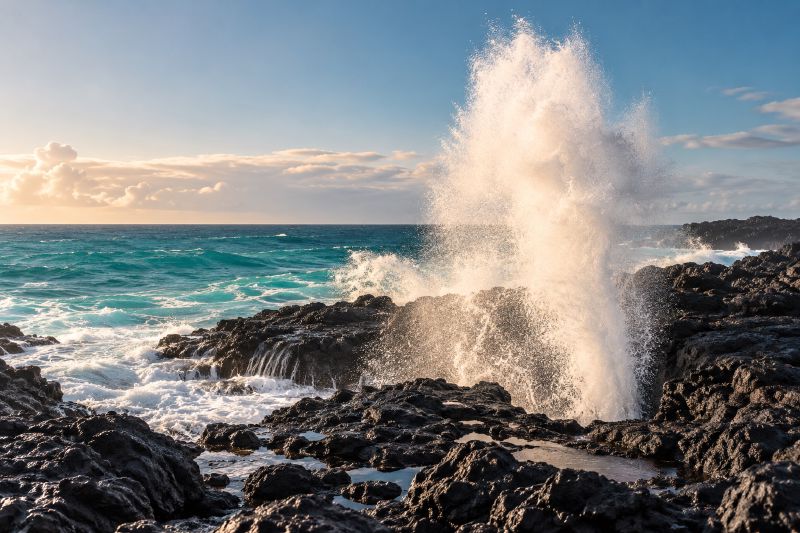
The device is called Project Hālona, after the Hālona blowhole on Oahu. That blowhole funnels incoming waves through a hollow chamber and throws them up as a geyser.
Why engineers keep coming back to it
Among wave energy converters, the oscillating water column is the type researchers have studied most, according to a 2025 paper in Scientific Reports. Its authors point to the turbines. Pneumatic turbines are a long-established industry, so that part of the machine is mature.
The design also fits into other structures, which cuts cost. Columns have been built into breakwaters and wave-powered navigation buoys.
Small power, out at sea
Many wave devices aim to pump as much electricity as possible into the grid. Hālona aims lower. It is meant to charge underwater drones and ocean sensors, so it puts stability for docking ahead of raw output.
The US Navy has a similar interest. Uses at sea need between 100 watts and 10 kilowatts, depending on the job, the Scientific Reports authors note.
The team tested Hālona as a 1:10 scale model in Oregon State University’s wave basin, then as a 1:4 model at Texas A&M. Scaling adds doubt of its own. The paper puts the uncertainty from scaling the chamber and turbine at up to 10%.