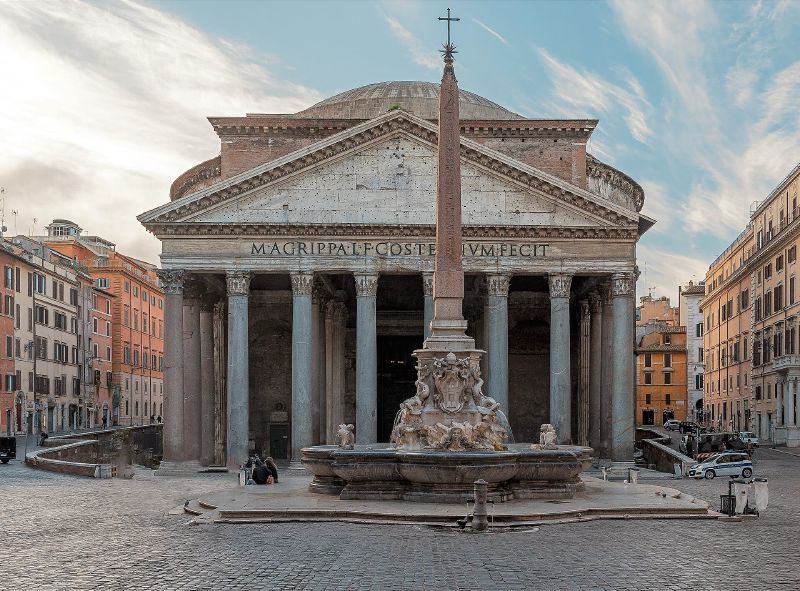
Rome’s Pantheon dome has stood for nearly 1,900 years, and no rebar or tension cable holds it up. It remains the largest dome ever cast in unreinforced concrete, and nobody built a wider one for the next thirteen centuries. Michelangelo, looking up at it, called the result “angelic and not human design.”
more
Concrete that keeps reacting long after it sets
The dome is opus caementicium, the Roman recipe set down by the architect Vitruvius: quicklime, volcanic ash and rubble, mixed with no steel at all. Modern concrete is built the opposite way round. Portland cement is paired with aggregate chosen to be as chemically inert as possible, so nothing reacts once the initial set is done. Marie Jackson, a geologist at the University of Utah, has studied Roman concrete for decades. A modern cement that changes chemically after it sets has usually gone wrong, she says. “Romans wanted their concrete to react.” They picked an aggregate built to stay part of the chemistry for centuries, not just for the initial pour.
Renato Perucchio, a mechanical engineer at the University of Rochester, sees an “engineering approach” in Roman building rather than luck. Left free to keep reacting, the volcanic aggregate can reinforce a small crack from the inside before it spreads. Modern Portland cement was never built for that regenerative capacity.
Why the dome gets lighter as it rises
The Pantheon standing today is the third building on the site. Marcus Agrippa’s original, dedicated in 27 BCE, burned in a fire around 80 AD, and Emperor Domitian’s rebuild burned again after a lightning strike in 110. What Hadrian put up afterwards was an entirely new design. Six-metre-thick walls ring the base, concealing a network of voids and arches that work as eight hidden piers, carrying the dome’s weight down to the ground. Inside, five rows of coffers step up toward the crown, each a stepped square recess. They cut material from the parts of the shell doing the least structural work, shedding weight without losing the strength to carry it.
The saving continues into the mix itself. Heavier stone was packed in low down, and the aggregate grows progressively lighter as the shell climbs, ending in pumice light enough to float on water. By the crown, the concrete weighs roughly a third less than it does at the base. Roma Agrawal is a structural engineer who has visited the building twice. She thinks the coffers may have done a second job besides saving weight, letting the wet concrete cool more evenly as it cured and guarding against the cracking that uneven cooling causes.
The hole that should be the weak point
At the crown sits the oculus, a nine-metre opening with nothing over it, open straight to the Roman sky. It looks like an obvious failure point. A dome usually fails when the ring near its top gets pushed outward by the weight piled below it, and the oculus removes the material that would otherwise sit at that exact spot. With no ring left there to fail, a thick band of compression takes its place instead.
Rain falls straight through in a visible column during a storm. The floor beneath is very slightly domed, and small drainage holes still carry the water away into the ancient sewers beneath.
What a study found in the cracks
For most of the twentieth century, historians credited the dome’s survival to volcanic ash alone. That answer skipped over small white flecks scattered through Roman concrete, called lime clasts, which earlier researchers had dismissed as evidence of careless mixing. Admir Masic, a materials scientist at MIT, argued otherwise in a paper his team published in Science Advances. His reading is that Roman builders used hot mixing, combining quicklime directly with volcanic ash before adding water, rather than slaking the lime first the way Vitruvius described. The reaction throws off intense heat and leaves the clasts behind. When a crack later opens and water gets in, it dissolves calcium from a clast and carries it into the gap, where it recrystallises as calcium carbonate and seals the break.
Masic’s team tested the idea by casting fresh concrete to the Roman formula, cracking it on purpose, and running water through the break. The Roman-recipe samples sealed shut within two weeks. A sample of ordinary modern concrete did not, and water kept running through the crack as though it were a drinking straw. By that measure, the average American highway bridge, engineered with steel and modern materials science, is considered structurally aged at 50 years. The Pantheon has passed that mark almost forty times over.
Left alone rather than restored
Survival was never only a material question. The building became a Christian church around 609, and that conversion spared it the fate of so many other Roman monuments, torn apart for their stone over the centuries that followed. Notre-Dame in Paris has been rebuilt and restored again and again. The Pantheon has done the smaller, stranger thing. Instead of being restored, it has been left mostly alone, still sealing its own cracks one storm at a time.