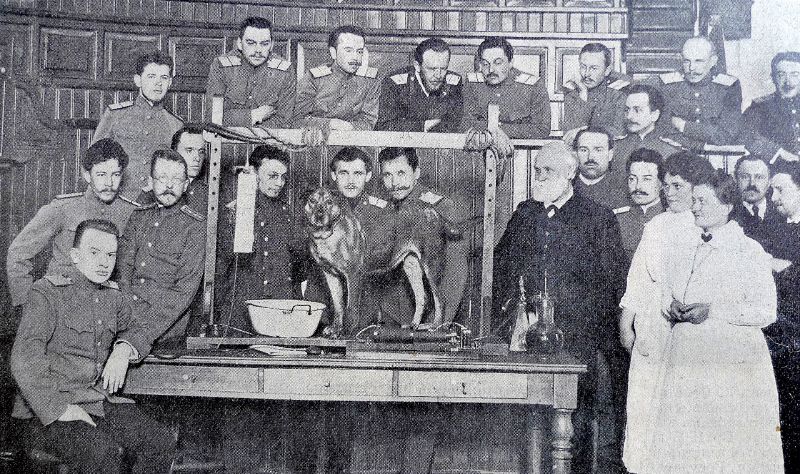
Pavlov’s dogs revealed classical conditioning by drooling at the wrong moment. They learned to link the dinner bell with the meal, and began to salivate when the bell rang, before any bowl was within reach.
more
That small, wet signal became the basis of what psychologists now call Pavlovian or classical conditioning: learning that one event predicts another.
A digestion scientist, not a psychologist
Ivan Pavlov, who lived from 1849 to 1936, began as a physiologist. His early work in his St Petersburg laboratories measured how dogs secreted gastric, pancreatic and saliva fluids as they ate. That work on digestion won him the Nobel Prize in 1904.
He studied salivation because it was the response system he knew best, an experimental psychologist writes in The Conversation. Pavlov did not think association was a crude process found only in animals. He expected it to explain a wide range of human behaviour.
What the experiments proved
The idea was old. British philosophers John Locke, David Hume and David Hartley had described laws of association long before, from their own observation. Pavlov’s contribution was to test those laws by experiment.
Textbooks sum up the result as two kinds of reflex. One is innate and fires at the stimulus itself. The other is acquired and fires at whatever the animal has learned to link with it. The work launched behaviourism, one of the most influential and disputed schools in psychology.
The dogs behind the diagrams
Those textbooks rarely show the animals. Matthew Adams, writing for the British Psychological Society, notes that Pavlov kept and experimented on thousands of dogs across six decades. His team operated on them to collect secretions from living animals, and many were vivisected and killed. The dogs were also named, cared for and described as having distinct personalities.
Where it shows up in people
The experimental psychologist writing in The Conversation argues the same learning drives much of human emotion. The music you dislike, the brand of peanut butter you favour and the people you side with come from experience rather than birth. Those preferences often form early and can be hard to shift.
It works in your favour too. A flash of lightning tells you thunder is coming, and a doorbell tells you a guest has arrived. Therapies for phobias and addictions build on the same process.
The phrase “Pavlovian response” has passed into everyday speech. Most people who use it have never asked what happened to the dogs.