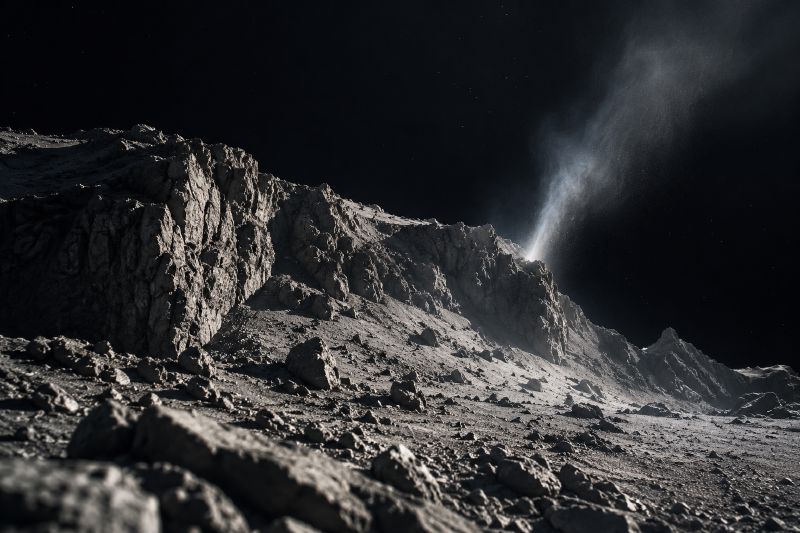
Philae landed on a comet by falling onto it slowly and, in the end, by luck. The lander touched comet 67P/Churyumov-Gerasimenko on 12 November 2014, bounced off, came down again, bounced a second time, and only settled on its third contact. Its anchoring harpoons never fired.
That third touchdown still made Philae the first spacecraft to soft-land on a comet, NASA’s Jet Propulsion Laboratory reported.
Why a comet is hard to land on
Gravity is the problem. On 67P it is about a hundred thousand times weaker than on Earth, so a lander has almost no weight to hold it down. Philae came in at roughly 3.2 kilometres per hour, slower than a brisk walk.
Distance made it harder. The European Space Agency’s timeline put the comet 511 million kilometres from Earth on landing day, with signals taking more than 28 minutes to cross one way. The timeline set the final go or no-go decision for the lander at 02:35 UTC on 12 November.
Space.com described the descent after separation from the Rosetta orbiter as a trip of about seven hours.
Three touchdowns in two hours
The first contact registered at 08:03 Pacific time. Without its harpoons, Philae rebounded and rose about a kilometre above the surface, drifting about the same distance across it.
It touched down again at 09:53, almost two hours after first contact, and bounced once more, less violently. At 10:00 Pacific it came to rest.
Mission controllers believed it had ended up in a hole or crevice about two metres across and two metres deep, lying on its side. It was not anchored, but it was stable. Paolo Ferri, ESA’s head of mission operations at Darmstadt, called it “a very happy lander”.
What the bounce cost
Parts of the lander sat in shadow. It drew some power from its solar panels, but teams were still checking its power and thermal state the next day.
Eight of its 10 instruments had already begun returning data. Space.com reported that Philae detected hints of organic molecules in the comet’s atmosphere during its short working life. The lander then fell silent as its batteries ran out, with scientists hoping it might wake as the comet’s orbit brought more sunlight.
The landing closed a long trip. Rosetta launched in March 2004 and woke in January 2014 after a record 957 days in hibernation. Space.com put the voyage at 10 years and four billion miles.