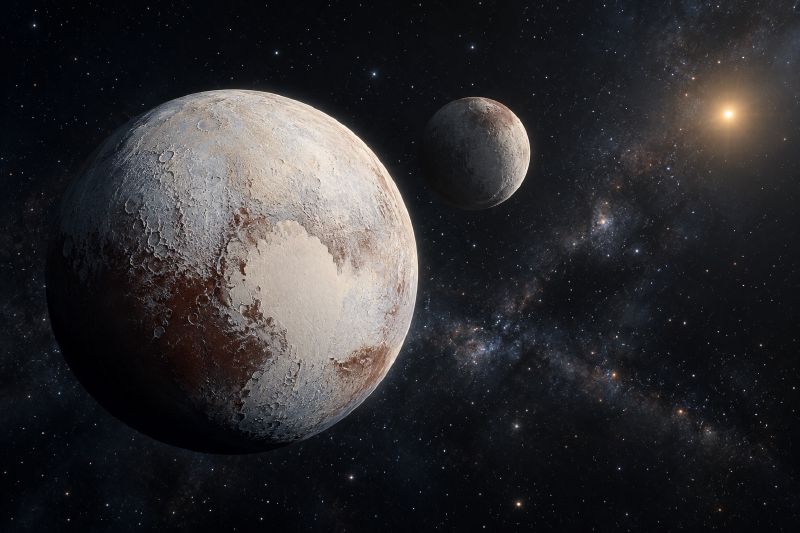
Pluto lost its planet status because astronomers finally wrote down what a planet is, and Pluto failed one line of the definition. On August 24, 2006, the last day of the International Astronomical Union’s General Assembly in Prague, members voted for a planet to meet three tests. It orbits the Sun. Its own gravity pulls it into a round shape. And it has cleared its neighbourhood of other bodies of similar size.
Pluto passed the first two. It shares its patch of space with other icy objects in the Kuiper Belt, so it failed the third.
Seventy-six years as the ninth planet
Clyde Tombaugh found Pluto in 1930 at the Lowell Observatory in Arizona, and textbooks soon added a ninth planet. An 11-year-old in Oxford, Venetia Burney, suggested the name, after the Roman god of the underworld.
Doubts grew over the following decades. Astronomers began to ask whether Pluto was only the first of many small icy bodies beyond Neptune, the BBC reports. The first other resident of that region, now called the Kuiper Belt, turned up in 1992, spotted by David Jewitt and colleagues on a telescope at Mauna Kea.
The discoveries that forced a vote
Each new find made Pluto look less special. In 2000 the Hayden Planetarium in New York opened an exhibit showing only eight planets. Then came objects close to Pluto in mass: Quaoar, announced in 2002, Sedna in 2003, and Eris in 2005. Eris seemed larger than Pluto, and people started calling it the tenth planet.
“We learned that there are lots of objects like Pluto,” Emily Safron, an astronomy instructor at Case Western Reserve University, told Space.com. Some, she said, are more like Pluto than Pluto is like the other planets.
The IAU set up a committee to define a planet and put a draft to members in Prague. An early plan would have raised the count from nine to 12. It would have made Pluto and its moon Charon a twin planet and admitted Ceres and Eris. That plan met opposition, and the narrower definition replaced it.
What changed on the day
Pluto moved straight into the new category of dwarf planet, alongside Ceres and Kuiper Belt objects such as Eris. The 2006 resolution defines a dwarf planet as a body orbiting the Sun that is round under its own gravity but has not cleared its orbit, NASA notes.
Iwan Williams, who led planetary systems science at the IAU, argued at the time that the alternative was a solar system heading for 100 planets by the end of the decade. The public reaction ran hot. The New York Times told readers to throw away the placemats and take scissors to the solar system mobile.
The argument has not closed. Astronomy magazine notes that the third test is still debated among astronomers and planetary scientists. Mike Brown of Caltech, whose team found Eris, later called himself the “man who killed Pluto”.