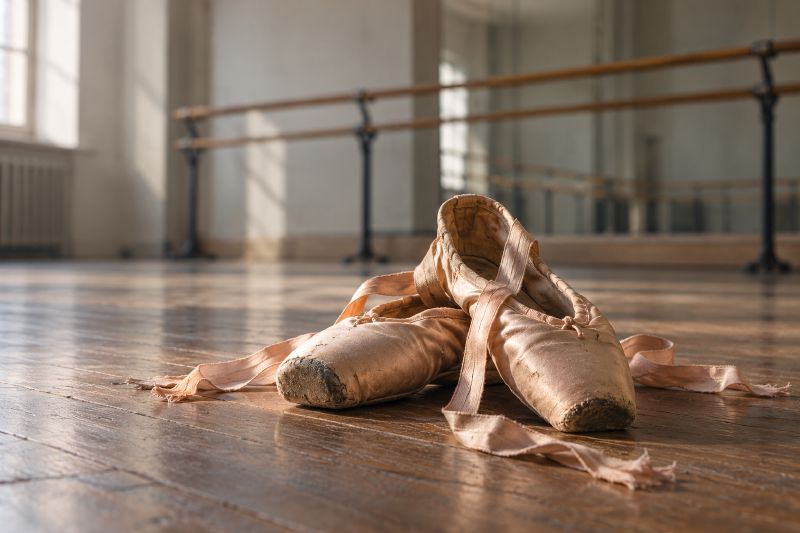
A pointe shoe is made by hand, and it does not last long. At New York City Ballet, a woman dancing in both rehearsal and performance can use up one pair each day, according to the company’s ballet shoe supervisor, Angel Betancourt. The company told Playbill in 2007 that it went through thousands of pairs a year, on a shoe budget of $500,000.
What is inside the shoe
The part a dancer stands on is the box. It is built up from layers of fabric stuck together with glue. Under the foot sit three more parts: an outer sole that meets the floor, an inner sole that braces the instep, and a shank between them that acts as a spine.
The shoe is still turned by hand. A maker shapes and stitches it inside out over a foot-shaped form called a last, then turns it the right way round to finish it. Betancourt said that hand work is the reason for the price.
At New York City Ballet the shoes came mainly from Freed’s and Capezio, in pink, white or black satin. Each pair was custom made. A dancer could ask for a reinforced wing block at the front, or for a higher or lower vamp and sides.
Why a dancer sticks with one maker
Every maker’s shoe is different, so settling on one is a personal choice. A dancer who finds the right shoe tends to depend on its maker for the rest of her career, the BBC reported.
A Radio 4 documentary in the BBC’s Seriously… series followed one such pairing. Its subjects were Francesca Hayward, a principal dancer with the Royal Ballet, and Bob Martin, the shoemaker who made her shoes and has since retired.
A craft with few hands left
The BBC described pointe shoe making as a dying craft, with not many makers like Martin left. The craft has been given heritage craft status in the UK, the broadcaster said.
In 1832 Maria Taglioni danced La Sylphide in satin slippers with darned tips, which let her balance briefly on her toes. George Balanchine later said that without pointe he would not have been a choreographer. The modern shoe is a far cry from Taglioni’s, but in 2007 it was still finished by hand.