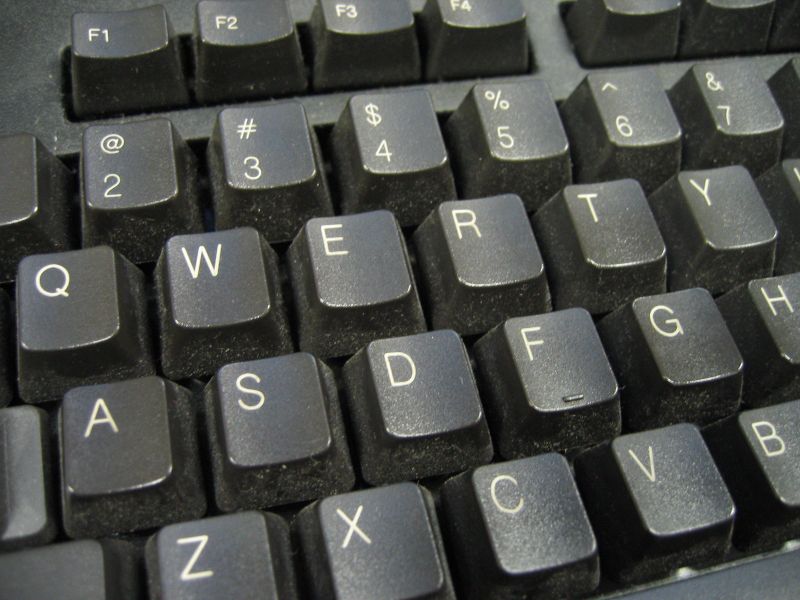
The QWERTY keyboard is usually explained as a jam-prevention fix, but researchers who traced its history point to telegraph operators rather than a broken typewriter.
more
Christopher Latham Sholes, a printer and inventor working in Milwaukee, patented an early typewriter in 1868 with its keys arranged alphabetically, in a layout closer to a piano than a modern keyboard. In that machine, and in the Sholes & Glidden “Type Writer” that Remington later manufactured, the type bars carrying each letter hung beneath the paper and swung up to strike it. Hit two keys whose bars sat close together in quick succession, and the bars could collide and jam.
The standard account says Sholes rearranged the keys to keep common letter pairs such as “th” and “he” apart, spacing out the type bars most likely to clash. The American Society of Mechanical Engineers, which designated the Sholes & Glidden a historic engineering landmark, describes the QWERTY layout as one that “minimized sticking keys.”
The theory has a hole in it. “E” and “R” sit next to each other on a QWERTY keyboard, despite “er” being the fourth most common letter pairing in English and exactly the kind of adjacent pair the redesign was supposed to avoid. One of Sholes’s own prototypes swapped the “R” key for a period, a change that never made it to production. The BBC’s account raises a similar objection to the idea that QWERTY was built to slow typists down. “T” and “H”, the most common pairing in English, sit next to each other under the index fingers.
A different explanation, from Kyoto
In a 2011 paper, the researchers Koichi Yasuoka and Motoko Yasuoka, of Kyoto University, tracked the keyboard’s evolution against records of who was using early typewriters. They concluded that the mechanics of the machine had little to do with the final arrangement. The layout instead grew out of the needs of telegraph operators.
In American Morse code, “Z” and “SE” are indistinguishable, so the layout puts “Z” next to “S” and “E” for an operator waiting on context. The BBC’s reporting adds a direct link: Sholes sold his first typewriter, in 1868, to Porter’s Telegraph College in Chicago. On this account, QWERTY was shaped by what a telegraph receiver needed to type quickly and accurately, not by which typebars sat where inside the machine.
How it became permanent
Whichever explanation is correct, the layout’s survival owed more to business than to engineering. Remington began selling its QWERTY typewriter for $125 in 1874, and by 1891 the company said more than 100,000 were in use. Remington also sold typing courses on its own layout, tying trained typists, and the employers who wanted them, to its machines. When several of the largest manufacturers merged into the Union Typewriter Company in 1893, they adopted QWERTY as the standard, and it has not been dislodged since.