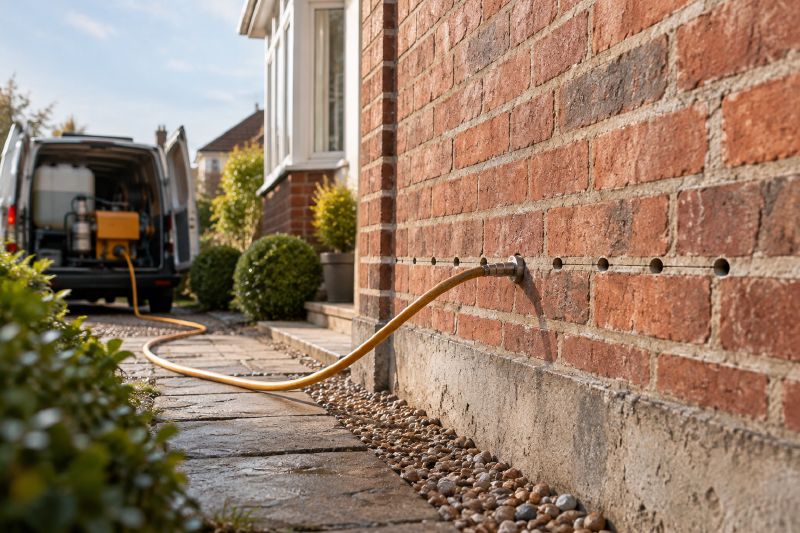
A damp-proof course is a barrier in a wall’s foundations that repels moisture from the ground below. Damp problems arise when the ground outside sits higher than the course, which lets water step around it.
more
What the barrier stops
Water climbs a wall by capillary action. The Royal Institution of Chartered Surveyors (RICS) compares it to a sponge sitting in a puddle, slowly drawing water up through tiny holes in the material.
The Energy Saving Trust says a tidemark along the bottom of a wall points to this kind of damp. The Guardian adds that much of it happens below floor level and creeps up the wall as it worsens. Look for patches above the skirting boards.
Under a concrete floor, the Guardian says, it can be a layer of plastic sheeting.
How the barrier gets bridged
RICS lists these among the causes of damp:
- Raised ground levels next to walls.
- Rubble under suspended ground floors.
- Rubble or other blockages inside a cavity wall.
Rubble under a suspended floor does double duty. It bridges the course and blocks the low-level vents that let the floor timbers dry. The Guardian says raised outside ground can also cover the air bricks that ventilate the space under those floors. Its advice is to keep the areas around the course and the air bricks clear.
Garden walls have the same weakness. George Edwards of Timberwise told House Beautiful that damp can rise through them by capillary action, often because of poor drainage or cracks. He recommends fitting a damp-proof membrane beneath a garden wall before building it.
Check before you pay for a new one
A damp patch near the floor does not prove the course has failed. RICS says “rising damp” is a term often misused, and it names the source of nothing. RICS calls a new damp-proof course a typical misdiagnosis, and failure of an original course extremely rare.
Other causes produce similar patches. Penetrating damp comes through walls from faulty guttering or roofing, or from cracks in external walls. Which? calls condensation the most common type of damp.
RICS suggests going outside in the rain to see whether the gutters overflow. For anything harder, it advises a specialist building surveyor and a survey that complies with the Joint Position Statement (JPS 2022).
If a survey does point to the course, the Guardian notes that a chemical course injected into the walls is regulated work. The installer must be reputable and supply a guarantee, which you will need when you sell or claim on insurance.