The restavek system asks a child to work for a household in return for being housed and fed. Poor families, often rural, send a child to live with relatives or acquaintances in a city, and the child works for its upkeep. Most become domestic servants. The work is unpaid, and many of these children are kept out of school.
The word comes from the French “rester avec”, meaning “stay with”.
What the day looks like
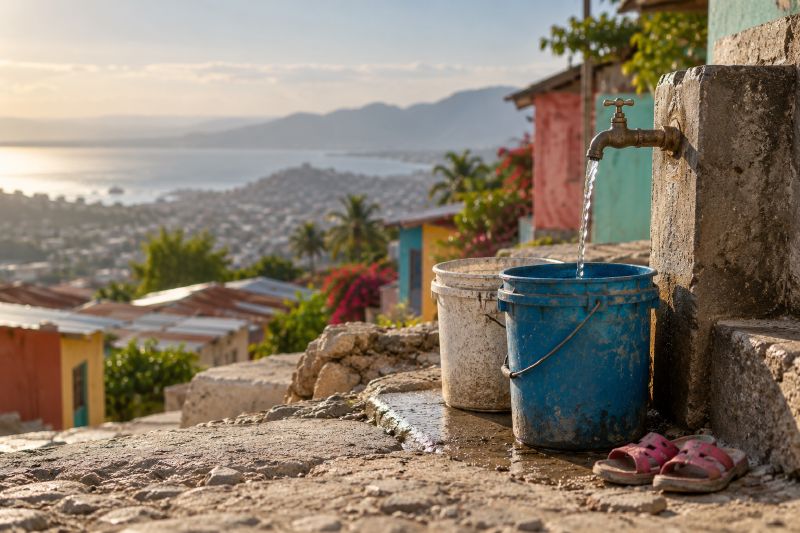
The BBC followed Jeanette, who was six when it met her in Petionville, a district of Port-au-Prince. Every day she walked 4km to a public standpipe and carried water back on her head. She also minded the family’s other children and did the cleaning and laundry. She did not go to school.
Fetching water is often one of the main tasks. Fewer than a quarter of homes in Port-au-Prince had running water on the property, the BBC reported. Everyone else fetched it from public taps, sometimes kilometres away.
The Independent met Esperence, a boy of 10 whose parents had given him up when he was eight. The paper described children like him as isolated from other children, with their days spent on floors, dishes and laundry.
Why families send them
Poverty drives it. When the BBC reported, more than half of Haiti’s 9 million people lived on under 50 US cents a day. Some officials still described the practice as a traditional way for rural families to give a child a start.
Margarett Lubin of the International Organization for Migration rejected that. She told the BBC it was “child slavery pure and simple”. Jean-Robert Cadet, once a restavek himself and now head of a foundation for them, called it “domestic slavery” in an interview with Reuters.
How many children
Counts differ by source and by year. In 2007 Unicef estimated 173,000 restavek children, more than 8% of Haitians aged 5 to 17. The BBC gave an estimate of 250,000. In 2019 the Independent cited the Restavek Freedom foundation’s figure of 300,000.
What happens at 15
Haitian law requires a worker aged 15 or over to be paid, according to the BBC. That is the point at which many households either put the child out on the street or keep them working without pay.
Many of these children have no birth certificate, which leaves them with no official identity. Prospery Raymond, of the Maurice Sixto centres in Port-au-Prince, told the BBC that the centres try to establish who each child is and get them into school.