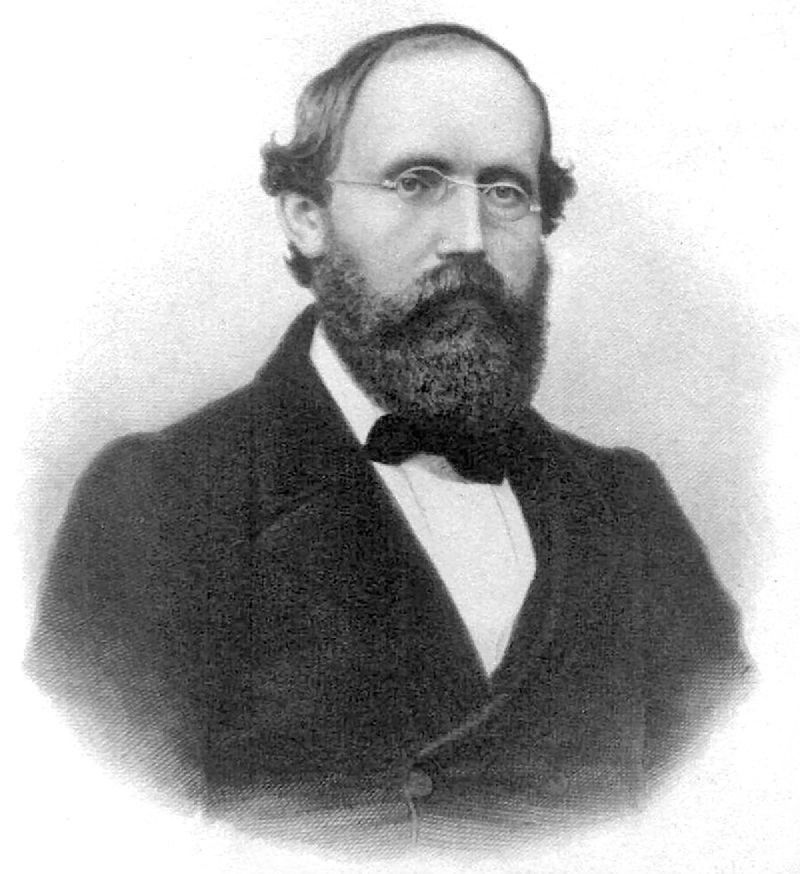
On June 10, 1854, a shy young mathematician named Bernhard Riemann stood in front of the Faculty of Philosophy at the University of Göttingen. Despite a fear of public speaking, he described a geometry that did not yet have a name for its own ideas. Sixty-one years later, Albert Einstein built general relativity on it.
more
A lecture set as a formality
Bernhard Riemann gave the talk, called a Habilitationsvortrag, to secure a teaching position at Göttingen. His assigned topic was the foundations of geometry. The lecture generalised the work of his supervisor, Carl Friedrich Gauss, who had studied the properties of curves and surfaces on their own terms. It grew into a theory that could describe any number of dimensions, even infinite ones.
Gauss was impressed immediately. Most other mathematicians were not. Riemann’s ideas struck them as too vague and abstract to be useful, and for decades the work was largely set aside. The lecture itself was not published until 1868, two years after Riemann died in 1866.
Why the maths went missing
Riemann’s talk contained no equations, an odd choice for a mathematics lecture. The long-standing explanation, drawn from an account by his friend Richard Dedekind, held that Riemann deliberately left out the technical detail. The aim, it said, was to let the Faculty’s non-mathematician professors follow him. A recent analysis on arXiv challenges that story. Three years earlier, presenting his doctoral dissertation to the same mixed audience, Riemann had not held back the mathematics at all. The analysis argues for a more credible explanation. The concepts at the centre of the 1854 lecture, including what mathematicians now call a manifold, were so new that no technical language yet existed to state them in equations.
From a shape an ant cannot see to spacetime
A manifold, in the vocabulary Riemann introduced, is a space that looks flat close up even if it curves globally, the way the Earth looks flat to someone standing in a field despite being round. The term itself comes from Riemann’s German word Mannigfaltigkeit, meaning variety or multiplicity.
Riemann, a pastor’s son, had planned to study theology before turning to mathematics and beginning a doctorate under Gauss in 1849. It took until the end of the 19th century for mathematicians such as Henri Poincaré to recognise the importance of his 1854 lecture. Then, in 1915, Einstein used Riemann’s geometry of curved space to describe gravity itself in general relativity, moving it from an abstract exercise into a description of the real world.