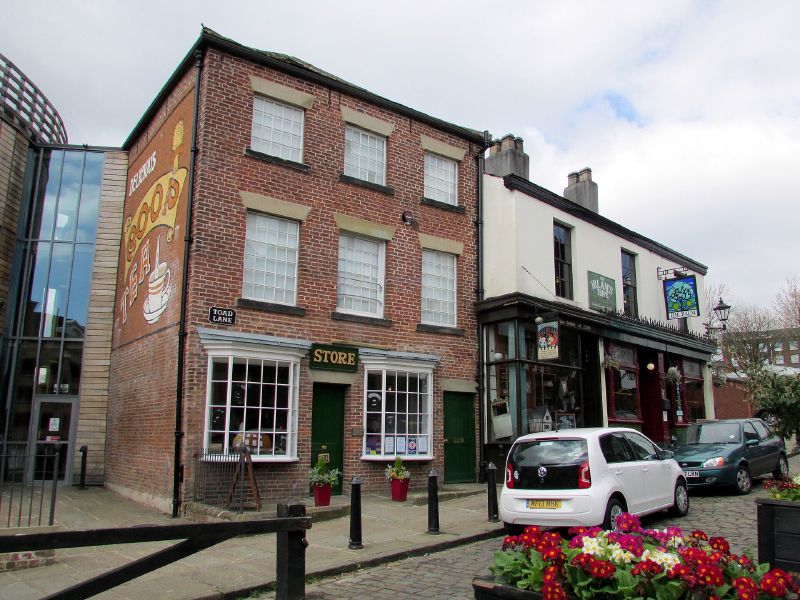
What set the Rochdale Pioneers apart was not their shop but the rulebook behind it. In 1844 the Rochdale Society of Equitable Pioneers wrote down seven principles, and two of them kept takings inside the society rather than dividing profits among shareholders, the usual practice. Those rules, not the counter on Toad Lane, are what co-operatives around the world went on to adopt.
more
Not the first co-op
The Pioneers were 28 mill workers. They were not the first people to run a co-operative. In 1761, 15 weavers in Fenwick, East Ayrshire, signed a document binding themselves to fair work and fair prices. By 1769 the Fenwick society was buying oatmeal wholesale, selling it on cheaply and dividing the savings among members. The Guardian reported in 2007 that the Co-op’s own historians, and Rochdale council, accept Fenwick as the first proven co-operative.
The difference, as the Fenwick researcher John McFadzean put it, was that Rochdale took the idea to the next level. The Pioneers worked amid the poverty of an industrial town and were better placed to shape the movement that followed.
Seven rules, written first
The BBC groups the seven by what each one governs.
- Who belongs: open membership, and neutrality on politics and religion
- Who decides: democratic control
- Where the money goes: a dividend on purchases, and a cap on interest paid to capital
- How goods are sold: for cash only
- What members owe each other: education
Open membership and democratic control meant anyone was free to join and every member had a vote. That was radical at a time when roughly one man in seven in the UK had the vote, and women would wait another 74 years.
The two money rules kept most takings inside the society or in reserve, where the usual practice was to share profits among shareholders. Cash trading banned selling “on tic”, so members could not run up debts against the society’s thin funds.
A thin first stock
The shop opened in an old Toad Lane warehouse on 21 December 1844. Its shelves held some butter and sugar, six sacks of flour, one of oatmeal and two dozen candles, bought for £16 11s 11d. Tea and tobacco followed within a few months. At first it opened two nights a week, and within three months it was open five days a week.
By 1854 more than 1,000 British co-operative stores ran on the Rochdale principles. About a decade later the North of England Co-operative Society formed, the body that became the modern Co-op. The International Co-operative Alliance updated the principles in 1966.