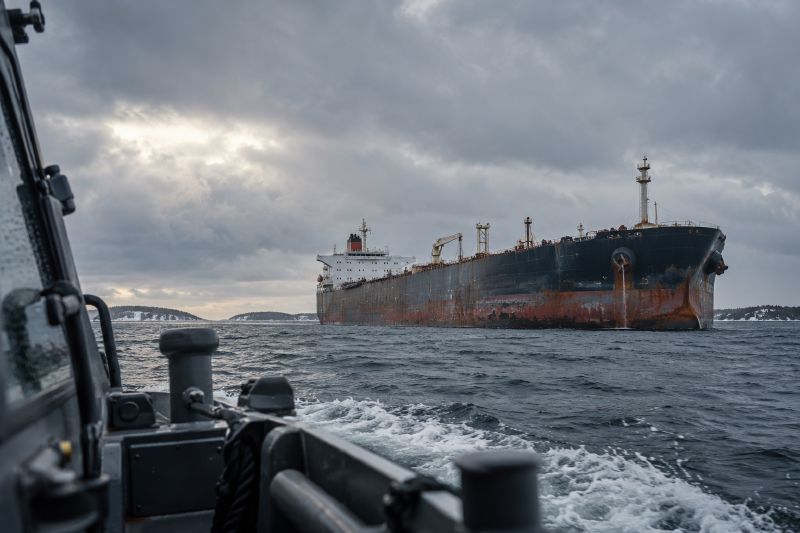
Russia’s shadow fleet keeps its oil moving by changing names and flags, and by using waters where coastal states have little power to stop it. The ships move under various identities and switch flags to get round Western sanctions.
The scale is large. The UK Ministry of Defence says the fleet runs to more than 700 vessels and carries 75% of Russia’s sanctioned oil.
A new name and a new flag
Sanctions attach to a named ship. The UK has sanctioned more than 500 vessels, barring them from British ports and banning British firms from insuring, financing or broking their cargoes.
The fleet’s answer is to become a different ship on paper. The tanker the Royal Marines boarded in June 2026 had been sanctioned in July 2025 as Myrtos. By then it was called Smyrtos, sailed under a Cameroon flag, and had changed flag twice since being listed.
The Guardian saw the same pattern from a Swedish coastguard patrol boat in 2025. One tanker it followed was flagged in Malta and, according to online maritime records, had flown the Marshall Islands flag under another name within the previous two years. The paper described the fleet as ageing, unregulated tankers in varying repair, carrying Russian oil to buyers including China and India.
Why coastguards struggle to act
Geography helps the fleet. A country’s national law runs only in its territorial sea, which reaches at most 12 nautical miles offshore. Beyond that, in the wider economic zone, the law of the flag state governs the ship.
Jonatan Tholin, an investigation manager for the Swedish coastguard, told the Guardian that under International Maritime Organization rules the fleet may move freely through the whole Baltic. Since July 2025 Swedish officers can radio a passing tanker to ask about its cargo and insurance, but the ship need not answer.
The tanker the Guardian watched said it was carrying just under 30,000 tonnes of diesel from Primorsk in Russia to Aliağa in Turkey. Its final destination was impossible to know.
The coastguard’s larger fear is a spill. Tholin named uninsured vessels as the fleet’s most dangerous risk. The captain of the patrol boat, Joakim Håkansson, said an accident in the Baltic would be an oil catastrophe.
When a state boards anyway
Britain has started to test the limits. Keir Starmer said in March 2026 that British forces could now board sanctioned vessels passing through UK waters.
On 14 June 2026 Royal Marines and National Crime Agency officers boarded Smyrtos in the English Channel. UK armed forces had never carried out such an operation before, and it took six hours. The ship had left Russia’s Ust-Luga terminal near St Petersburg on 5 June, BBC Verify found.
The NCA arrested a 38-year-old Indian national on suspicion of sanctions offences. The MoD said the boarding took place in international waters, more than 12 nautical miles out, and complied with domestic and international law. Moscow has called earlier interceptions illegal and close to piracy.
That leaves the question the Baltic patrols cannot yet answer. Sweden can count hundreds of these ships. Britain has now boarded one. Stopping the trade is a different matter.