Voyager’s project manager, John Casani, asked astronomer Carl Sagan to lead a committee. Its brief was unusual: decide what humanity should say to whoever might one day find one of the two Voyager spacecraft. Sagan’s group had less than six weeks to choose sounds, images and music that could stand in for an entire planet.
more
Why a record, not another plaque
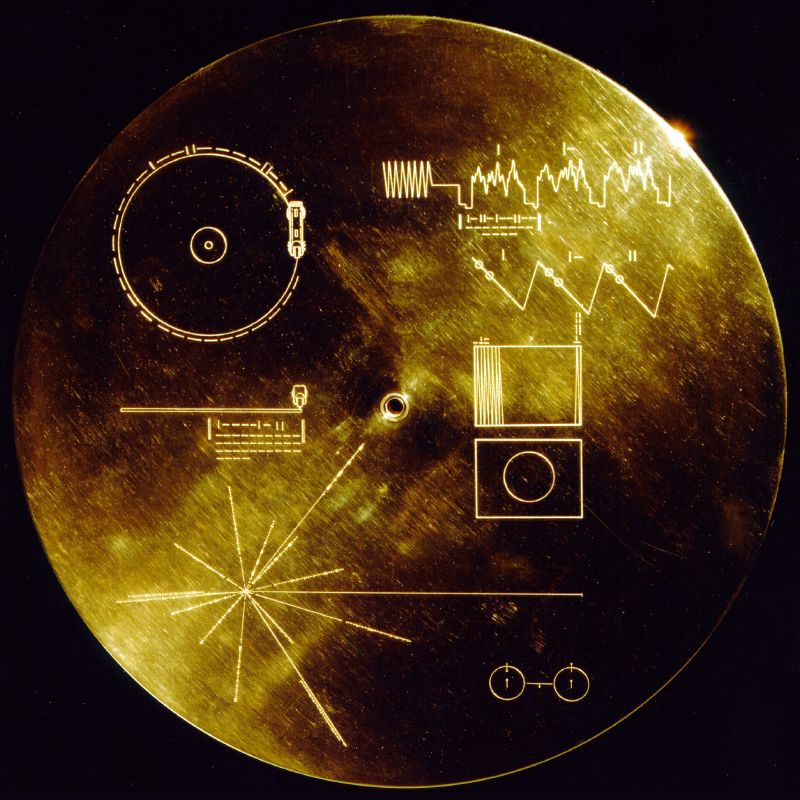
Earlier NASA probes had carried metal plaques, added in case an alien intelligence ever intercepted them. Sagan’s committee went further. The physicist Frank Drake proposed a phonograph record instead of a plaque. Sound cut into a record’s grooves, on the right material, could survive for millions of years. NASA had each record made from gold-plated copper and sealed inside an aluminium cover built to withstand the vacuum of space. Instructions for playing it were etched on the outside, in a mathematical code meant to be legible to an advanced species.
What went into the sound side
One side of the record carries what the committee judged the sounds of a living planet. Wind, rain, ocean surf, a chimpanzee, crickets, frogs, birdsong, whale song, footsteps, a heartbeat, laughter and a kiss on the cheek all made the cut. The record also carries short greetings recorded in 55 languages. Among them is a child’s voice. Carl Sagan’s own son, Nick, was six years old in 1977. He recorded the words “Hello from the children of planet Earth.” Nick Sagan later said he had “no sense of the magnitude of it at the time.” He came to see it as a “strange but wonderful honor” only as he grew older.
Ann Druyan, the record’s creative director, compiled that side of the disc. She went further than gathering recordings, and had her own brain waves recorded on an electroencephalogram. That recording sits on the record too. Sagan was keen on the idea of sending music to an alien listener, and later chronicled the project in his book “Murmurs of Earth”. Druyan put the idea plainly: the record proved that “science and technology could come together with art.”
What the photographs teach, not just show
The record also holds encoded images, arranged so that decoding them correctly produces a circle as the first picture. That is a built-in check that whoever is looking has calibrated the equipment right. Jon Lomberg, the project’s design director, wanted the sequence of photographs to read as a single account of Earth, not “a grab bag of unrelated things.” He built what he called substories into the run of pictures. One covered how people eat, another how they are born, another how they travel. Some images carry silhouette outlines. A viewer without human eyes could then tell which part of a photograph mattered, and judge that a smaller shape stood further away.
The cover diagrams work the same way the images do, as a lesson rather than just an instruction sheet. One diagram maps the position of 14 pulsars relative to the Sun. Their rapid, distinctive pulses of radiation could let a distant reader triangulate where the record came from. Another diagram shows the two lowest energy states of a hydrogen atom, the unit of time and measurement the rest of the disc is built on. Seth Shostak, director of the Center for SETI Research at the SETI Institute, explained why a photograph of Earth needs that kind of scale attached to it. A picture alone leaves an obvious question, he said: does the planet “fit in a bread box, or is it 100,000 miles across?”
What the committee thought they were making
Ed Stone, Voyager’s project scientist, said the record will almost certainly never be found, so its real value is as a message to us. “In a sense it’s a unifying message,” he said. “It’s a message from Earth,” and a record “of who we think we are.” Ann Druyan put the wager behind the whole project more starkly. “It’s the classic message in a bottle,” she said. The odds of it ever being found are slim, but the reward would be immense if it happened.
More than four decades later, both Voyager spacecraft are still sending data home, carrying their records outward into interstellar space.