Las Vegas has hosted three different self-driving vehicle trials since 2017, and the first one crashed within two hours of its debut.
An autonomous shuttle bus, built by the French company Navya, began carrying free passengers around a 0.6-mile loop in the city’s Innovation District in 2017. Local celebrities turned out to see it off, among them the racing driver Danica Patrick and the magicians Penn and Teller. The oval-shaped shuttle seated up to eight people, had no steering wheel or brake pedals, and used GPS and kerb sensors to find its way at no more than 15mph.
Less than two hours later, the shuttle was in a crash with a delivery lorry. Passenger Jenny Wong told local news that the vehicle “just stayed still” as the lorry approached, and that “it’s going to hit us” was all she and other riders could say before it did. The shuttle’s sensors had detected the lorry and stopped, the city said in a statement, but the lorry driver failed to stop and clipped its front fender. Police cited the lorry driver, not the shuttle, for the crash. Nobody was hurt, and the shuttle finished two more loops that day.
That first pilot, backed by the motoring group AAA, was meant to run a year and carry 250,000 passengers. The AAA argued the risk was worth taking, since human error caused more than 90% of the roughly 30,000 US road deaths recorded in 2016.
A different company, a different approach
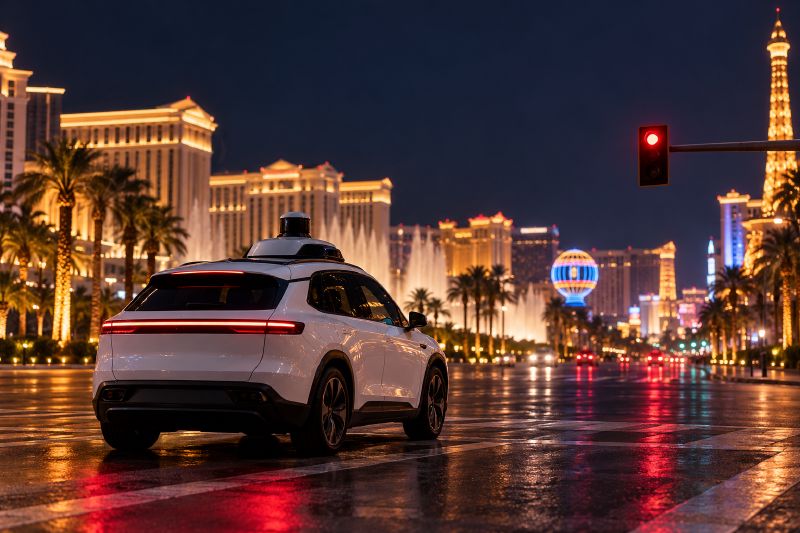
Las Vegas later hosted a second trial. Uber and the American start-up Motional launched a public robotaxi service in the city. It ran on a fleet of Hyundai Ioniq 5 electric SUVs modified for Level Four autonomous driving.
The one running now
Amazon’s Zoox began carrying free passengers on the Strip on 10 September 2025. Its vehicles have no steering wheel, pedals or shifter, and seat passengers facing each other in a carriage-style layout rather than the usual rows. Riders book through an app, match their car to its licence plate, and are picked up and dropped off only at fixed points such as AREA15, Topgolf and Resorts World Las Vegas. Videos posted on Instagram have shown the cars hesitating at intersections with unclear lane markings, though the vehicles found their way again without incident. Zoox also had a waiting list for a second launch, in San Francisco.
Three companies, three approaches, and one city that keeps saying yes to the next trial. On the evidence so far, whatever comes after Zoox will not be the first self-driving pilot Las Vegas has hosted, and it may not be the last one to hit a snag either.