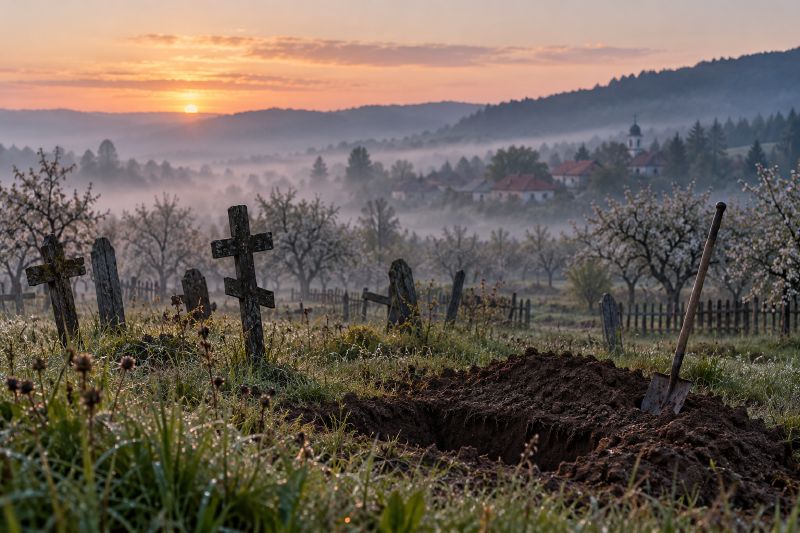
The vampire entered print through a health inspector’s report from a Serbian village. In July 1725, villagers in Kisiljevo, on the edge of the Habsburg Empire, called in an official named Frombald because they believed a dead man was killing them. His account made sensational newspaper copy and gave Europe the first printed use of the local word “vampyri”.
The dead man in Kisiljevo
The suspect was Petar Blagojević, who had been buried ten weeks earlier. His widow said he had knocked on her door after the funeral, asked for his shoes and then tried to strangle her. Over the next nine nights, nine more villagers said he had lain on them and throttled them, and each died after a brief illness.
The village elders had already decided what he was. Frombald examined the exhumed body and wrote that it looked and smelled “completely fresh”, with fresh blood around the mouth. When the villagers drove a stake through the torso, he saw blood pour from the ears and mouth. He told his superiors that every sign was present, and he blamed any error on villagers he described as beside themselves with fear.
Why bodies seemed to come back
The fear grew out of crowded graveyards, Smithsonian Magazine reports. Since the 11th century, European towns had built homes around churches and their burial grounds. By the late 17th century, full plots meant sextons dug graves two feet deep rather than six, and most of the dead wore only a shroud.
Rain, dogs or a careless gravedigger could expose a body. Some looked withered, while others looked ruddy and well fed. Folk tradition called the undecayed dead revenants, and the Slavic names were “vampyr” and “upyr”. People blamed them on a suspicious death or a burial done wrongly.
The traditional remedy was to dig the body up, stake it, behead it and burn it, then scatter the ashes in running water. By the early 18th century, parish priests were barred from those rites, so villagers turned to government officials instead.
A fear that lasted two centuries
Kisiljevo was not an isolated case. The historian Richard Sugg, writing in History Today, traces vampire scares from at least 1591 to 1923. He counts outbreaks in these countries:
- Greece
- Romania
- Ukraine
- Bulgaria
- Croatia
- Poland
- Germany
Many of those outbreaks looked like poltergeist cases, with loud noises, strange lights, smashed crockery and beatings that lasted for months. Around 1890, villagers in Messaria on the Greek island of Kythnos blamed a dead man named Andilaveris, whom they called a vrykolakas, a close cousin of the vampire.
Sugg argues that the fear itself was real even though vampires were not. He notes that burning, staking or beheading the suspect often calmed a village, and the trouble then stopped.