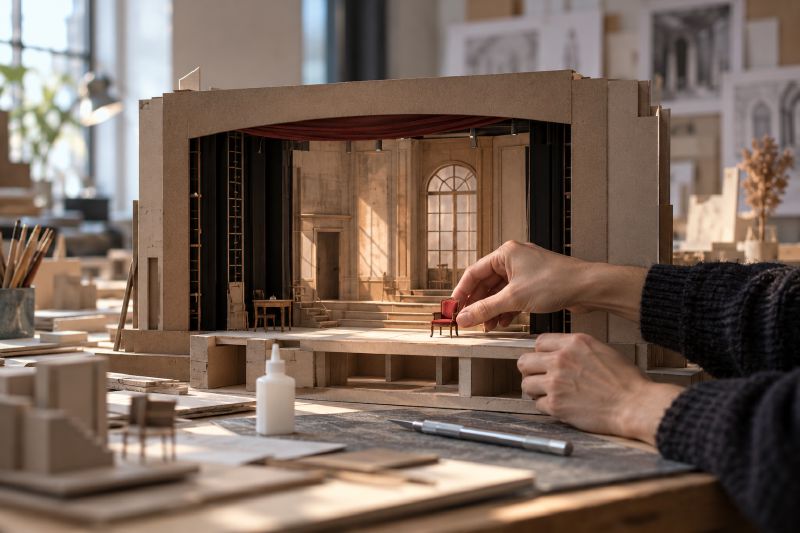
A model box shows the whole set, shrunk to scale, before construction begins. The National Theatre describes it as a scaled, three-dimensional version of a theatre set. It is how a designer translates a design for a show into a physical space that others can read.
Who looks inside the box
The model is a shared reference. According to the National Theatre, it lets the director, the producer, the workshop teams and the actors grasp the space and what the show will need on stage.
At the Royal Opera House, the set designer makes a miniature version for every ballet and opera. The people who build and paint the set and scenery use it to see what the stage will look like, and so do the performers.
What scale means in practice
With BBC Bitesize, the Royal Opera House made a template for a cardboard version of its stage at 1:100. At that ratio, an object one metre tall in real life measures one centimetre in the model. The kit includes a pair of paper dancers, 2cm high, so a maker can check that props sit in proportion to a person.
The model also carries the frame of the stage itself. The Bitesize template has the maker cut out the stage front, known as the proscenium arch. Its open sides let a maker slide scenery in and out.
The box goes digital
The Royal Shakespeare Company has built a Virtual Model Box on the Unreal Engine. The RSC says it can render reflections, haze and lighting in far higher detail than the company managed in-house before. Designers can place virtual props, performers, lights and cameras, and build “white card” style layouts.
It also shows the view from each seat. The tool holds an accurate map of the audience seating, so a designer can test sightlines and check that access screens are visible.
The work took several seasons:
- In 2020/21 the RSC made a LiDAR scan of its Stratford-upon-Avon campus.
- In 2021/22 the team moved that scan into Unreal Engine and rebuilt doors and seats.
- In 2022/23 it added interactive features and a seat-view preview, launched in the Swan.
- In 2023/24 the drawing office began beta testing it, including for a 2023 Tempest.
The RSC lists virtual lighting as a next step, so lighting set-ups can be tested on the digital stage before a show reaches the real one.