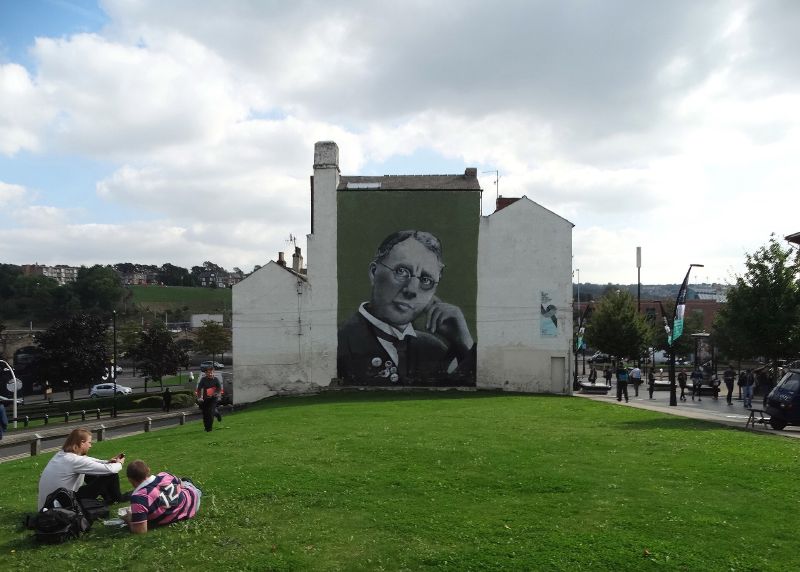
Harry Brearley was not trying to make a steel that would stay bright. In 1913 his job in a Sheffield laboratory was to find a better alloy for gun barrels, one that would resist erosion rather than corrosion. The rust-proof metal he found instead ended up in almost every cutlery drawer.
more
A lab run by a big steelmaker
Brearley was the first manager of the Brown Firth Research Laboratories, BBC News reports, run by one of Sheffield’s biggest steelmakers. He was testing different alloying elements to make steel harder. The British Stainless Steel Association says the request came from a small arms maker whose gun barrels were wearing away too fast. Brearley tried alloys with between 6% and 15% chromium.
The glint in the scrap pile
The Guardian tells the famous version. Brearley threw unpromising samples into a corner, and one day he saw one still shining among the rusting rejects. The British Stainless Steel Association calls that story myth. Its likelier account is that Brearley etched his samples with nitric acid to study them under a microscope, and one would not etch.
The association dates the first alloy to 13 August 1913, with 12.8% chromium and 0.24% carbon. Chromium is what does the work. The Guardian explains that it forms a stable, transparent oxide layer on the surface, and that layer stops rust.
Not the first, but the first to sell it
Brearley was not alone. Scientists in France, Germany and the US had already found that chromium made steel resist rust, the Guardian notes. BBC News adds that the Germans built a stainless steel yacht for the Kaiser in 1908.
What set Brearley apart, BBC News argues, was seeing the commercial market. Its first use was still military, in the exhaust pipes of First World War biplanes. In 1915 he applied for US and Canadian patents for stainless steel cutlery, after Brown Firth refused to file a British patent for him. That led to disputes with the firm and with two American rivals, but in the end it made him rich. He worked with the Sheffield cutler R F Mosley to bring the knives to market.
The Guardian adds one more detail. Working in a city of cutlers, Brearley put the metal in his mouth to see whether it tasted of anything. It did not, and that was what made it fit for a spoon.
A plaque marks the old laboratory site, on the corner of Princess Street and Blackmore Street in Sheffield. BBC News reported that the plaque itself had started to rust.