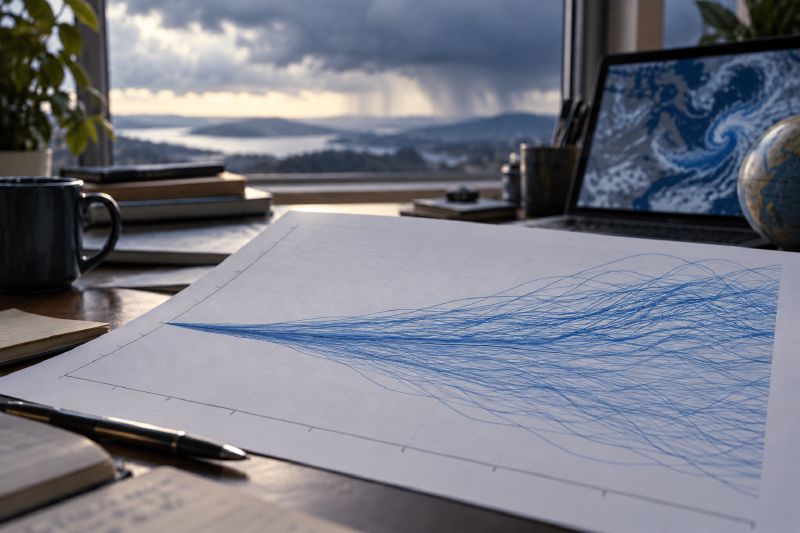
A forecast for next week can go wrong for one plain reason: the conditions a model started from were slightly off, and that gap grew. The atmosphere behaves as what scientists call a chaotic system, which means a small difference in today’s conditions does not stay small. It compounds, day after day, until it reshapes what a model says will happen a week out.
Researchers who study this describe the result as an insurmountable predictability limit. Sharper models and faster computers narrow the error a forecast starts with, but they cannot remove it, and the limit comes from the physics of the air rather than from any shortfall in computing power.
Why the atmosphere won’t hold still
Turbulence pours energy into the atmosphere at every scale, from a gust over a car park to a jet stream crossing an ocean, and that churn is what generates the chaos in the first place. Researchers picture every state the atmosphere can settle into as points on one vast shape, the atmospheric attractor. Start a forecast slightly off one point on that shape, and the outcome depends on that starting error, which is what scientists call the butterfly effect.
Predictability is not a fixed number attached to the atmosphere as a whole. It shifts with whatever pattern the atmosphere sits in when the forecast begins. A steady, strongly eastward jet stream, what researchers term a zonal flow, is more predictable than a spell where the atmosphere is switching between a blocked pattern and that same zonal one. A forecaster reading a settled jet stream can trust a longer outlook than one watching the atmosphere mid-swing.
To track that shifting predictability over the North Atlantic, researchers built two measurements from dynamical systems theory. One, a local dimension, counts how many ways a given atmospheric state can change next, and links to how predictable that state is. It can shift within days, so it reads nothing like a model’s own forecast error. The other, a persistence value, tracks how long a state holds before it moves on: a highly persistent state tends to be a highly predictable one.
Where the butterfly effect came from
The idea that today’s full knowledge would let you predict tomorrow with certainty is older than any computer. Pierre-Simon Laplace put it to paper in 1814, arguing that a mind clever enough to know everything about the present, down to the last detail, could work out the entire future.
Physics spent the next two centuries taking that claim apart. Quantum mechanics arrived first, in the early 1900s, and showed that a particle has no exact position until it’s measured, so there is no complete present for any mind to grasp in the first place. Chaos theory delivered the second blow, later that century, once physicists realised how far even an ordinary, non-quantum system amplifies the smallest gap in what is known about it. A demon forecasting the weather decades ahead would need to know the present down to every beat of every butterfly’s wing.
A limit beyond chaos
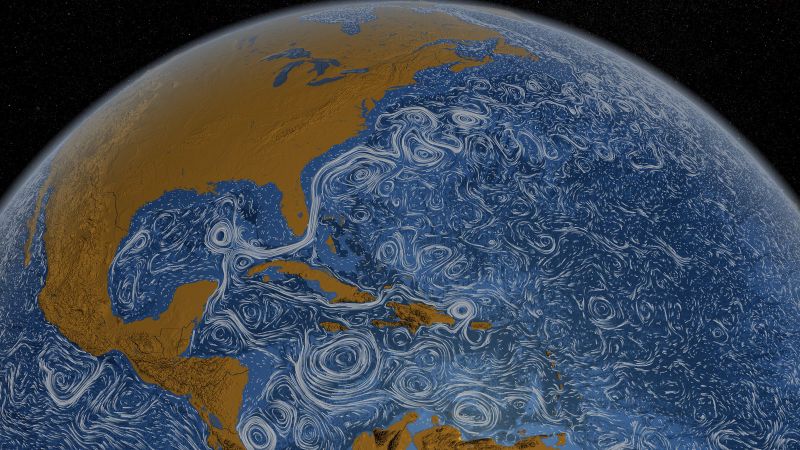
Some physicists now argue that chaos is not the final word. A property called undecidability, long known to mathematicians as a class of question with no answer, has turned up in physical systems too, including swirling ocean currents. Even total knowledge of where such a system stands today, it turns out, does not guarantee knowledge of where it goes next.
Toby Cubitt, a University College London physicist who works on the problem, put the finding plainly: handed a system’s exact present state, “you still can’t predict what it’s going to do.” Eva Miranda, a mathematician at the Polytechnic University of Catalonia, calls undecidability “a next-level chaotic thing.”
One theoretical demonstration of it needs nothing more exotic than an imagined pinball machine. In 1990, Cris Moore, then a graduate student at Cornell University, designed a box open at the bottom and filled with bumpers, with a ball fired in from a chosen starting spot. Aimed precisely enough, that ball’s path carries out the same step-by-step working as a Turing machine. Alan Turing defined that theoretical device in 1936. Many physicists still treat it as marking the edge of what any calculation, by human, computer or demon, can achieve. David Wolpert, a Santa Fe Institute researcher who had no part in the work, called the resulting limits on prediction “inviolable.”
Why the limit might be moving
None of that is the last word on next week’s forecast, though. Researchers modelling the North Atlantic warmed the ocean surface in their simulations by four degrees and quadrupled the carbon dioxide in the air above it. The atmosphere’s large-scale predictability rose rather than fell.
The warmer ocean pushed the atmosphere towards steadier, more eastward-flowing patterns, the kind chaos theory already marks as easier to call. The researchers named the finding the hammam effect. A hotter planet, on this reading, hands the forecaster back some of what chaos took away.