Steve Irwin’s family has marked 20 years since the Crocodile Hunter died, and his daughter Bindi called him a “superhero” in a post on Instagram. Irwin died on September 4, 2006, aged 44, when a stingray’s barb pierced his chest as he filmed underwater at the Great Barrier Reef.
more
What his children said
Bindi, now 28, was eight when her father died. She wrote that she had always thought his legacy was wildlife conservation, and had come to see it as love instead. She said her own five-year-old daughter watches his documentaries every morning and feels loved by her “grandpa crocodile” without ever meeting him.
Her brother Robert, now 22, posted a photograph of his father holding him as a baby, captioned “Your legacy is forever”. Their mother, Terri, shared an old interview in which Irwin called Bindi’s birth the most incredible wildlife encounter of his life. He said he named her after his favourite crocodile.
The family has kept running Australia Zoo in Queensland since his death. Primetimer reports that Terri, Bindi and Robert have built projects around wildlife rescue, animal research and environmental education. In October 2025, while he was competing on Dancing with the Stars, Robert wrote that everything he does rests on a conservation mission his father started. He went on to win the US competition, a decade after his sister took the same title.
Why he mattered
Irwin was born in a Melbourne suburb on February 22, 1962, and grew up in Queensland at the wildlife park his parents ran. That park eventually became Australia Zoo. He began appearing on television in the mid-1990s, and The Crocodile Hunter reached more than 100 countries through the Discovery Channel and Animal Planet. Time put the figure at 130 countries.
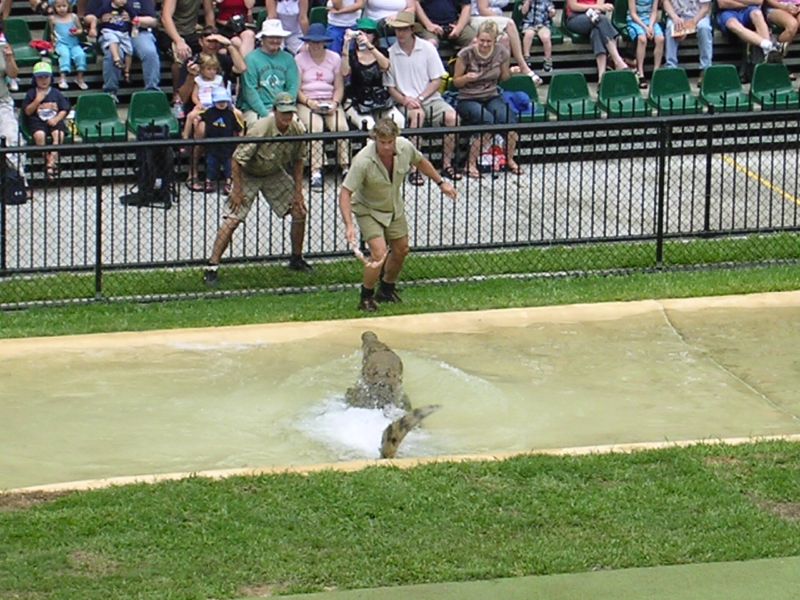
His style was the draw. He leapt on crocodiles and handled venomous snakes while keeping up a running commentary, and fans copied his cry of “Crikey!” Some observers criticised the risks he took, the Television Academy noted, though Irwin always said he worked within safe limits.
Grahame Webb, a crocodile expert who ran a crocodile park in Darwin, told Time that Irwin helped people value dangerous animals. Conserving koalas is easy, Webb said, but spiders, snakes and crocodiles are a harder sell. The RSPCA called Irwin a “modern-day Noah”, and Prime Minister John Howard said Australia had lost “a wonderful and colorful son”.
How he died
Irwin was snorkelling on Batt Reef, about 15km from Port Douglas, when a ray he swam over struck upwards with its tail. Crew members began resuscitation on the way to meet a rescue helicopter. He was pronounced dead at noon at Cairns Base Hospital, Time reported. He had been filming for a project called The Ocean’s Deadliest.
Two decades on, his grandchild knows him only from those documentaries, and that is how most of the world met him too.