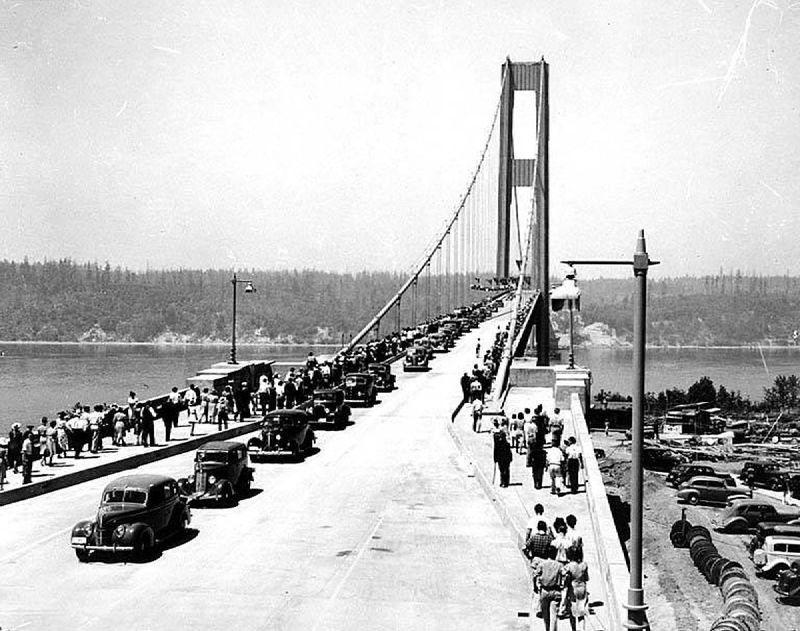
The Tacoma Narrows Bridge broke apart on November 7, 1940, in a wind of 40 to 45 miles an hour. The investigation that followed told engineers they had to test suspension bridge designs on models in a wind tunnel, according to the Washington State Department of Transportation (WSDOT). The bridge had been open for four months.
more
A bridge that moved from the start
Leon Moisseiff redesigned the crossing so it could be built for $7 million, the budget allotted, against $11 million for Clark Eldridge’s original plan. The deck began to sway while the floor was still going in. After the bridge opened on July 1, 1940, its wave-like bounce in high winds earned it the name “Galloping Gertie”, and people paid the toll to ride it.
On the last morning, the main span began to twist in two segments at about 10:00 a.m. It broke up shortly after 11:00 a.m. Professor F. B. Farquharson of the University of Washington, who had tested a model of the bridge, was the last person on it, and walked off along the yellow centre line.
What the inquiry found
The Federal Works Administration appointed three engineers to investigate: Othmar Amman, Theodore von Karman, and Glen B. Woodruff. Their report, known as the Carmody Board report, came out in March 1941. WSDOT sums up its three main points:
- The bridge failed mainly because it was far too flexible.
- The solid plate girder and deck behaved like an aerofoil, producing drag and lift.
- Engineers understood little about aerodynamic forces and needed wind tunnel tests on models.
WSDOT lists why it flexed so much. The deck was too light and only 8 feet deep. Its width against the centre span gave a ratio of 1 to 72, which no bridge had tried before. The Board traced the turn to twisting to a cable band slipping on the north cable at mid-span. That split the cable into two unequal lengths, and the thin girders twisted easily.
Farquharson kept running wind tunnel tests after the collapse. He concluded that rhythmic forces, left undamped, had built into intense resonant oscillation.
What changed
Britannica records that the failure spurred aerodynamic research and that designers abandoned the plate girder for suspension bridges. Nobody died, because the bridge had been closed to traffic in time. Its 1950 replacement used a stiffening web truss instead.