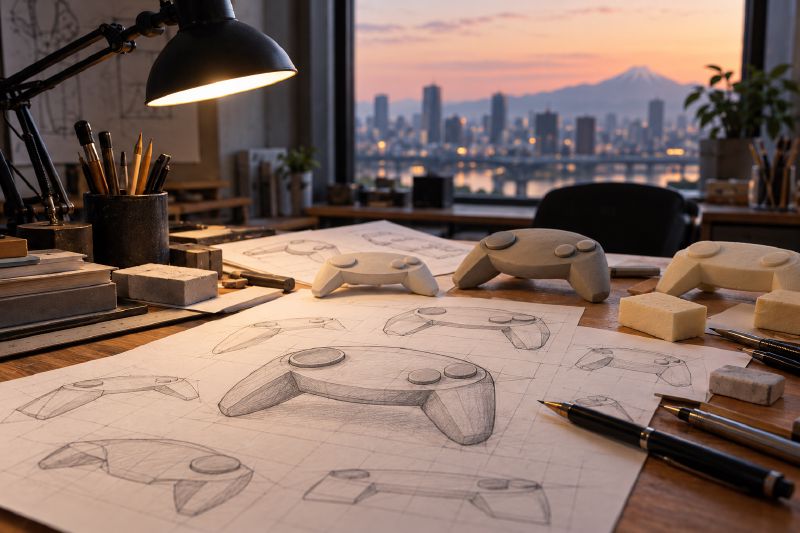
Teiyu Goto designed the original PlayStation controller as a careful copy with a few deliberate breaks. He kept the basic layout of the Super Nintendo pad, added grips and a second pair of shoulder buttons, and replaced lettered buttons with four symbols he invented. Sony shipped it with the first PlayStation in 1994.
Two of them needed persuading. Goto told the Japanese magazine Famitsu that it took work to convince Sony management the grips were a good idea, and that the colours on his symbols met resistance too.
Why it looked like a Nintendo pad
The caution came from the top. The Super NES was a hit, and Sony wanted its owners to move across, Goto said in remarks IGN quoted. Management told him the controller had to be a standard design, because gamers would not accept anything else.
So the core inputs stayed the same. The first pad had a d-pad and four face buttons, exactly the set the Super Nintendo used.
What he added, and why
The second pair of shoulder buttons was aimed at 3D games, which needed more ways to move around. Moving between L1 and R1 and the new L2 and R2 meant shifting the hands, and the grip handles were there to make that shift smoother. Kotaku called the result a “handlebar” shape, and in 2011 Kotaku said it persisted to that day.
Four symbols, four meanings
Rival consoles marked their buttons with letters or colours. Goto wanted something easier to remember, so he chose icons, and the triangle, circle, X and square arrived together. Each got a meaning and a colour.
- The triangle stands for viewpoint, a head or a direction, and he made it green.
- The square is a sheet of paper, for menus and documents, in pink.
- The circle and the X are the yes and no of a decision, in red and blue.
People at Sony thought he had mixed the colours up. Goto said he had to make clear to management that the scheme was what he wanted.
He counted himself lucky. A designer rarely gets to work with symbols that plain, he said, and he compared the effect to the way most people picture the same Madonna when they think of painting.
How long the design lasted
The original pad sold from 1994 to 1997, with one small revision in 1996 that changed its cable. The Dual Analog controller of 1997 added twin thumbsticks, and the DualShock that soon replaced it added two rumble motors.
Neither changed the outline or the symbols. Kotaku, writing in 2011, called the pad the longest-serving design in game controllers. Sony brought the original controller back with the PlayStation Classic console.