American politicians favour a party by redrawing the lines of the districts that elect the House of Representatives. Each of the 435 members represents one district in their home state, and state governments set the process that fixes its boundaries. Who holds the pen decides much of whether a district leans Democratic or Republican.
The BBC defines gerrymandering as redrawing electoral boundaries to favour a party. Both main parties do it, and it is legal unless a court finds it racially motivated. Since a 2019 Supreme Court ruling, courts can no longer block political gerrymandering.
Why the maps changed mid-decade
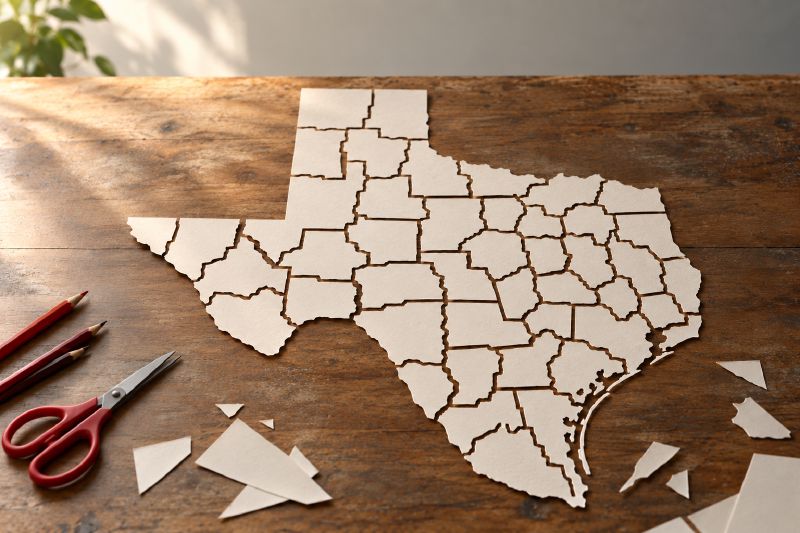
States normally redraw after the census, which counts residents every ten years. That changed in the summer of 2025. Texas’s Republican-majority legislature redrew its congressional seats mid-decade, under pressure from Donald Trump, to send more Republicans to Washington. The Atlantic’s Russell Berman traces the push to Trump’s political team, which saw a chance to gerrymander an already Republican-leaning state further.
The Guardian’s tally shows what the redraw did on paper. On 2024 votes, the new Texas map turns a 25-13 Republican split into 30-8.
How the other side answered
California replied with a measure of its own, Prop 50, which voters approved. It set aside a neutral redistricting commission written into the state constitution. On 2024 votes, it moves a 43-9 Democratic margin to 48-4.
Other states followed:
- Missouri’s Republican legislature turned a safe Democratic seat near Kansas City into one that leans Republican.
- North Carolina’s Republican legislature redrew its map on 22 October, moving a 10-4 split to 11-3.
- Virginia voters narrowly approved a constitutional amendment on 22 April that let legislators redistrict. They redrew four districts, taking a 6-5 Democratic edge to 10-1.
- In Utah, Judge Dianna Gibson threw out the Republican map and imposed one with a solidly Democratic district around Salt Lake City.
By late April 2026 the Guardian counted ten new districts drawn for Democrats and nine for Republicans. That count could swing to a three-seat Republican edge if Florida adopted its proposed map.
What the Supreme Court changed
On April 29, 2026, the Supreme Court decided Louisiana v Callais. The ruling makes it harder to prove a congressional map is racially discriminatory. Louisiana at once suspended its primaries to redraw, aiming to turn its two majority-Black districts into one. Tennessee advanced a map that would split its only majority-Black district.
About a week later, the Supreme Court of Virginia struck down the map that could have added four Democratic seats. After those two rulings, The Atlantic judged a Democratic House far less certain.
The stakes are narrow margins. On 28 April, Republicans held the House 217-212, with four seats empty. The Guardian ranks that among the narrowest majorities in US history. Critics quoted by the BBC say the process lets politicians pick their voters, rather than the other way round.