Folk horror came out of a handful of British films and television plays made around 1970, and it was named decades later. Its heart is three films: Witchfinder General, The Blood on Satan’s Claw and The Wicker Man. Start there, and then follow the genre out into the woods of New England, the islands of Sweden and the Himalayas.
This is a genre made by people who loved the countryside and feared it in equal measure. It is a good one for Halloween, because its monsters are rarely monsters. They are neighbours, harvest songs, and the soil itself.
Where folk horror came from
Folk horror is older than its name. The films that define it were made between 1968 and 1973, but nobody called them folk horror at the time. Kier-La Janisse, who made a three-hour documentary on the genre, says the label was applied after the fact.
more
The name goes back to an interview. In 2004 the director Piers Haggard told Fangoria that with Blood on Satan’s Claw he had been trying to make a folk horror film. Six years later Mark Gatiss picked up the phrase for his BBC Four series A History of Horror, and used it to gather a group of British films under one roof. From there it spread online, and it swept in silent Scandinavian cinema, public information films, the Ghost Box record label, and the writing of M.R. James, Susan Cooper and Arthur Machen.
Three films, one shelf
The heart of the genre is a trio of British films now called the Unholy Trinity. They are Michael Reeves’s Witchfinder General (1968), Haggard’s Blood on Satan’s Claw, and Robin Hardy’s The Wicker Man (1973). The BFI’s guide to the genre points out a quiet irony in that order. The run opens on its bleakest film and closes on its most hopeful, however warped that hope is.
What ties them is ground. In each, the land cuts a community off from the world, and the isolation bends its morals far enough to end in torture, sacrifice or something summoned from below. The BFI calls the result an alternative vision of Albion, one that unearths a darker past in copses few people visit.
Older than film
The roots go back much further. In 1975 the Guardian critic Caroline Tisdall described Henry Fuseli’s art as a mix of history, Shakespeare and “dramatic folk horror”. Fuseli’s The Nightmare, painted in 1781, puts a squatting demon on the chest of a sleeping woman.
The literature runs deep too. In M.R. James’s 1925 story “A View from a Hill”, a man scans the English countryside through a strange pair of binoculars and glimpses a scene from the past, with “something hanging on the gibbet”. The horror writer Andrew Michael Hurley links that image straight to Witchfinder General. Across the Atlantic, Nathaniel Hawthorne’s “Young Goodman Brown” follows a Salem man into the woods to a Satanic gathering of his own respectable neighbours.
Cinema found the mood before Britain did. The BFI places Ingmar Bergman in the genre’s family tree. The Seventh Seal grew from a mural, “Death Playing Chess”, that Bergman saw as a boy in Täby church near Stockholm. The Virgin Spring took its story from a 13th-century Swedish ballad, and one of its characters prays to Odin. Bergman may not have known he was making folk horror, the BFI argues, but his films kept wandering onto its ground.
Why the countryside frightens us
Hurley, author of the novel Starve Acre, has a theory about the pull of these stories. In them the countryside calls to people as a place of hope and healing, and then it turns on them. He traces the same faith in nature back to the gardens Cyrus the Great built at Pasargadae and to Britain’s national parks of the 1950s. Folk horror, in his reading, pushes back against a nostalgia that pretends the past was simpler and kinder.
Janisse sees a link to the years that made the first films. She points to the early and mid 1970s, with their political breakdown, environmental fears, and people trying out new-age religion and herbalism. Her question for the genre is the one it keeps asking: is the real horror the old ways, or the civilisation built on top of them?
The people who made it
Two of the three Unholy Trinity films came from the same company, Tigon.
Michael Reeves and the Norfolk summer
Michael Reeves made Witchfinder General, a historical drama about religious fanaticism rather than real witches. He thought of it as a Western. His star Ian Ogilvy told Empire that Reeves always said so, and the director died young soon after the film came out.
The shoot was hard. Ogilvy remembered the wilds of Norfolk in summer as bleak and brutal, though not unremittingly gloomy. Vincent Price, used to a comfortable studio, was not happy. Ogilvy adds that there is plenty of exciting stuff in the film.
Piers Haggard and the camera in the soil
Piers Haggard wanted Blood on Satan’s Claw to feel like it came out of the ground. He told Mark Gatiss that he brought the woodland edges, the ploughing and the labour into the film. His crew dug many holes so the camera could sit low, as if the audience were inside the earth.
The writer Robert Wynne-Simmons gave the film its argument. For him, its theme was the stamping out of old religion, not by Christianity but by a dogged, atheistic enlightenment. The judge in the film stands for that drive to drag things out of the dark and get rid of them.
Robin Hardy and the invented Scotland
The Wicker Man feels ancient, yet Empire points out that almost all of it was made up. Englishmen wrote and directed it, an American scored it, and the Scotland on screen is an outsider’s dream. Paul Giovanni wrote most of its folk songs himself. The Summerisle song sounds medieval, but it dates from 1973, a joke the Mediaeval Baebes enjoy by slipping it into their sets.
Its fans are devoted. Janisse first saw it as a teenager and later made a pilgrimage to the harbour town in the north of Scotland where its harbour scenes were shot. A fisherman named Calum Mackenzie had a stranger on a motorbike drop her at a castle, and she found the shed in the woods. Inside sat the harbourmaster’s red and blue boat, eyes painted on its prow, and she climbed in to eat her sandwich.
The television writers
Some of the genre’s founders wrote for the small screen. Alan Garner adapted his own novel The Owl Service for children’s television in 1969 and 1970, setting a legend from The Mabinogion in Wales. Nigel Kneale, whom Empire calls “the great Nigel Kneale”, crashed folklore into science fiction in Quatermass and the Pit. The BBC turned M.R. James’s ghost stories into Christmas dramas through the 1970s.
The director Daniel Kokotajlo, who programmed a BFI season of that television, thinks it was the stranger medium. Stranger things were being made on TV then, he told the BFI, and their makers did not much care how to label them.
Far from England
The mood also surfaced elsewhere. Ted Kotcheff’s Wake in Fright, set in an Australian town the locals call the Yabba, made middle-class viewers fear the people around them a year before Deliverance did the same. Bright Wall/Dark Room’s critic notes the twist: nobody in the Yabba harms the hero, and the horror turns out to be inside him.
The films and plays that set the rules
The Guardian offers a working test. Folk horror is a rural story in which old skills, beliefs or rites rub against a newer kind of civilisation. Every work below passes it in its own way.
The Unholy Trinity
The three films that anchor the genre arrived as a cluster: Witchfinder General in 1968, The Blood on Satan’s Claw in 1971, and The Wicker Man in 1973. IndieWire says Janisse’s documentary argues that they heard echoes from a past that post-war society hoped to forget.
The Wicker Man gives the genre its plainest picture. Pagan islanders with maypoles and a taste for sacrifice face a stiff Christian policeman. Its history is tangled. It first came out cut short, and a longer version had its premiere on the first broadcast of the BBC2 series Moviedrome in 1988. In 2025 the BFI screened the 2013 Final Cut.
The Blood on Satan’s Claw, the BFI notes, came from Tigon, the same company as Witchfinder General. The BFI also puts Hammer’s The Witches (1966) on the same shelf, while pointing out that Hammer wanted fast returns at the cinema.
The plays nobody could pin down
British television made some of the genre’s richest work, and the BFI argues that much of it is still unexplored. Analogue broadcast TV, it says, remains an undiscovered country.
Play for Today, the BBC’s single-drama strand, is the deepest seam. John Bowen’s Robin Redbreast (1970) is by now close to canonical folk horror, the BFI says, and fills a sinister gap shaped like The Wicker Man. David Rudkin’s Penda’s Fen (1974) follows a boy who loves Englishness and slowly finds his own inheritance and sexuality are more mixed than he thought. When the producer David Rose picked BBC highlights to repeat on Channel 4 in 1990, Penda’s Fen was high on his list, and Rudkin introduced it.
Alan Garner’s Red Shift ran three time streams side by side: Roman Britain, the English civil war, and the present day. It went out on BBC1 at 9.25pm on 17 January 1978. Garner had already written The Owl Service, which the BFI calls an exemplar of weird television.
Bergman’s island
Ingmar Bergman’s Hour of the Wolf (1968) earns its place in the canon, the BFI argues, because it joins Fuseli-like demons to folklore. Its painter hero fears the forest and empty beaches of his island refuge. Bergman’s The Virgin Spring went on to inspire Wes Craven’s first film, The Last House on the Left (1972). Janisse’s documentary draws a line from Hour of the Wolf to La Llorona through their shared water imagery.
The new canon
The genre kept adding works. Robert Eggers’s The Witch, with its witchcraft, animal shapes and blood set against prim 17th-century pilgrims, is now one of folk horror’s obvious touchstones. Bright Wall/Dark Room calls it Eggers’s Sundance folk horror and compares its devil to the seductive one in Hawthorne. Ari Aster sees his Midsommar as a fairy tale more than anything. Its heroine loses a family at the start and gains one at the end.
Adam Scovell’s book Folk Horror: Hours Dreadful and Things Strange, published by the BFI, maps the field. It runs from the furrows of Hardy, Haggard and Reeves to wicker men, stone circles and malicious stone tapes.
How it travelled
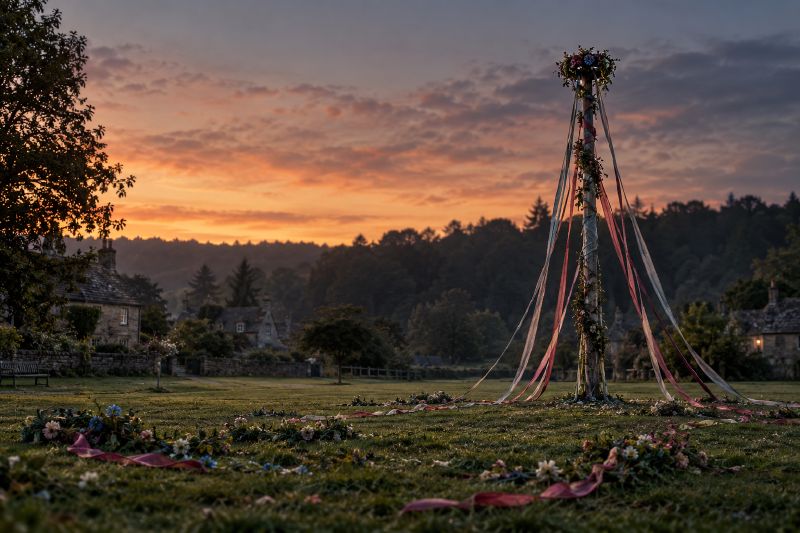
Folk horror left the English field early and never stopped moving. It reached European art cinema, American television, heavy metal and the radio.
more
Across Europe
The BFI links Bergman’s The Seventh Seal to a group of folk-tinged European art films. They include Andrei Tarkovsky’s Andrei Rublev (1966), František Vláčil’s Marketa Lazarová (1967), and Otakar Vávra’s Witchhammer (1970).
Sweden keeps drawing film-makers back. Ari Aster made Midsommar because a Swedish production company, B-Reel, asked him for a horror film set there. He was going through a breakup and found he could fold a breakup story into a folk horror structure. His crew built the whole village from scratch in an empty field, then tore it down after the shoot. In September 2026 a new psychological folk horror called Häxan began filming around Stockholm. Tina Gharavi directs it, and Moby is composing the score. It draws on Sweden’s 17th-century witch trials.
Into American woods
In the United States the genre found Puritan New England. Patrick McHale’s Cartoon Network series Over the Garden Wall took Hawthorne’s “Young Goodman Brown” as a major influence on its villain, the Beast. Its artists based their backgrounds on the Hudson River School of painting, which saw the north-east as a place of awe and dread. Bright Wall/Dark Room calls it a new seasonal staple.
Into heavy metal
The genre also found a home in British metal. In the early 1980s a Stourbridge band called Witchfinder General wrote a song of that name, inspired by the 1968 film. Only later was the band credited as the birth of UK doom metal. South London’s Pagan Altar left only a self-released set of demos, and legends grew around them, including a studio said to stand where witches were burned.
The line runs on today. Green Lung, a British metal band, built its fourth album, Necropolitan, around London’s “Magnificent Seven” cemeteries. Shonagh Brown of Newcastle’s Druidess thinks people who spend so much time in front of screens want to reach the natural world, and folk traditions offer a way in.
On the radio and beyond
BBC radio keeps returning to the genre. In January 2023 Ellen E Jones and Mark Kermode gave an episode of Radio 4’s Screenshot to folk horror. The director Nikyatu Jusu talked about using West African folklore in Nanny, and Mark Jenkin explained why he calls Enys Men a folk film rather than folk horror. BBC Sounds now runs a Midsummer Horror collection, including Shard, a folk horror drama about a commune and the price it pays.
The BFI describes the British revival as a full cultural movement. It traces it to Ben Wheatley’s Kill List in 2011, then through films such as Gwen (2018) and Enys Men (2022), and out into galleries, theatre and zines. In 2025 the BFI’s Moviedrome season screened Witchfinder General with an introduction by Reece Shearsmith.
Where folk horror stands now
One map of folk horror is a documentary that runs more than three hours. Kier-La Janisse’s Woodlands Dark and Days Bewitched premiered at SXSW in 2021 and runs 194 minutes.
It began as something much smaller. Janisse set out to make a half-hour extra for a Severin Films release of The Blood on Satan’s Claw, and it kept growing until it took in some 240 releases. Variety’s reviewer called it a must for programmers of fantasy festivals and midnight screenings. Its last chapter follows the revival through film-makers such as Robert Eggers and the Laotian director Mattie Do.
Janisse dates the North American wave to the middle of 2018, when she started the film. In Britain, she says, it had been going for a while already.
The people who never stopped loving it
Some of the genre’s champions found it young. Reece Shearsmith of The League of Gentleman first saw Häxan, Benjamin Christensen’s 1922 film about the history of witchcraft, on Channel 4 at about 12 or 13. He has watched it every Halloween since, and he narrates it live alongside Stephen Horne’s new score. Shearsmith traces a line from Häxan through The Wicker Man and Witchfinder General to Ben Wheatley’s A Field in England, which he acted in. People of his age who grew up on 1970s horror, he says, are now putting those films back into their own work.
In 2019 Simon Hollis made Fear in the Furrows for BBC Radio 4. He spoke to Alan Garner, Piers Haggard and the writer Adam Scovell about the darker side of the pastoral.
New films, from new places
British film-makers still look back to the 1970s. Daniel Kokotajlo shot Starve Acre on 1970s lenses because real film was too expensive, then printed the finished edit onto film to blend its colours. He calls it a nature’s revenge story. Empire sees the old demons changing shape in films such as James Watkins’s Eden Lake (2008), where hooded teenagers kill middle-class visitors in the woods.
The genre now arrives from much further afield. Bhargav Saikia’s Bokshi, named after the Nepali word for witch, was shot over 80 days in remote Himalayan locations. It premiered at Rotterdam in January 2025, and the Spanish distributor Wild Duck bought it for a Halloween release. Its cast speaks Boksirit, a full invented language built for the film by the Dutch linguist Jan van Steenbergen. From Ireland, Paul Duane’s All You Need Is Death draws on the strangeness of old Irish ballads.
The BFI sees room for all of it. Folk horror, in its words, is both tightly coded and loose, and the works that fit it least are often the most interesting.
Starter guide
The list runs in order of release, from Häxan to Midsommar. Each film has at least two publications behind it.
- Häxan (Benjamin Christensen, 1922). IndieWire calls this silent study of witchcraft an essential part of film history, and the BFI says it was destined to be a cult classic.
- Night of the Demon (Jacques Tourneur, 1957). Dana Andrews plays a psychologist who investigates a possible satanic cult. IndieWire puts it on its list of the 100 best horror films, and the BFI counts it among the established classics of British rural horror.
- Witchfinder General (Michael Reeves, 1968). IndieWire places it in the Unholy Trinity of folk horror classics, and The Guardian names it among the best British folk horror films.
- The Devil Rides Out (Terence Fisher, 1968). Hammer’s occult thriller is on the best horror lists of both Empire and IndieWire. The BFI counts it among the established classics of British rural horror.
- The Blood on Satan’s Claw (Piers Haggard, 1971). IndieWire places it in the same Unholy Trinity of folk horror classics. The Guardian names it among the best British folk horror films, and says it perfected the genre’s sense of evil planted in the earth.
- The Wicker Man (Robin Hardy, 1973). Variety and Empire both put it on their lists of the best horror films of all time. The Guardian says it is generally regarded as one of the three cornerstones of British folk horror.
- Kill List (Ben Wheatley, 2011). Empire puts it on its list of the 50 best horror films of all time. The Guardian names it among the best British folk horror films, as “a tight, nasty update”.
- The Witch (Robert Eggers, 2015). Variety and Empire both put Eggers’s debut on their lists of the best horror films of all time, and IndieWire ranks it among the best A24 horror films.
- Midsommar (Ari Aster, 2019). Empire puts it on its list of the 50 best horror films of all time, and IndieWire ranks it among the best A24 horror films.