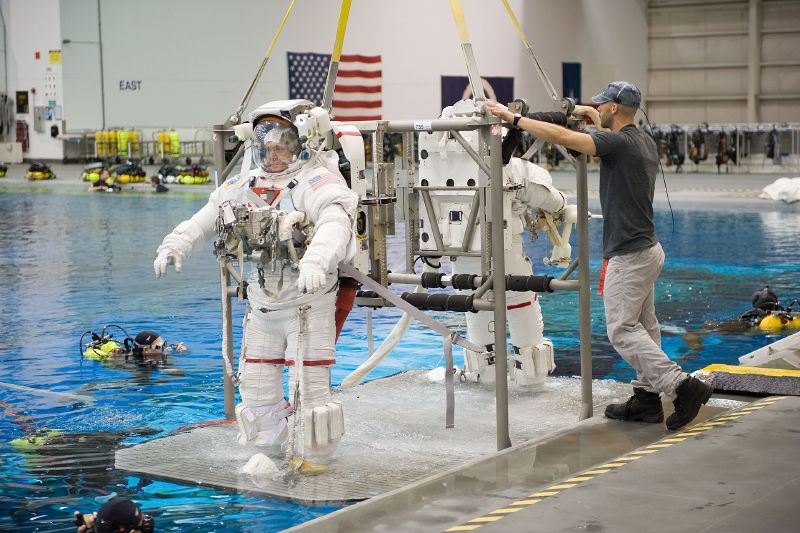
An astronaut practises for roughly seven hours in a swimming pool for every hour they might spend outside the International Space Station, according to NASA figures reported by Space.com. The pool is the Neutral Buoyancy Lab at NASA’s Johnson Space Center in Houston, and it holds a submerged replica of the station. Astronauts start training there years before their first real spacewalk.
more
The water stands in for weightlessness, but it is only half of the preparation. The other half is a plan, written on the ground, that the crew rehearses until the day itself.
Why a pool?
The Neutral Buoyancy Lab holds 6 million gallons, and the station mock-up sits 40 feet (12 metres) down. That is where astronauts first see the station while wearing a spacesuit. Underwater they practise the jobs they will do in orbit, such as connecting electrical cables and removing broken equipment, while learning to work inside a suit that restricts every movement.
The pool is not the real thing. Tracy Caldwell Dyson, a NASA astronaut with three spacewalks behind her, told NPR that in space there is no diver floating nearby to keep you safe.
Ordinary jobs in stiff gloves
On paper, the work looks mundane. NASA’s own flight directors list examples such as driving a bolt, taking off a cover or plugging in a cable. The difficulty comes from doing them in a pressurised suit, in microgravity, around huge structures, against a clock set by the suit’s consumables.
The gloves add to the strain. NASA describes them as feeling like stiff balloons, and says work with cables or fluid hoses gives the fingers and forearms a hard workout.
“Walking” is the wrong word, too. Astronauts move mostly with their hands, pulling themselves from handhold to handhold. Everything, the astronaut included, stays tethered at all times. If an astronaut loses their tether, the suit carries a jet pack called SAFER (Simplified Aid for EVA Rescue), steered with a small joystick.
The plan comes from the ground
The choreography comes from the ground. Flight controllers build each spacewalk’s timeline from a ranked list of tasks set by station management, such as moving an antenna or installing an avionics box.
They start with the top task and fit others around it. Their judgement weighs several factors:
- how long similar tasks took before
- whether both crew members must work together
- where on the station the task sits
- how much equipment fits in the airlock
- the crew’s experience and the effort involved
A task that might fit if the team works quickly goes on the list as a “get-ahead” task. Mission Control can add it during the spacewalk if time, fatigue and suit supplies allow. Some jobs run against a separate clock. An item cut off from power can get cold and need heater power within hours, or sometimes minutes.
While the timeline is still a draft, the team tests the operations to prove they work. Then it trains the crew and keeps refining the timeline, sometimes right up to the day of the spacewalk.
The night in the airlock
In orbit, preparation starts days ahead. Astronauts check every part of their suits and tools, and make sure both are assembled and tethered properly.
About 24 hours out comes a step that divers use too: decompression. The station keeps its air at 14.7 pounds per square inch, the same as sea level on Earth. A spacesuit runs at 4.3 psi, about the pressure at 30,000 feet. A fast drop between the two can form nitrogen bubbles in the blood, the condition known as the bends. So astronauts spend the night before in a closet-sized airlock, letting their bodies adjust.
Two people, one lead
Most spacewalks are done in pairs, and only one so far has involved three people. One astronaut leads, keeping track of pace, safety and the completion of the whole outing.
Outside, the suit is the only shelter. Temperatures can reach 250 degrees Fahrenheit (120 degrees Celsius) in sunlight and fall to minus 250 F (minus 160 C) in shadow. Mike Massimino, a former NASA astronaut who made two spacewalks, told Space.com the suit is like your “own little spaceship”.