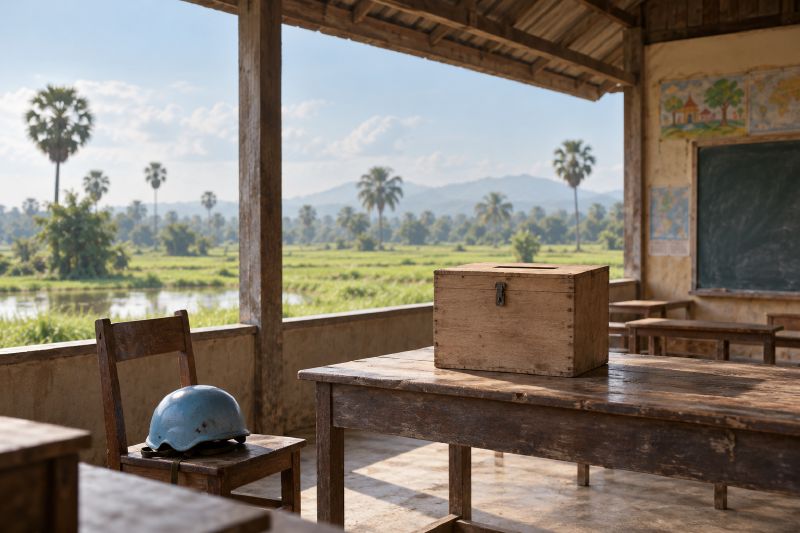
The United Nations supervised Cambodia’s May 1993 election. It sent a peacekeeping force of 22,000 people at a cost of $2 billion, the largest operation in its history, and staged a vote over six days. The Khmer Rouge boycotted it and attacked the people running it.
The mandate came from a peace deal. In 1990 the UN Security Council endorsed a plan for a UN-supervised interim government and free elections. Cambodia’s factions signed the accord in Paris in October 1991, and the United Nations Transitional Authority in Cambodia, known as UNTAC, began work in 1992.
Who did the work on the ground
Much of it fell to volunteers. In a Commons debate on 6 May 1993, the MP Jim Lester quoted a colleague in Cambodia who said the elections depended on UN volunteers. The colleague warned there would be no election if the Khmer Rouge frightened them out of working. One Japanese volunteer and his interpreter had been killed on 8 April, and Lester said more than 40 of the 400 volunteers had already asked to stop.
The threat came from two directions. Lester reported the fear of Professor Reginald Austin, who directed UNTAC’s electoral component. Austin feared the Khmer Rouge would target UN staff while the State of Cambodia government harassed opposition parties.
What voting looked like
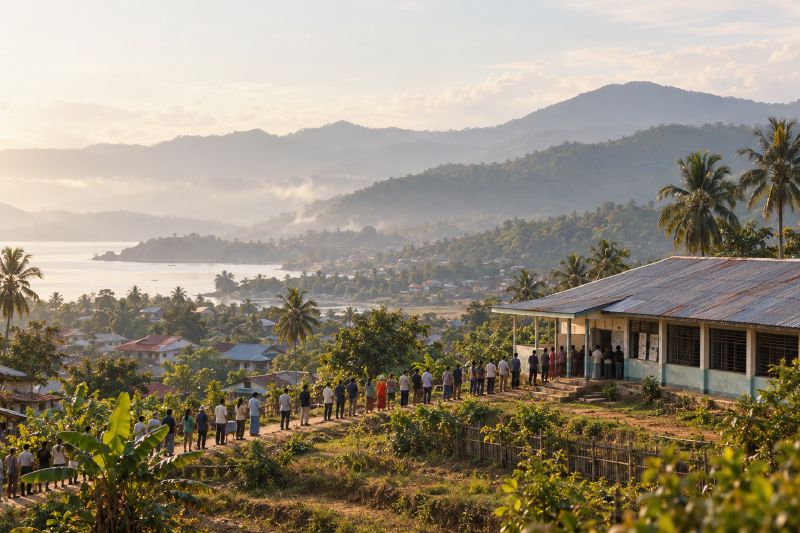
Voters held laminated UN voting cards carrying their own photograph and signature. Cambodia had 4.7 million registered voters, and for most of them this was their first chance to choose a government.
Twenty parties stood for a 120-member national assembly that would write a new constitution. The real contest was between the governing Cambodian People’s Party and Funcinpec, the royalist party led by Prince Norodom Ranariddh.
The day before voting opened, two Chinese peacekeepers died in a raid the UN blamed on the Khmer Rouge. UN peacekeepers still expected to set up polling stations across at least 80 percent of the country. “We have the minimum acceptable conditions for free and fair elections,” said UNTAC’s head, Yasushi Akashi, adding that this was far from the maximum.
What the result produced
Funcinpec won 58 seats to the CPP’s 51. Testimony to a US hearing, published by Brookings, records that the CPP refused to accept the result. What came out was a coalition with Ranariddh and Hun Sen as co-prime ministers.
It did not hold. In July 1997, after fighting in Phnom Penh, Ranariddh left for France and accused Hun Sen of staging a coup. The international community had treated the 1993 vote as close to a democratic miracle. Within four years, the government it produced had broken apart.