Where kitchen sink drama came from
more
The best-known story of kitchen sink drama starts with an unknown actor’s script, read in a riverside house in Hammersmith in 1956. John Osborne’s Look Back in Anger put a university graduate who runs a sweet stall, and his cramped attic flat, on the London stage. Within two years of that premiere, Wesker had opened a play in Coventry, and Delaney had put Salford on the stage.
The phrase had already appeared in painting, two years earlier. In December 1954 the critic David Sylvester wrote about four realist painters in Encounter magazine, under the heading “The Kitchen Sink”. John Bratby, Derrick Greaves, Edward Middleditch and Jack Smith became the kitchen sink school overnight, and none of them wanted the label.
Smith’s Children and Dog became the emblem of the group. It shows a scruffy little girl and a forlorn dog on bare floorboards, beside a table covered in the remains of a meal. The kitchen was real: Smith shared the London house with other art students and their families. He once said that if he had been born in a castle, he would have painted chandeliers.
What the stage looked like before
The West End of the 1950s ran on the “well-made play”, and Terence Rattigan was its model. BroadwayWorld describes these as comfortable, careful plays about the upper middle class. BBC Bitesize adds that many plays of the decade dealt with middle-class lives and steered away from homosexuality and racism.
Kitchen sink drama turned the stage round to face everyone else. BBC Bitesize defines it as plays showing the daily struggles of ordinary working-class people. Its subjects were poor housing, unemployment, poverty and stormy relationships.
Osborne wrote what he knew. He was born in London on 12 December 1929, the son of a Welsh commercial artist and a Cockney barmaid. He found the theatre by tutoring children in a touring company, then worked as an actor and actor-manager before he tried writing plays.
A script from the pile
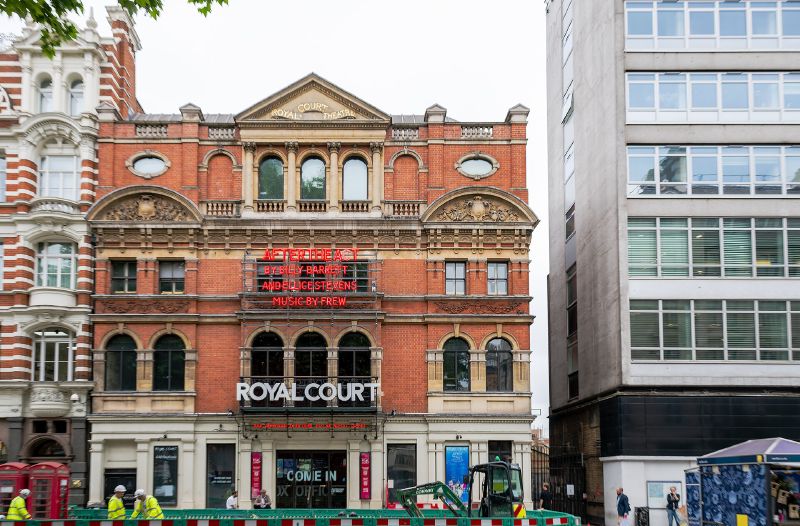
The English Stage Company took over the Royal Court in Sloane Square in April 1956. Its mission was to offer an alternative to the West End by finding new British plays and the best work from abroad. Its director, George Devine, had just visited Brecht’s Berliner Ensemble, and he wanted lavish painted scenery gone.
Devine went through the pile of scripts. Only one leapt out: a play by an unknown young actor with a curious title. Devine read it in his riverside house in Hammersmith. Then he took it upstairs to Tony Richardson, who lodged in the flat above and liked it even more.
Look Back in Anger opened on 8 May 1956. Philip Hope-Wallace reviewed it for the Guardian the next morning. He judged it far from a total artistic success. He still found enough tension, feeling and originality to make the choice understandable.
A Guardian writer who was then a 16-year-old Midlands schoolboy calls the overnight revolution one of British theatre’s consoling myths. What the play did, he argues, was give youth a voice, spur other dramatists and free audiences.
It was not an instant hit. Two things gave it fresh momentum. BBC Television showed an 18-minute extract, and the box office was besieged. Then Charles Monteith, a young editor at Faber, asked to publish the script, when few plays ever reached print.
Kenneth Tynan took sides. He wrote in 1956 that he could hardly love anyone who did not want to see the play. WhatsOnStage calls that review a line in the sand for British theatre.
The ironing board and the Sunday papers
Part of the shock was the furniture. One person at the 1956 premiere later recalled the jolt of seeing people on stage reading the Sunday newspapers. Productions still keep the ironing board where Alison works, as the Almeida’s revival did in 2024.
The play had many revivals, including one in 1957. A poster in the V&A’s collection advertises a four-week run directed by John Dexter, from an original production by Tony Richardson. Every seat was bookable, at prices from five shillings to 15 shillings.
The label that followed the play came from inside the building. The Royal Court’s own press officer coined “Angry Young Man”, and it stuck to Osborne at once.
A Guardian review of Roots points out a gap in the usual story. Look Back in Anger is often cited as the first kitchen sink drama, yet women were the ones tied to the sink. Osborne’s play keeps its focus on Jimmy Porter, the male rebel.
Cinema had its own roots. The New York Times traces the film movement to the Free Cinema documentary makers of the 1950s. The BFI goes back further, to Robert Hamer’s It Always Rains on Sunday (1947) and J. Lee Thompson’s Woman in a Dressing Gown (1957).
The writers who broke in
Three playwrights carried the movement on stage, and none of them came from the drawing rooms they displaced. Osborne came from Fulham, Shelagh Delaney in Salford and Arnold Wesker in the East End of London.
John Osborne
Michael Billington, writing Osborne’s Guardian obituary in 1994, argued that Look Back in Anger alone would have secured his place. Its premiere put the English Stage Company on the map. It also showed a generation of writers that contemporary Britain could be put on stage.
Osborne wrote a second play for the Royal Court, The Entertainer, and Laurence Olivier played its seedy music-hall comic, Archie Rice. Billington calls it a brutally bitter play about family life, and he hears Osborne’s Fulham childhood in its rows.
Fame changed his life. He married the actor Mary Ure and bought houses in Chelsea and the Kent countryside. He kept his edge. When Tynan, newly literary manager of the National Theatre, invited him to join and make history, Osborne snapped that he had already made it.
Shelagh Delaney
Delaney was a teenager when she wrote A Taste of Honey, straight after her first trip to the theatre. She typed it on a borrowed typewriter, sure she could do better than the play she had seen at Manchester’s Opera House.
She sent it to Joan Littlewood’s Theatre Workshop at the Theatre Royal in Stratford, east London. The 1958 programme introduced her as a Salford girl who worked in an engineering factory. Her father worked on the buses, and her brother was an apprentice engineer. The note called her the antithesis of London’s angry young men, because she knew what she was angry about.
Murray Melvin, who was in the original cast, remembers the opening night clearly. The cast had been warned of trouble, and told the safety curtain would come down if it started. Instead, at the curtain call they heard what he calls “an amazing noise”, a roar of approval. The play transferred to the West End in 1959.
Melvin is wary of the label all the same. Littlewood’s theatre ran on imagination and theatricality, he says, and “there were no kitchen sinks here”.
Delaney was not the only woman in the new wave. Ann Jellicoe’s The Sport of My Mad Mother reached the Royal Court shortly before A Taste of Honey opened. It won a prize in the Observer playwriting competition that Tynan had set up. Jellicoe remembers Devine telling her he regarded himself as her “mad uncle”.
Arnold Wesker
Wesker was born in Stepney and grew up in Fashion Street, Spitalfields, in a working-class family. His mother, Leah, was a passionate communist born in Transylvania. His Ukrainian father, Joe, was a tailor’s machinist who hated tailoring.
That family became the Kahns of Chicken Soup With Barley, first staged at the Belgrade Theatre in Coventry in 1958. Its three acts run from 1936 to 1956, starting on the day of the Battle of Cable Street. Roots followed in 1959 and I’m Talking About Jerusalem in 1960, completing what became the Wesker Trilogy.
Wesker was working as a kitchen porter at The Bell Hotel in Norwich when he met Doreen Bicker, a chambermaid there. He nicknamed her Dusty for her gold-dust hair, and a £500 Arts Council bursary paid for their wedding in 1958. She inspired Beatie Bryant.
Critics grouped Wesker with the angry young men, and he rejected the label. He put it plainly on Desert Island Discs in 2006: a writer is good because of the work, not the background.
The film-makers
Five directors took the movement to the cinema: John Schlesinger, Lindsay Anderson, Jack Clayton, Karel Reisz and Tony Richardson. The New York Times says they drew on the literary example of the Angry Young Men. They also disliked the bourgeois values of a staid national cinema.
Schlesinger later had no wish to go back. Asked if he would make films like Billy Liar again, he growled, “Why? We’ve done all that.”
The plays that set the pattern
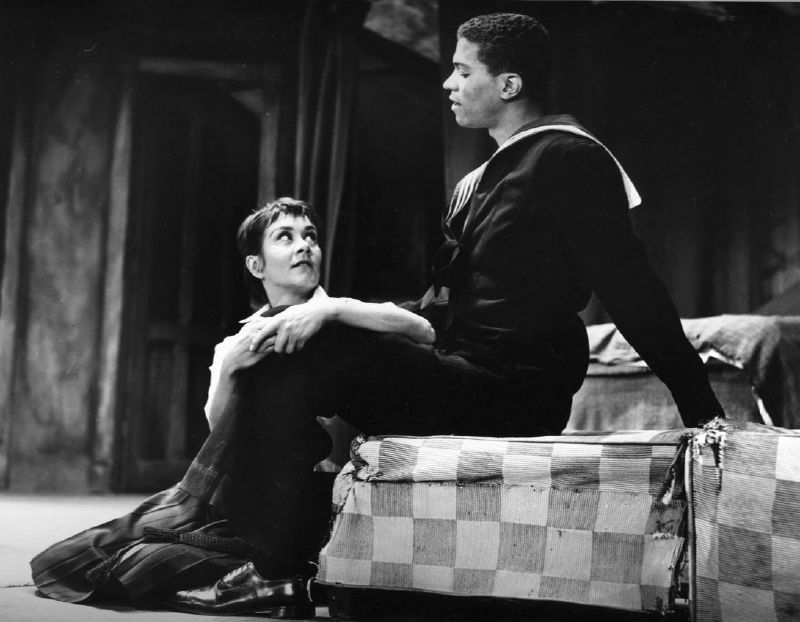
This section covers three plays: Look Back in Anger in 1956, A Taste of Honey in 1958 and Wesker’s Roots in 1959.
more
Look Back in Anger
Variety called it “the seminal 1956 John Osborne play” when the National Theatre revived it in 1999. The same review called it the play in which the English theatre grew up. WhatsOnStage, announcing that revival, said the play is widely regarded to have changed the course of British drama.
The Guardian writer explains why. Through Jimmy Porter’s long speeches, the play takes on sex, class, religion, politics and the press. Osborne insisted they were “arias”, not “tirades”. It caught a country stifled by an official culture, and in the 1950s audiences prized it as a social document of alienated youth.
Osborne also gave Alison’s upper-class father, Colonel Redfern, a hearing. Alison tells him that he is hurt because everything has changed, while Jimmy is hurt because nothing has.
The writer suspects the real revolution was in the language. Osborne once despaired of learning Somerset Maugham’s dialogue as a young actor, calling it “dead” and “inert”. His own lines drew on Bunyan’s moral fire, the rapid repetitions of music hall and the sexual frankness of D. H. Lawrence.
The writer names Harold Pinter, John Arden and Peter Gill among the writers who gained from it. Alan Sillitoe put it more bluntly: Osborne “set off a landmine” in British theatre, and it could never be the same again.
A Taste of Honey
A Taste of Honey opened on 27 May 1958 at the Theatre Royal Stratford East. Delaney’s Guardian obituary calls it one of the defining plays of the working-class and feminist movements of the 1950s.
Its people would have had no place in the “anyone for tennis?” theatre of the time. Jo lives in a run-down Salford flat with her mother, Helen, who keeps drifting off after men with money. Jo gets pregnant by a black sailor and is looked after by Geoffrey, a young gay friend.
The play broke taboos that Noël Coward and Rattigan had quietly kept. It let working-class women speak for themselves, through a working-class woman’s eyes. It made a gay man central and sympathetic, and gave a black character who was neither idealised nor a stereotype.
Salford’s council fumed that the play insulted the town. Once it became a runaway success, the council asked Delaney for her manuscript for its library. She called them hypocrites and gave it to Littlewood instead.
The play moved to Wyndham’s Theatre in the West End in 1959. Delaney sold the film rights that year for £20,000. In 1960 it opened on Broadway, with Joan Plowright as Jo and Angela Lansbury as her mother, and Plowright won a Tony award.
WhatsOnStage now calls it a modern classic. A 2014 review of a touring production counted what the play takes on: single motherhood, poverty, homosexuality, race and working-class struggle.
One Guardian writer has a phrase for Delaney herself: a “finder of wonder in back streets and bedsits”. Delaney was 22 when she co-wrote the screenplay for the 1961 film.
Roots
Roots is the central play of the Wesker Trilogy. Beatie Bryant comes home to her Norfolk farming family after three years in London, quoting her socialist boyfriend Ronnie at every turn. Ronnie never appears.
The play builds to Beatie’s final speech, when she finds words to describe herself at last. WhatsOnStage, reviewing the Almeida’s 2024 revival, found it closer to a sociological study than a drama. It still called Roots, with Look Back in Anger, a play “we should want to see”.
The films
The New York Times describes the screen movement as a brief series of socially aware films about regional working-class life. It notes they were grim, and occasionally funny.
The BFI, in its guide for newcomers, names A Kind of Loving (1962), The L-Shaped Room (1962) and This Sporting Life (1963) as essential entries in the cycle.
How the kitchen sink reached cinema and television
British cinema needed something new by the late 1950s. Box office takings fell from £108m at the start of the decade to £64m by its end. By 1957 television had overtaken radio in the UK, and picture houses were closing across the country.
Room at the Top and the X certificate
A censor helped clear the way. John Trevelyan, a former schoolmaster, became secretary of the British Board of Film Censors in July 1958. He believed films had to change with a changing society. He also thought the X certificate deserved better than horror films.
Romulus had bought the rights to John Braine’s bestselling 1957 novel Room at the Top, and worked closely with Trevelyan to get it passed. The Rank Organisation banned “non-family” films outright, so it was the rival ABC chain that took a chance on it.
Jack Clayton, the director, was no Oxbridge graduate. He was an industry veteran of more than 20 years, though only 37. He cast Laurence Harvey as Joe Lampton, an ambitious former prisoner of war, against the mill chimneys of Bradford. Simone Signoret won the Oscar for best actress. Her win put mainstream British cinema in the spotlight for the first time in nearly a decade. The Association of Boys’ Clubs, meanwhile, banned its members from seeing the film.
The Observer’s review of its legacy says the film’s significance “cannot be overstated”. It showed that British cinema could explore landscape, on the map and in the heart, in an adult way. Room at the Top reached people who had never heard of Free Cinema, and for whom Osborne’s play was a London event.
The adaptations that followed
Its success led to more films from new novels and plays. The Observer names the finest: Saturday Night and Sunday Morning, A Taste of Honey, A Kind of Loving, Billy Liar and This Sporting Life.
Each had its own register. Albert Finney’s Arthur Seaton in Saturday Night and Sunday Morning spends his £14 3s 2d a week as fast as he earns it. Richard Harris in This Sporting Life plays confused masculinity of a very different kind.
In A Taste of Honey, Rita Tushingham’s Jo takes a day trip to Blackpool with her mother and her mother’s flashy new husband. The Observer ranks the scene among the best portrayals of the British at play, all fake rock’n’roll and tawdry sideshows.
Billy Liar was one of the last films of the movement. It was shot in a Bradford of new supermarkets and coffee bars, and Tom Courtenay’s fantasist chooses to stay rather than follow Julie Christie to London.
Room at the Top left its mark on other films too. Hell Is a City, Life for Ruth and The Small World of Sammy Lee used real places as part of the story rather than as scenery.
The stage kept feeding the screen. Joan Littlewood turned her 1960 stage show Sparrows Can’t Sing into a 1963 film. Barbara Windsor earned a Bafta nomination as Maggie, a cockney wife left by her husband with a baby. The Guardian calls her later Carry On persona a cartoon version of that performance.
Into the living room
Television carried the movement into the late 1960s. The BBC’s Wednesday Play ran from 1964 to 1970 and took on homelessness, women’s rights and abortion.
Ken Loach directed Cathy Come Home, written by Jeremy Sandford, for the strand in 1966. It showed a family made homeless and, in its last scene, children taken from their mother by social services. The charity Shelter was founded the same year, and the play prompted a debate in Parliament.
Loach said at the time that he wanted the plays seen as continuations of the news, not as dramas. The BFI adds that his Up the Junction (1965) and Cathy Come Home helped shape the Abortion Act 1967 and the founding of the charity Crisis.
The New York Times traces a later peak to the 1970s and 1980s, the era of Loach, Mike Leigh and Alan Clarke on television. Clarke’s Scum was banned by the BBC, which had paid for it. The paper ranks Clarke with Loach and Leigh among the seminal figures of British social realism.
What the writers did next
The censor also caught up with Osborne. His 1965 play A Patriot for Me, about a gay spy in the Austro-Hungarian army, fell foul of the Lord Chamberlain. The Royal Court staged it as a club production for members only.
Wesker turned to getting the arts to working people. In the early 1960s he set up Centre 42 at the Roundhouse in London, a former engine shed. In 1961 he was jailed for demonstrating against nuclear weapons.
Delaney moved towards film and radio. Her biggest screen successes were Charlie Bubbles, with Albert Finney, and Dance With a Stranger, Mike Newell’s 1985 film about Ruth Ellis.
The Royal Court went on finding writers. The same writer counts David Hare, Christopher Hampton and Howard Brenton among a later generation who caught the ambition Osborne had lit.
Where kitchen sink drama stands now
The plays are still on stage, and every revival reopens the argument about them. The films have heirs, though most of those heirs refuse the family name.

more
Revivals that argue back
Look Back in Anger turned 50 in 2006, and the anniversary brought a hard look at whether it still had any force. Two years later Alexander Gilmour cast Jimmy Akingbola, a black actor, as Jimmy Porter. Gilmour said the shock of 1956 had faded, and he hoped the casting would bring back some of it. WhatsOnStage’s critic was not convinced, and worried that the play had become a period piece.
In 2024 the Almeida in London paired Look Back in Anger with Roots in a season called Angry and Young. WhatsOnStage found both plays still incendiary, though not in the way their authors meant. It found both shot through with misogyny. Billy Howle gave Jimmy’s rants what the critic called almost unbearable power.
A Taste of Honey keeps returning to northern stages. Emma Baggott staged it at Manchester’s Royal Exchange in 2024, with Rowan Robinson as Jo and Jill Halfpenny as Helen. WhatsOnStage called it a modern classic and the production wonderful.
Some productions also push against the label. A WhatsOnStage review said Mark Babych’s 2014 production at Hull Truck seemed intent on reclaiming the play from its kitchen sink reputation. A Sheffield reviewer in 2012 found it both a document of its period and strangely contemporary.
The generation that made these plays is going. When Wesker died in 2016, Stephen Daldry said “we are beginning to lose the voices” of that generation. Daldry ran the Royal Court from 1992 to 1998.
Billy Liar’s long afterlife
Keith Waterhouse’s Billy Liar has lived as a novel, a play, a film, a musical and a television series. The Guardian traces its influence into pop music. The video for Oasis’s The Importance of Being Idle refers to it, and so do a song by the Decemberists and many of Morrissey’s lyrics.
Julie Christie, who played Liz in the 1963 film, calls it historically and socially very perceptive. She says it caught the gap between postwar austerity and the start of the 60s. Tom Courtenay, who played Billy, is less sure why it lasted. “Who can say why some things are successful?” he asks.
The novel came out in August 1959. The Guardian, marking its 50th anniversary, judged it Waterhouse’s best book, with regional speech and working-class characters at its heart.
The new realists
In 2000 the New York Times profiled a new generation of British realists. It named Gary Oldman’s Nil by Mouth, Tim Roth’s The War Zone, Lynne Ramsay’s Ratcatcher and Shane Meadows’s A Room for Romeo Brass.
Two of them kept their distance from the old movement. Michael Winterbottom said he was not consciously trying to copy 60s kitchen sink realism in Wonderland. Ramsay allowed that Ratcatcher was connected to that kitchen sink tradition, but said she never set out to make a social realist film.
Meadows was the exception. He admitted the direct influence of the Loach, Leigh and Clarke era. He remembered coming home from the youth club in Stoke-on-Trent to find hard-hitting dramas on television, and wondering who had made them. What they lacked, he thought, was comedy, and he set out to add it.
The Observer counts Meadows, along with Garth Jennings’s Son of Rambow, as the heirs who carry on the best of the British kitchen sink. It praises their use of the English landscape and their emotional honesty about relationships.
The sink in the housing crisis
Cathy Come Home’s legacy is still brought up repeatedly in talk about housing. In 2016, its 50th anniversary year, the Guardian’s housing network argued that its story was being lived out again. It pointed to Philip Ridley’s Radiant Vermin at the Soho Theatre, about a couple who give up every moral code for a “dream home”.
The Almeida’s Jimmy Porter shows how far the reading has moved. Atri Banerjee’s 2024 production pushed against Osborne’s wish to see him as a hero, and turned the attention to Alison’s pain.
Starter guide
Start here. Each pick has two independent publications behind it. A Taste of Honey appears twice, because publications praise the play and the film each on its own terms.
- Look Back in Anger (John Osborne, 1956). Variety calls it seminal, and the Guardian calls it Osborne’s classic 1956 play.
- A Taste of Honey (Shelagh Delaney, 1958). The Guardian counts it among the defining plays of the working-class and feminist movements of the 1950s, and WhatsOnStage calls it a modern classic.
- Room at the Top (Jack Clayton, 1959). The BFI counts it among the classics of the era, and the BBC’s list of the best 100 British films includes it.
- Saturday Night and Sunday Morning (Karel Reisz, 1960). The BFI calls it the seminal film of the British New Wave, and it is on the BBC’s list of the best 100 British films.
- A Taste of Honey (Tony Richardson, 1961). The BFI names it among the gritty classics of the 1960s, and it is on the BBC’s list of the best 100 British films.
- The Loneliness of the Long Distance Runner (Tony Richardson, 1962). The BFI names it among the gritty classics of the 1960s, and it is on the BBC’s list of the best 100 British films.
- This Sporting Life (Lindsay Anderson, 1963). The BFI calls it an essential entry in the cycle, and it is on the BBC’s list of the best 100 British films.
- Billy Liar (John Schlesinger, 1963). The BFI calls it a kitchen sink classic, and it is on the BBC’s list of the best 100 British films. The BFI’s guide for newcomers advises seeing it after the others, because its daydream sequences depart from the movement’s usual realism.
- Kes (Ken Loach, 1969). The BFI names it among the gritty classics of the 1960s, and it is on the BBC’s list of the best 100 British films.