A Victorian dinner party could run to about nine courses and last several hours, with up to eight forks laid at each place. That table sat at the top of a long ladder. In Wiltshire, the Poor Law Commission found the standard fare was bread, butter, potatoes, beer and tea. Between the two stood a growing middle class, and two women wrote its cookbooks. Eliza Acton published Modern Cookery for Private Families in 1845. Isabella Beeton’s Book of Household Management first appeared as a bound book in 1861.
more
Both books survive in full on Project Gutenberg, so this piece quotes them directly. The Acton text is the 1882 edition from Longmans, Green. The Beeton text is the 1861 bound edition. Three of their recipes run alongside, each with a modern version.
The table where everything arrived at once
Before service à la russe, dinner followed the French style. Servants carried a spread of dishes from the kitchen together and set them all on the table. The meal came in three waves: soup and fish first, roasts next, desserts last, and guests helped themselves to whatever they could reach. The Rosenberg Library in Galveston, Texas, traces today’s buffet and family-style service back to this method.
Beeton’s book still prints menus in the old shape. Her first January dinner for six people opens with julienne soup and soles à la Normandie. Sweetbreads and mutton cutlets follow as entrées, then a haunch of venison with boiled fowls and bacon. The third course puts plum pudding, custards in glasses and an apple tart on the table together, with a cheese fondue named after the French gastronome Brillat-Savarin. Another of her bills sets widgeon and partridges beside mince pies, orange jelly and cabinet pudding in a single course.
The old style made the host a carver. Beeton recalled the “grand carver” of olden times, and thought Russian-style dinners might one day spare gentlemen from learning the skill. Until side tables became universal, she advised everyone to learn it anyway. The etiquette manuals Debrett’s has collected from the 1860s say the same thing: every gentleman should be a competent carver, even where servants did the work.
The cookbooks behind those tables had not been written for the people doing the cooking. Mental Floss points to the Forme of Cury, compiled by the cooks of Richard II around 1390, which told a cook to soak rice in a “good broth” and left the rest to judgement. Early books like it gave instructions for peacock and flamingo, and worked more as memory aids for royal chefs than as teaching. When Acton was born in Sussex in 1799, vague recipes pitched at the rich were still the norm.
Why dinner became a procession of courses
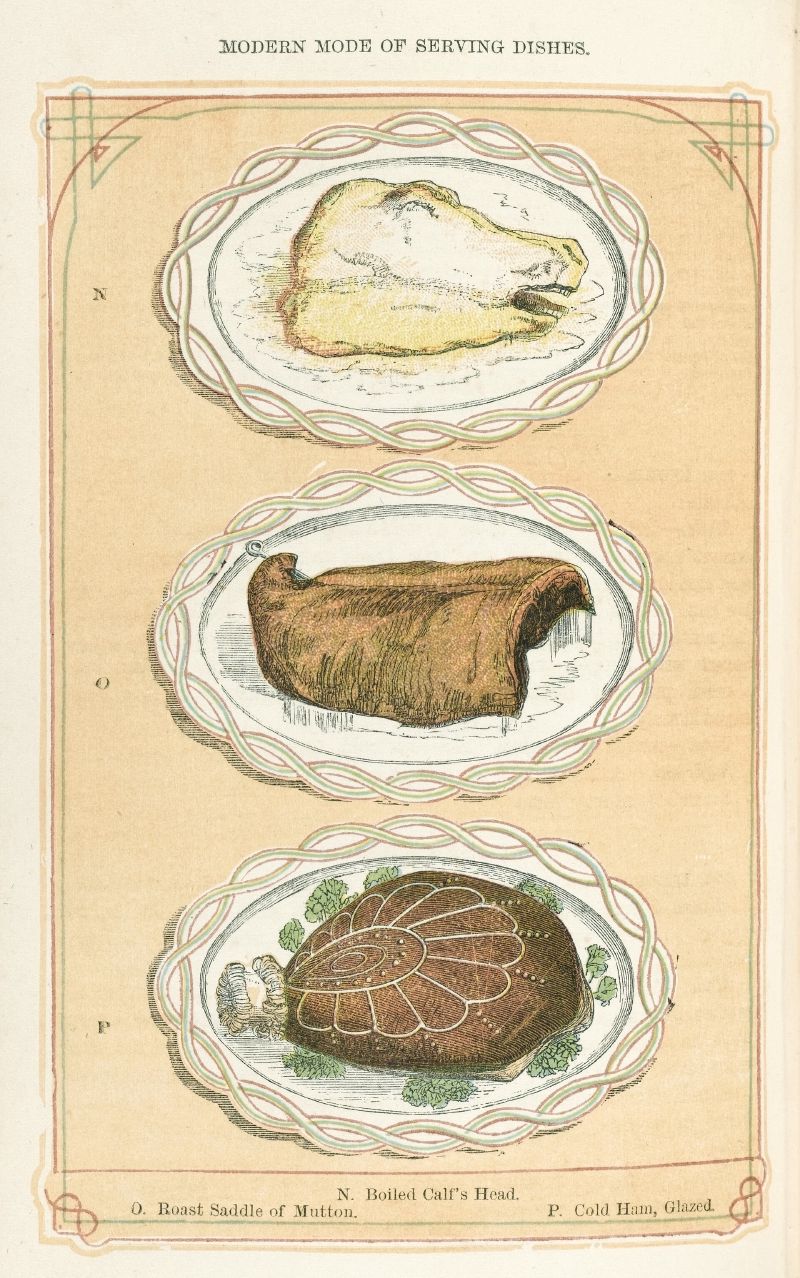
Service à la russe arrived during the 19th century and changed the rhythm of the meal. Dishes now came out one after another, and servants served each guest in their seat. Beeton described the method plainly. The food was cut up on a sideboard and handed round, and each dish counted as a course. Her footman’s chapter gives the running order as soup, fish, entrées, meat, game and sweets.
more
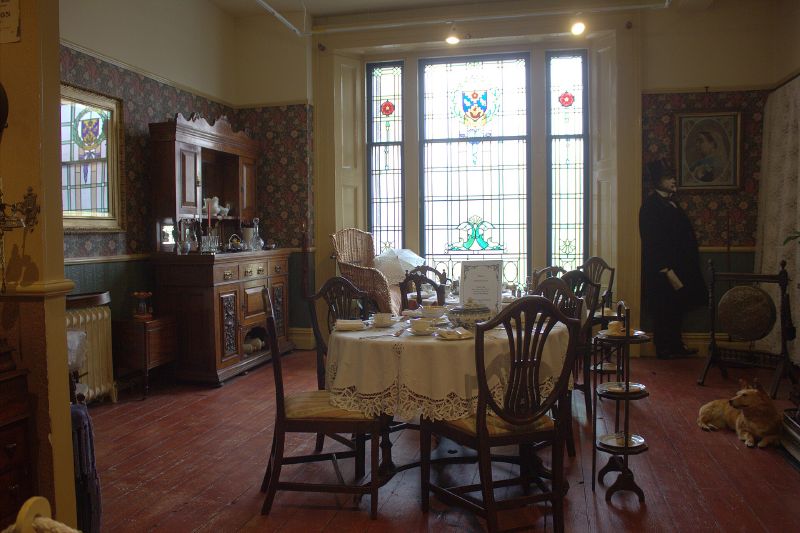
The table itself changed. Instead of food, it carried flowers in ornamental pots down the middle, some of the dessert, and a menu beside each guest. At the Rosenberg Library’s reconstruction, each setting held a name card, a dinner plate and a rolled napkin, with several wine glasses, a water goblet, a salt cellar and a nut dish. On the right, working inwards, lay the oyster fork, soup spoon and three knives for fish, meat and fruit, with their forks on the left. The dessert spoon came out only with the dessert. Some diners faced a 24-piece setting.
Beeton thought there was perhaps no more enjoyable way to serve a dinner, where a household could manage it. Few could. A Russian dinner needed many servants to carve and to help the guests, she warned, and more plates, knives, forks and spoons than most homes owned. She called it elegant and even economical, since fewer dishes were needed. She also warned that unless the servants were very active and intelligent, “many blunders” were likely.
The footman’s evening, as Beeton set it out, began with laying the cloth without a wrinkle, a job for two people. He put five or six plates out for each guest and a glass for every wine to be served. He announced dinner in white cotton gloves and stood behind his master’s chair. When he opened champagne, she told him it needed no pop.
The rules for guests
The etiquette of the dinner was as fixed as the cutlery. Debrett’s has gathered the advice of Routledge’s Manual of Etiquette from 1860 and Samuel Wells’s How to Behave from 1865. Guests answered invitations at once and arrived “exactly punctual”. Some manuals held that staying away, with an apology, was better than arriving late.
The procession to the table followed rank. The host paired each gentleman with a lady, and the couples walked down to the dining room in order of precedence. In distinguished company, the host was told to check Debrett or Burke before placing anyone. The lady of the house took the head of the table and the master the foot. Married couples sat apart, unless they were newly wed.
Once seated, guests took off their gloves and put their napkins on their knees. A manual declared that every well-ordered dinner began with soup, summer or winter. Asking for more soup or fish was discouraged, because it held up the main course for everyone. Unlike a modern table, nobody waited for the others before starting to eat. The manuals called waiting old-fashioned and “ill-bred”.
Wine had its own rules. Servants filled the glasses, and a lady could refuse wine but never ask for it, so she depended on the gentleman beside her. One manual expected married women used to society to take five or six glasses at dinner. At the end, the ladies withdrew to the drawing room and the men stayed with cigars and cognac. The Rosenberg Library adds that guests rinsed their hands in bowls of lemon water before the party broke up.
The hostess carried the heaviest load. The manuals told her to be calm, never to scold a servant aloud, and to keep small children out of sight. One wanted her to watch her old china break “without a sigh”.
The room mattered as much as the guests. An 1875 article in Cassell’s Family Magazine, quoted by Debrett’s, wanted dining-room walls in crimson, oak or green, a Turkey carpet, and heavy curtains. It recommended mahogany furniture and a four-legged table, and condemned the Pembroke table because its legs were always being kicked. The sideboard was the room’s “chief glory”, but a plain one beat a showy fake.
Two women who wrote the kitchen down
Eliza Acton came to cookery from poetry. She grew up in a house beside the brewery where her father worked, ran girls’ boarding schools, and published a collection called Poems in 1826. Brighton & Hove Museums records that a publisher told her there were enough poetry books already and suggested she write about food. She spent years testing recipes, and the resulting Modern Cookery appeared from Longmans in 1845.
more
The book did something new. It was the first to list ingredients and quantities, with cooking times, apart from the method. It was aimed at the home cook rather than the professional chef, and Acton dedicated it to “the Young Housekeepers of England”. Woodcuts showed tools and ingredients, so a reader could tell a John Dory from a turbot at the fishmonger. Mental Floss credits the book with the first English use of spaghetti in print, spelled “sparghetti” and glossed as “Naples vermicelli”. By 1853 it had gone through 13 editions.
Acton’s own preface, in the 1882 edition, takes aim at copyists. She explains that she labelled many dishes “Author’s Receipt” in self-defence. Other writers, she says, had lifted large parts of her book without a word of credit. She also wrote that good cookery was “the best and truest economy”. Her original aim, quoted from the first edition, was a book the “totally inexperienced” could follow.
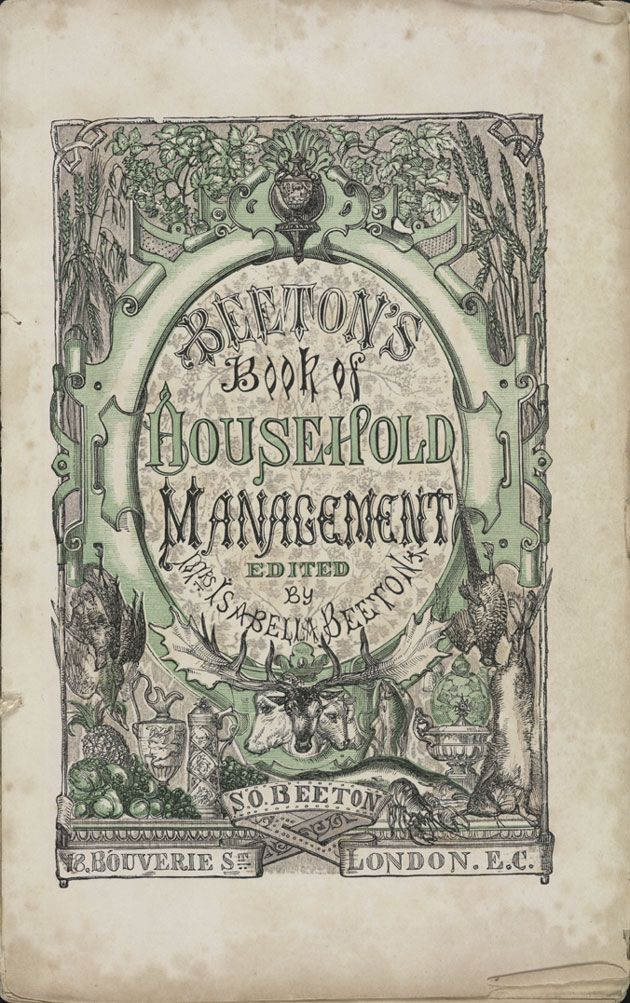
Isabella Beeton was born in London on 12 March 1836, the daughter of a linen merchant. She married the publisher Samuel Beeton in 1856 and began writing a cookery column in his magazine. The couple published her book in monthly parts from 1859, and it sold 60,000 copies in its first year. She was 25 when it came out.
Her preface states her motive without softening it. She had seen “discomfort and suffering” brought on by household mismanagement. Men were now so well fed at their clubs and taverns, she argued, that a wife had to master cookery to compete. The BBC reads that preface as a statement of the Victorian doctrine of separate spheres, with the woman at home and the man in public. Yet Beeton herself commuted to London with her husband each day, and edited his magazine for two years.
Her method was a set of fixed headings. Each recipe gave its ingredients, its “mode”, its cost, the number of people it would feed, and the season it suited. She credited many recipes to readers of the Englishwoman’s Domestic Magazine. Her plain family dinners show how a middle-class week ran on leftovers. Sunday’s boiled turbot came back on Monday warmed in oyster sauce, beside the cold pork from the Sunday roast. Wednesday’s roast ribs of beef gave their bones to Thursday’s vegetable soup. She did not credit Acton. Mental Floss and Brighton & Hove Museums both say Beeton copied many of Acton’s recipes without acknowledgement. Her book overtook Acton’s in sales during the 1860s.
Acton died in 1859, aged 59. Beeton died in 1864, aged 28, after the birth of her third child, most likely of puerperal fever.
Who did the cooking, and on what
In a wealthy house, the cooking belonged to the servants, and Beeton ranked them. Her table of yearly wages puts a woman cook at £11 to £30, a kitchen-maid at £9 to £14, and a scullery-maid at £5 to £9. All those servants, she wrote, would work for a wealthy nobleman. A family on about £1,000 a year might keep a cook, two housemaids, a nursemaid and a manservant. On £150 to £200 a year, a family kept one maid-of-all-work.
A male cook, by Beeton’s account, worked only for princes, noblemen, the very rich, and large hotels and clubs. Most households had a woman at the stove. Beeton wanted her up at six in summer and seven in winter, because an hour lost in the morning would keep her “toiling” all day. At dinner the cook took the fish, soups and poultry, the kitchen-maid the vegetables, sauces and gravies, and the scullery-maid waited on the cook.
The maid-of-all-work had the hardest place. Beeton called her perhaps the only servant “deserving of commiseration”, a girl who might start work at thirteen. Her day began with brushing the kitchen range, lighting the fire, clearing the ashes and polishing the bright metal. She cooked, served, cleared and cleaned, and could not stay in the dining room through dinner because she had the pudding to dish up.
The range at the centre
The closed iron range was the first big change in British cooking since the open fire, according to the Holst Victorian House in Cheltenham. Beeton called the kitchen “the great laboratory of every household”. The museum adds that she claims closed ranges were first used mainly in Devon, where the hot plate scalded milk for clotted cream. Ranges heated water in a boiler as well as cooking, and they stopped soot falling down the chimney into the food. A two-oven model cost between £17 and £19.
Beeton’s own catalogue was cheaper at the bottom end. A plain open range with an oven and boiler started at £3 10s, and she praised the “Improved Leamington Kitchener” for cooking everything on one fire. Acton watched another technology arrive. She noted that steam cooking was spreading through large kitchens, some piping steam from the boiler to the pans.
All of it had to be cleaned. At the Holst house, a maid scattered damp tea leaves to keep the dust down, raked out the ashes and sifted them for reusable cinders. She blackleaded the front every day and washed the oven with vinegar and water. The museum’s own range came from a Cheltenham house and went in when the museum opened in 1974. It still bakes cakes and puddings.
The servant at the range was not always trusted to plan the meal. The etiquette manuals told a hostess never to depend on her cook’s taste, and to order dinner from a good restaurant if the cook fell short.
What the poor ate instead
Most Victorians never saw a menu card. The historian Anthony Wohl, writing on the Victorian Web, describes the working-class diet as uncertain in supply and unhealthy in effect. Few poor families owned an oven, so they cooked in a pan over an open fire, bought hot food, or ate cold. Social workers at the turn of the century found homes with a single pot, which first had to be cleaned of the baby’s bath water. In 1904 an official inquiry was still worried by how few poor families could cook at home.
Country cooking was plain. Esther Copley’s Cottage Cookery of 1849 offered potato pie, stirabout, stewed ox-cheek and mutton chitterlings. Town families bought tripe, “slink” from calves born too early, and “broxy” from diseased sheep. A sheep’s head cost 3d, and American bacon 4d to 6d a pound, which was still too dear for a casual labourer to buy often. In Macclesfield, 23 per cent of silk workers had never tasted meat, and in Coventry 17 per cent of labourers.
The two cookbook writers both saw the problem. Beeton told mistresses to visit the poor, and to teach them cookery and cleanliness “in a pleasant and unobtrusive manner”. Acton opened her 1882 preface on waste. She wrote that ignorance and mismanagement wasted good food daily while many people in England struggled to earn enough bread.
Beeton also printed her own answer. Her recipe 165, a “Useful Soup for Benevolent Purposes”, is built on an ox-cheek and beef trimmings, made by the ten gallons. She made 8 or 9 gallons of it each week in the winter of 1858 for about a dozen village families. It cost her 1½d a quart. The recipe sits in her chapter on soups, and the tea method used below is paragraph 1814, in her chapter on beverages. Acton’s book carries a cheap plum pudding from a reader, made with mashed potato and carrot. The reader says it fed sixteen for no more than half a crown.
Things improved late. Between 1877 and 1889, the cost of a weekly basket of butter, bread, tea, milk and meat fell by about 30 per cent. Wohl credits refrigerated ships, cheap margarine and falling prices for the first real gain in the working diet.
The Christmas dinner and other things we kept
The Victorian dinner that lasted best was the one held once a year. At the start of the 19th century Christmas was hardly celebrated, and by its end it was the year’s biggest festival, according to the BBC. Its dinner took shape in the same decades. Mince pies began the period filled with meat, a Tudor habit, and meatless mixes caught on among the well-off. Acton’s own mince pies, Brighton & Hove Museums notes, still held ox tongue and boiled lemons.
Turkey came in at the top of the table. Wealthy families added it to the older beef and goose, and its size suited a middle-class gathering, so it led by the early 20th century. Beeton wrote that a middle-class Christmas dinner would “scarcely” count without one. Most Victorians were not wealthy, and English Heritage notes that many ate goose, some paying into a goose club through the year.
The royal family ate on another scale. English Heritage lists mince pies, soups, turkey and chipolatas, with plum pudding after, and sometimes beef or boar’s head. Acton’s book was the first to publish a recipe for Christmas pudding, according to Brighton & Hove Museums. Her own “Author’s Christmas Pudding”, on page 417 of the 1882 edition, is a light, small pudding of suet, dried fruit, apple and brandy, boiled in a cloth for three and a half hours. Beeton’s version adds a sprig of holly and a glass of brandy set alight as the pudding reaches the table.
Other habits came from the same years. Henry Cole commissioned a Christmas card in 1843 showing a group around a dinner table, at a shilling a copy. By 1880 the industry printed 11.5 million cards a year. The confectioner Tom Smith invented the cracker in 1848 as a way to sell sweets. The BBC credits Charles Dickens’s A Christmas Carol with spreading the festival’s customs.
The cookbook kept its Victorian shape too. Mental Floss notes that measured ingredients, cooking times and a separate ingredients list are now the norm. Delia Smith called Acton “the best writer of recipes in the English language”. Beeton’s name became shorthand: by 1891, the Oxford English Dictionary records “Mrs Beeton” as a term for any authority on cooking. Her book is still in print.
Acton’s grave in Hampstead fell into disrepair. In 2022 the writer Annabel Abbs began a campaign to fund its restoration. Her book, meanwhile, still shows its author’s mark beside the recipes she defended, page after page.
Starter guide
These works, all named by the trusted sources behind this piece, are a place to start reading and watching.
- Modern Cookery for Private Families (Eliza Acton, 1845). Acton wrote it for the “totally inexperienced” cook, and her 1882 preface defends it against copyists.
- Mrs Beeton’s Book of Household Management (Isabella Beeton, 1861). The BBC calls it one of the most famous books of the Victorian age, and the best example of its advice literature.
- A Christmas Carol (Charles Dickens). The BBC credits it with helping to spread the traditions of the Victorian Christmas.
- The first Christmas card (Henry Cole, 1843). The BBC notes that Cole’s card showed a group of people around a dinner table.
- The Physiology of Taste (Jean Anthelme Brillat-Savarin). Beeton calls it “clever and amusing” and quotes it on how many oysters Parisian diners ate.
- The Englishwoman’s Domestic Magazine (Samuel Beeton). Beeton credits its readers with many of the recipes in her book.
- An Encyclopaedia of Domestic Economy (Thomas Webster). Acton sends readers to Webster’s “excellent work” to understand cooking with steam.
- Cassell’s Family Magazine (Cassell, 1875). Debrett’s quotes its advice on the ideal Victorian dining room.