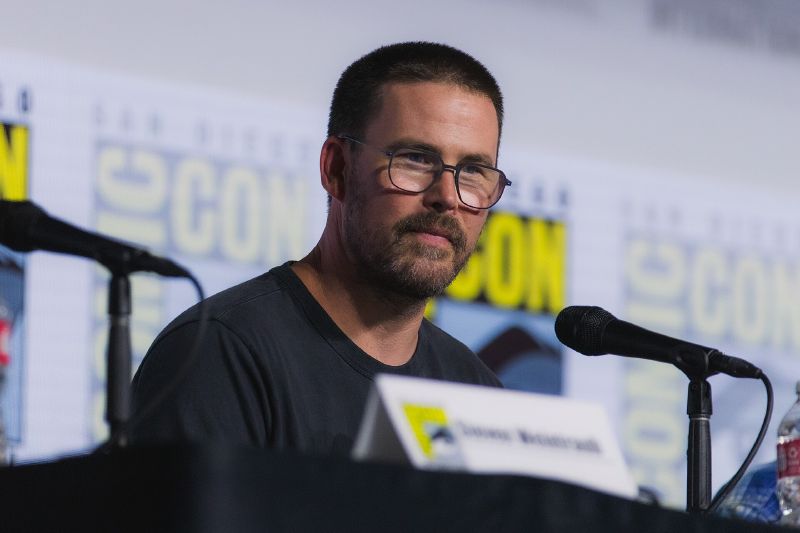
On a Monday morning in 2023, Zach Cregger and his producer Roy Lee sent a horror script to every major studio in Hollywood at the same instant. They used a locked-down reading app called Embershot, which let a studio read the script only inside the app, and set the same 8 a.m. start time for everyone. By 9:30, Warner Bros co-chief Mike De Luca was on the phone. “I have to make this movie with you,” he told Cregger. The deal was done that afternoon.
more
New Line and Warner Bros paid $38 million for that script, a figure that covered a $10 million fee for Cregger to write, direct and produce it. The Hollywood Reporter later recorded “Weapons” as the number-one movie of August 2025, with a gross of $264 million.
The size of the bet made sense only against what came before it. Cregger’s directorial debut, “Barbarian,” had turned a rental-home nightmare into a word-of-mouth sensation in 2022, taking $40 million domestically from a budget under $5 million. Both films built their horror around a real social fear. “Barbarian” drew on sexual assault and “Weapons” on the aftermath of a school shooting, and neither offered an easy reading of what the story meant.
Where the story came from
Cregger wrote the script while grieving. His dear friend and longtime collaborator from the sketch troupe The Whitest Kids U’Know, Trevor Moore, died in an accident in August 2021. Cregger was still in post-production on his 2022 debut, “Barbarian,” and the new script became what he later called an emotional reaction to the loss rather than an attempt to write a follow-up hit.
He told The Hollywood Reporter that he discovered the plot without knowing where it was going. He compares the process to how Stephen King has described finding a novel, like a palaeontologist unearthing a full skeleton one bone at a time. What he found was blunt. At 2:17 a.m. on a school night, seventeen children from the same third-grade class leave their beds and run into the dark. Only one boy, Alex, stays behind. Cregger has said the premise came to him line by line, with no fixed idea of where the missing children had gone.
What nearly stopped it
Selling the script was the easy part. Cregger says roughly two years passed between the sale and the start of filming, and partway through that gap, the strike cost him his entire cast over scheduling issues. Cregger had to recast the film from the ground up. “That was just a goddamn nightmare,” he told The Hollywood Reporter.
Casting the recast film was its own puzzle. Cregger has described building the ensemble from several near-equal lead roles rather than around one star. The multi-chapter script asked every actor to carry a chapter of their own, while still fitting the tone of the whole.
The script itself kept changing after the sale, in ways meant to sharpen what the story asked of its audience. A tray of assorted junk food became a tray of exactly seven hot dogs, a private tribute to Moore. Alex, the boy who stays behind, was rewritten at a friend’s suggestion. He originally received Valentine’s Day cards from his vanished classmates. The actor and filmmaker Bill Hader, a friend of Cregger’s, proposed having Alex steal a keepsake from each child instead. The change gave the boy a reason to feel complicit, and a clearer motive for staying silent.
Why the trade press expected less
Cregger had downplayed the stakes even before release, describing the film to Empire as “fun,” “funny,” “scary” and “inviting,” rather than the “grim, morose slog” its premise might suggest. Screen’s advance review, published three days before the film opened, praised its craft but predicted it “might not be killer at the box office.” It forecast merely “solid” theatrical returns, given a summer with no direct genre competition. Pre-release tracking put the opening weekend at $25 million to $30 million.
Warner Bros helped keep expectations contained on purpose. Rival studios told The Hollywood Reporter that the marketing campaign was “nothing short of brilliant,” specifically because it withheld the film’s twist instead of spoiling it to sell tickets. Audiences and critics both arrived at a plot they could not have half-guessed from a trailer.
How the opening beat the tracking
“Weapons” opened at $42.5 million domestically, more than $10 million ahead of expectations, and added $27.5 million internationally for a $70 million global debut. Horror rarely travels well, but the film found an audience in markets that usually resist the genre, opening well across Europe and Latin America rather than on domestic ticket sales alone.
Two figures explain why distributors took notice. The film scored 96% among critics on Rotten Tomatoes and an A- CinemaScore, a grade horror films almost never receive. The Hollywood Reporter named Jordan Peele’s “Get Out” as one exception. It also over-performed on premium screens: Imax alone supplied $6.2 million of the opening weekend, about 15% of the domestic total, from just 410 screens. The debut made “Weapons” Warner Bros.’s seventh number-one opening of the year and its sixth release in a row to clear $40 million domestically, both studio records at the time. Warner Bros Discovery’s chief executive, David Zaslav, told an earnings call the same week that the studio planned to release 12 to 14 theatrical titles a year.
Why it kept climbing
A horror film’s real test comes after the opening crowd thins out. “Weapons” fell 43% domestically in its second weekend and 33% internationally, for a global weekend total of $43.4 million that still topped the worldwide chart. Screen called the hold “strong… but not a stunning one” for the genre. By then the film had taken $88.5 million domestically and $148.8 million worldwide, with the UK and Ireland leading overseas markets at $8.3 million cumulative, ahead of Mexico at $5.5 million and France and Spain at $4.0 million apiece.
Variety’s box-office desk was blunter about what that hold meant. It called the drop an impressive one for a genre that usually collapses fast once opening weekend ends. The film had become Warner Bros.’s fifth consecutive hit of the year, following “A Minecraft Movie,” “Sinners,” “Final Destination Bloodlines” and “Superman.” That run followed a rockier start to 2025, which had included the flops “Mickey 17” and “The Alto Knights.” Empire had judged the $70 million opening weekend alone enough to put the film “in great stead financially.” What followed went well past that early verdict: nearly four times the opening weekend’s total by the time The Hollywood Reporter tallied the finished run.
What critics found once they saw it
Critics who saw an advance cut were not simply relieved that the secrecy had paid off. BFI’s review compared the six-chapter structure to Stephen King’s “Needful Things” and Robert Altman’s “Short Cuts.” It likened the late reveal to a stage mystery like “The Mousetrap,” the kind whose ending audiences are asked not to spoil for friends. Variety’s review found a closer echo in Denis Villeneuve’s “Prisoners,” both films following parents whose children vanish from a town that had always felt safe. Empire called it “a significant step up from Barbarian,” praising a script disciplined enough to hold grief, comedy and violence together without one tone swallowing the rest.
Cregger has said the six-chapter structure came from a rule he set for himself: once the story moved on to a new character, he would never return to the one before. He has cited Paul Thomas Anderson’s “Magnolia” as a reference point for scale and tone, even though that film breaks the very rule Cregger imposed on himself. Holding to the stricter version, he told Variety, made the film better, even when it cost him scenes he liked.
Not every reviewer left satisfied. Dread Central called the film an instant horror classic, but noted that its two queer characters, one of whom is also its only significant non-white character, suffer some of the most prolonged and violent deaths in the story. The reviewer wrote that the choice, likely unintentional, still stung.
Amy Madigan plays Aunt Gladys, an ailing, cane-carrying witch whose late arrival tips the story from thriller into something stranger. The Guardian later reported that the role won Madigan the Academy Award for best supporting actress. Wikipedia’s account of the film’s awards run adds that she also won the Screen Actors Guild award and picked up a Golden Globe nomination in the same category.
What the payoff bought him
The bidding war and the box-office run gave Cregger the standing to choose his next project freely, and he has used it in an unexpected direction. His next film is not another original script born from grief. It is an eighth entry in the Resident Evil franchise, adapted from the Japanese survival-horror game series that began on PlayStation in 1996. The earlier Resident Evil films, built around Milla Jovovich, were commercially reliable but never a critical favourite. The best-reviewed instalment in the series holds a 39% score on Rotten Tomatoes.
Cregger is candid that he has never seen one of those films, and that he was always a fan of the games rather than the films. His approach, he says, is to recreate what a 90-minute session on the console feels like for a cinema audience. A single medical courier moves through a zombie outbreak near Raccoon City, switching environment the way a player switches levels, from snowy road to farmhouse to sewage tunnel. “The IP is not the point,” he says of taking on an established franchise. “The point is the story,” he adds, insisting the film is an original work despite the name on the poster.