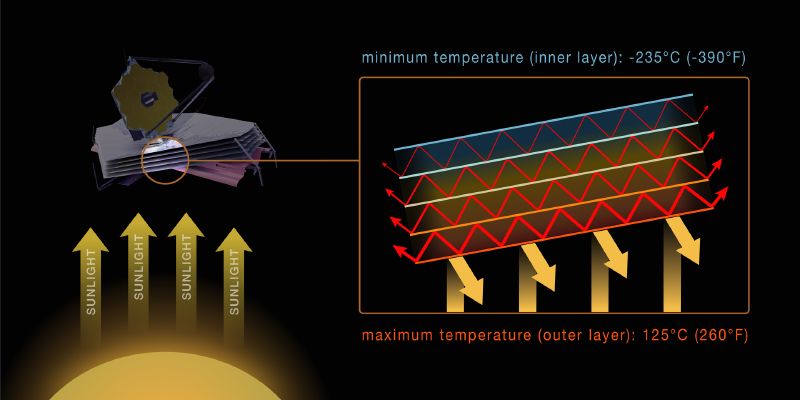
The James Webb Space Telescope stays cold because its sunshield reflects the Sun’s heat back into space. The shield has five layers of Kapton film, coated with aluminium and silicon. That keeps the telescope at minus 233C, which protects its infrared observations.
more
The shield is huge. It measures about 21 by 14 metres, roughly the area of a tennis court.
Why the telescope has to be cold
Webb looks at the universe in infrared light. Any heat from the telescope itself would swamp the faint signals from distant objects, according to GOV.UK. The UK government page says the telescope must sit within a few tens of degrees of absolute zero.
Two temperatures matter. The mid-infrared instrument, MIRI, runs at 7 kelvin, and the other instruments run at 40 kelvin.
What each side of the shield does
The two faces have different jobs. The side facing the Sun blocks sunlight. The side facing away cuts light scattering and heat.
About half a metre separates each one, and the whole stack stands about 2 metres tall, though that varies across the shield.
How five layers opened in space
Webb launched on 2021-12-25, and the shield began to deploy three days later. Five days after launch, the covers pulled back and exposed the layers. Booms attached to the membranes then pulled the shield out at the six-day mark.
Tensioning came next. Six motors around the shield’s edge pulled on cables to draw each layer taut. Engineers began on 2022-01-03 and had planned only one layer that day. The first layer went so well that they carried on and finished three, in a little over five and a half hours.
NASA sunshield manager James Cooper called tensioning “the hardest part to test on the ground”. On 2022-01-04, controllers in Baltimore confirmed the fifth layer was taut shortly before noon EST.
What could have gone wrong
A total of 107 pins held the material to the telescope’s structure. If a single pin had stayed fixed, that layer would have snagged and the team would have needed a fallback plan.
Webb has 344 single points of failure, which are components that must work for the mission to succeed. NASA project manager Bill Ochs said that finishing the sunshield would retire 70 to 75 percent of them.