No single body sets the price of a blue plaque, or the rules for who gets one. England’s best known scheme, run by English Heritage, has put the cost of making and fitting one at just under £1,000. A council running its own scheme instead bills that cost straight to whoever made the nomination.
more
No national body governs plaques, so the criteria vary widely from place to place. Local councils, charities and history organisations police the plaques in their own areas.
Who runs the scheme most people picture
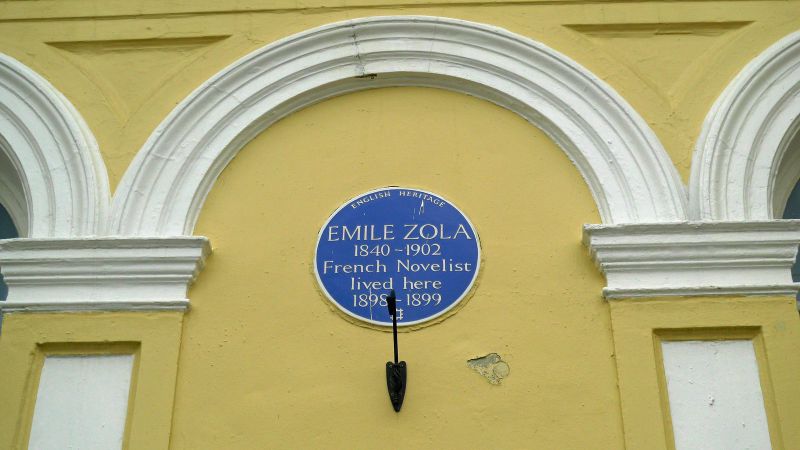
The round blue disc most people picture belongs to English Heritage, which has run it since 1986. The scheme itself is older. The Society of Arts began it in 1866. Its first two plaques went up the following year, one to Lord Byron, since lost to demolition, and one to Napoleon III. Napoleon’s plaque still survives as the oldest one standing. Four bodies have run the scheme in turn, and more than 1,000 official plaques have gone up across London.
A candidate has to have been dead for at least 20 years. They also need to have lived at the address for a long stretch, or during a defining period of their life, such as when they wrote their best known work.
Alexandra Carson, then English Heritage’s national PR executive, explained the reasoning. The rule gives the scheme “the benefit of hindsight.” The building has to look much as it did in the subject’s day too. As Carson put it, the point is “bringing history to life.”
Why so few nominations succeed
English Heritage takes only public nominations, and it turns away most of them. It receives about 80 valid suggestions a year and puts up around 12 plaques. A panel of a dozen historians and specialists meets three times a year to draw up a shortlist. “It’s pretty stringent,” said Howard Spencer, the scheme’s senior historian.
Even a successful nomination waits on more than the panel’s yes. Every plaque is made by Cornwall-based ceramicists Frank and Sue Ashworth, who have made plaques since 1984 and now work with their son, Justin. Each letter is made by hand. Each disc is fired twice in a kiln reaching 1,200C, a process that takes roughly three and a half weeks from clay to finished plaque.
What a smaller scheme charges instead
Dudley Council runs its own commemorative plaque scheme, open to anyone willing to make a case. The nominator has to gather evidence of the candidate’s public recognition, fund any surveys that involves, and secure the building owner’s written consent before the council will even process the paperwork. Once approved, the nominator pays to design, produce and install the plaque, with the installation cost assessed for each building individually. Dudley says the whole process runs to about six months.
Dudley’s eligibility rules echo English Heritage’s without matching them. A candidate needs to have been dead for 15 years, or have passed the centenary of their birth, whichever comes sooner, five years short of the London rule. The nomination also needs backing from a local history society, and Dudley’s own director has to approve it before any design work begins.
When the price of ambition is public money
The English Heritage figure of roughly £1,000 a plaque comes from 2013, when the organisation’s public funding was cut from £130 million to £92 million and it warned the scheme might not survive. It said it would honour plaques already promised but stop taking new nominations. The scheme carried on. By 2021, only 14% of its plaques celebrated women, and English Heritage had launched a campaign in 2016 to draw more nominations for women.
A rejected candidate is not necessarily rejected everywhere. Since there is no central authority, a name English Heritage turns down can still find a home elsewhere. A local council, a civic society, or a themed trust may run its own list under its own rules.
Where the next plaque might come from
A trial between 1998 and 2005 put up 34 plaques outside London, but it was discontinued. The 2023 Levelling-up and Regeneration Act then extended the scheme to the whole of England, though plaques outside the capital now go up under Historic England rather than English Heritage.