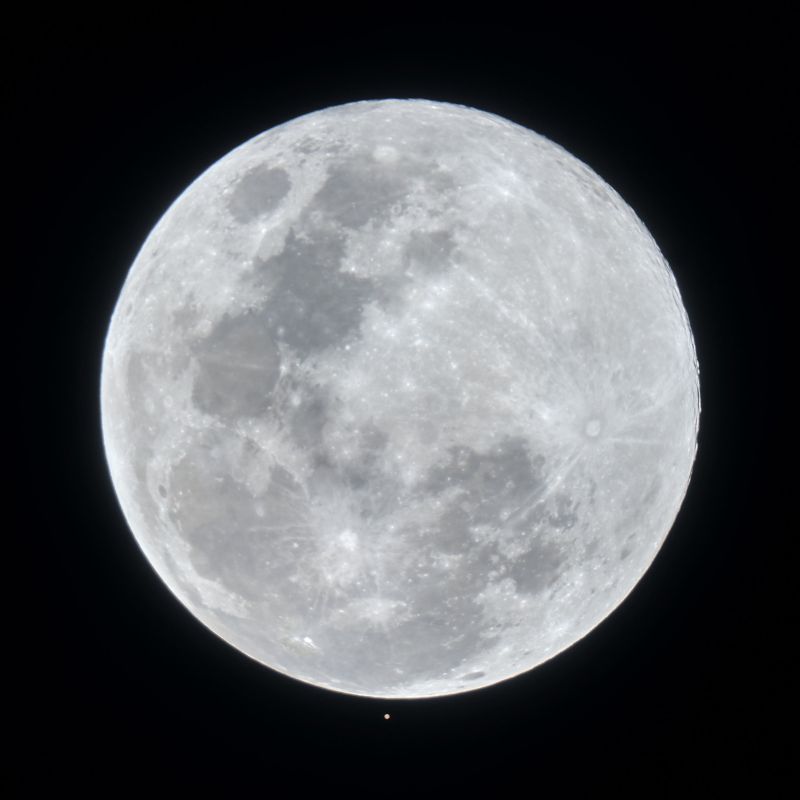
On 18 February 2026, Mercury slipped behind the Moon for skywatchers south of Sallisaw, Oklahoma, and stayed hidden for about three minutes. Astronomers call this a lunar occultation: the Moon passing directly in front of another body and blocking it from view, the way it blocks the Sun during a solar eclipse. A star occulted this way gives no warning. The Moon has a very thin atmosphere and a star’s disc is tiny, so the star disappears at once rather than dimming first.
more
That happens because of relative speed. The Moon moves across the sky at about 0.55 arcseconds a second, while even the widest star, seen from Earth, spans no more than 0.057 arcseconds. Close that gap and a star can vanish behind the Moon’s edge in a tenth of a second or less.
Why does a graze show more than a straight hit?
Most occultations cross the Moon’s disc cleanly, but some only graze its edge. During a graze, the object passes behind the Moon’s mountains and valleys rather than its middle, so it flickers in and out of view instead of vanishing once. Watching the same graze from several points on the ground can settle a real mystery. The International Occultation Timing Association says a star that disappears and reappears in stages during a graze indicates a previously unknown double star, too close together for a telescope alone to split.
Occultation timing has already rewritten what astronomers knew about a planet. In 1977, scientists flying aboard NASA’s Kuiper Airborne Observatory watched Uranus cross in front of a star and saw the starlight flicker as the planet’s disc arrived, then flicker again as it passed. NASA said that flicker is how the planet’s rings were found.
How to watch one yourself
The International Occultation Timing Association keeps details of upcoming occultations, including exact locations and timings, and most can be followed with nothing more than a small telescope. A graze is the exception. Its visible path runs only a few miles wide, so watching one usually means travelling to stand inside that strip.
When the Moon hides two planets at once
Rarer still is a night when the Moon covers two planets together. That last happened in 1998, when it passed in front of both Venus and Jupiter. The next double occultation is due in 2056, when the Moon will hide Mercury and Mars on the same pass.