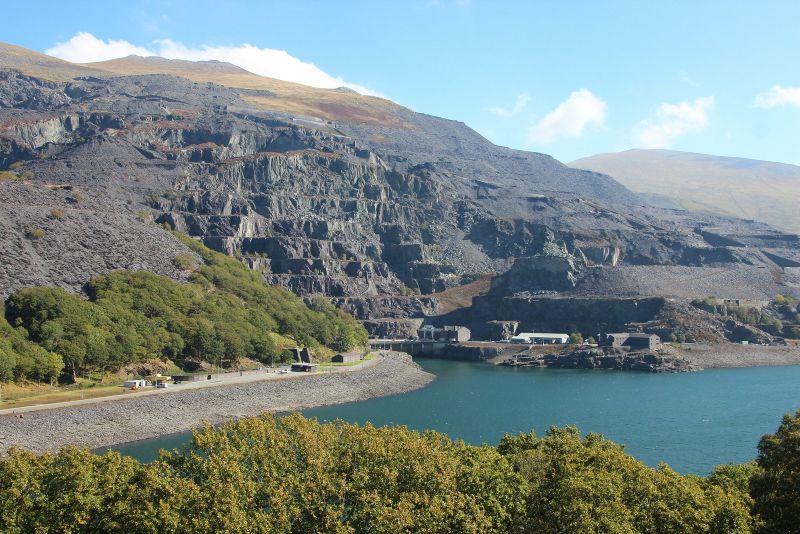
A pumped-hydro plant stores energy as height. It moves water between two reservoirs set at different elevations, pushing it uphill when power is spare and letting it run back down when power is wanted. The water is only the carrier. What the plant banks is the drop.
more
That trick matters because a grid cannot keep electricity sitting in a wire for later. Duke Energy, which runs two of these plants in the Carolinas, puts it plainly: electricity cannot be stored, but the potential to make it can.
How the power comes back
Giving the power back works like any hydroelectric dam. The US Energy Information Administration describes the basic chain: water runs down a pipe called a penstock, pushes the blades of a turbine, and the turbine spins a generator.
The US Department of Energy explains what a pumped-storage plant adds to that chain. When the grid calls for power, water leaves the upper reservoir, turns the turbines, and settles in the lower reservoir. It waits there until demand falls. Then the turbines spin backward and pump the water back up, so the same water can generate again.
A conventional dam lets river water through once. A pumped-storage plant, in the Department of Energy’s words, can use the same water over and over.
What sets how much it can hold
The EIA names two things that decide how much energy moving water carries: how much of it flows, and how far it falls. Engineers call that fall the head. More flow and more head mean more electricity.
For a pumped-storage plant, that turns into reservoir size and the height gap between them. The International Hydropower Association gives a worked example. Two reservoirs about the size of two Olympic swimming pools, 500 metres apart in height, could hold up to 3.5 megawatt hours. That is why sites need a big body of water close to, but far above, a second one.
The Department of Energy puts the US fleet at about 22 gigawatts of generating capacity and 550 gigawatt hours of storage, with plants in every region of the country. By the department’s count, 88% of the country’s utility-scale storage capacity is pumped hydro.
The price of the round trip
Every conversion loses something. After pumping losses and evaporation from the open water, a plant recovers roughly 70% to 80% of the energy it spent. So it uses more electricity than it returns. Wikipedia’s summary notes that this makes a plant a net consumer of energy overall, unless rain or a river tops up the upper lake.
It still pays, because it buys power when it is cheap and sells it at peak demand, when prices are highest. Duke Energy runs its plants mainly for the hottest weeks of summer and the coldest of winter, when customers draw the most. Its Jocassee station, finished in 1975, and Bad Creek, running commercially since 1991, both work this way as peaking plants.
Why grids want more of it
Wind and solar output rises and falls with the weather. The National Hydropower Association says pumped storage soaks up surplus generation and stands ready when wind and sun drop off. The same association notes that newer adjustable-speed machines can ramp up and down quickly and regulate frequency in both pumping and generating modes. The Department of Energy calls it the dominant commercial technology for long-duration storage.
Worldwide, the International Hydropower Association counts nearly 200 gigawatts installed, over 94% of long-duration storage capacity. In the US, the National Hydropower Association’s 2024 report lists 67 planned projects across 21 states.
The next question is where to put them. A plant with no river at all can work, and atlases from the Australian National University list 600,000 such off-river sites.