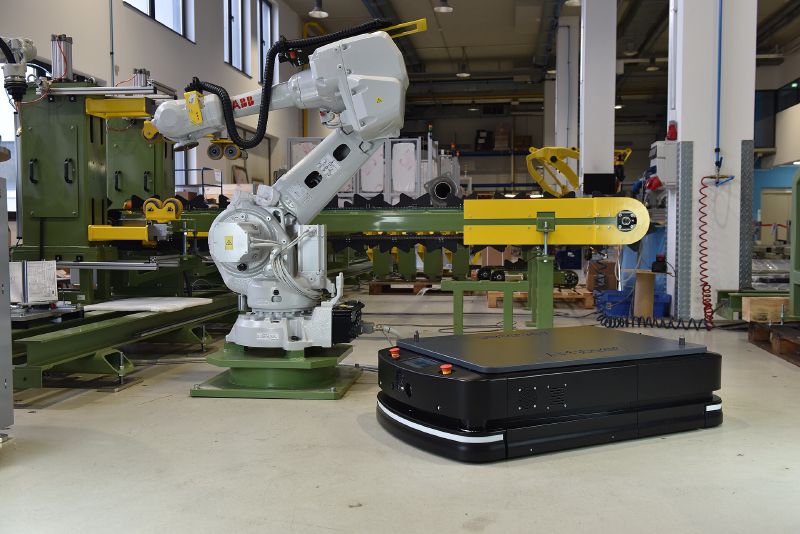
A warehouse robot spends its shift carrying things, not choosing what happens to them. It moves a pallet, a tote, or a whole shelving unit from one point on the floor to another, and a routing system well above its own sensors decides where that point should be. Most of the fleet never touches a single item on its own. That part still belongs to a person, or to the rare robot built for exactly that job.
more
Why a robot rarely touches what it carries
At an Amazon sorting centre outside Denver, a squat wheeled robot called a drive unit takes a package a person has already scanned and loaded onto its back. It then sets off across a 125,000-square-foot floor toward one of more than 300 chutes, each tied to a group of zip codes. The robot doesn’t plan its own way there. A system in the cloud coordinates the route of every drive on the floor. At the chute, the robot’s own conveyor belt slides the package off and down to the floor below, where it’s loaded onto a lorry. Sensors sit at both ends of that belt, so a package sliding off the side triggers the belt to pull it back on.
That distinction between carrying and choosing runs through the industry’s own language for the two halves of the job. Picking is a robot or a person taking one item from a jumbled bin and placing it somewhere an order can use it. Stowing is the same job run in reverse, getting items into the bins in the first place. A drive unit does neither. It carries the shelf the picking and stowing happen at.
The traffic problem underneath the floor
Put hundreds of drive units on one floor and the harder engineering problem isn’t the robot. It’s the routing. Amazon’s coordination system works like an air traffic controller. It tracks every robot’s path so two drives don’t collide at a junction, and it decides when a robot should peel off to recharge rather than take its next job. Some zip codes get more than one chute, so the system also weighs which one a given robot should reach to keep traffic even across the floor. Ryan Clarke, a senior manager on Amazon’s robotics technology team, sums up the choreography as “a very large sudoku puzzle,” aimed at spreading drops evenly across every row and column of chutes.
Speed turns out not to be the answer. Amazon ran simulations to find the drives’ optimal speed and acceleration, and pushing both higher had the reverse effect. Clarke compares it to having a Ferrari in downtown San Francisco: all the speed in the world doesn’t help when the next move is a stop.
Bringing the shelf to the person, not the person to the shelf
At Decathlon’s warehouse in Northampton, England, the same logic runs in the other direction. Rather than a robot delivering a finished order, a fleet of 100 robots brings stock to a worker at a picking station. Before the warehouse was largely automated in 2023, staff walked more than six miles a day picking items by hand. Smaller motorised robots reach almost 9mph and climb shelves over 12 metres high to fetch stock. A different arm on the floor lifts boxes as heavy as 25kg, gripping each one with a suction pad.
Diana Kovacs has worked at the warehouse for about three years. She stands at a picking station while a stream of robots brings her boxes of trainers, socks, or sports equipment. A screen tells her how many of each to move into one of four outgoing boxes before the next robot arrives. “You can’t help but grow fond of them over time,” she says, and laughs when the system breaks down, “as if it’s in a mood.”
The robots, guided by sensors and GPS, track stock across roughly 70,000 locations in the building’s shelving grid.
What happened to the people who used to do this job
About 75% of items moving through the Northampton warehouse are now handled by robots, and Decathlon’s UK director of logistics, Alastair Bell, says the site runs three times more efficiently than before. He gives numbers to back the claim. A task that once needed 12 to 24 people now needs five or six. An outbound team that once ran six people a day now runs one or two. Picking 50,000 items a day, once a job for 50 to 60 people, now takes 12. Bell says Decathlon has “upskilled” staff into other roles, including a bicycle refurbishment operation that grew from five workers to 12.
Not everyone reads the same numbers the same way. Steve Garelick, who covers automation for the GMB union, calls claims of no job losses “fanciful”: a warehouse built around automation is, in his words, “stripping out the workers.”
He says the effect so far has been limited, but fears it will grow. A local academic, Tony Bellot of the University of Northampton, takes the more optimistic view, arguing that logistics employers now want staff with analytical and digital skills. Logistics is not a small slice of the economy either side of that argument: the trade body Logistics UK puts the industry at £170bn and 8% of the country’s workforce.
The task no warehouse robot has solved
For all that routing and lifting, the job robots still struggle with is the one that happens before any of it: getting new stock onto a shelf. Sidd Srinivasa, director of Amazon Robotics AI, describes stowing as a nightmare, because it “fundamentally breaks all existing industrial robotic thinking.”
A picking robot usually gets a robot-friendly bin, holding identical items or only a few different ones. Amazon has pursued that kind of robot since at least 2015, when it sponsored the Amazon Picking Challenge at ICRA. A stower faces a shelf where a person has already wedged in whatever fit, in no particular order.
Amazon’s answer has been to work with that mess rather than tidy it. When new stock arrives, workers deliberately spread it across several different shelving pods instead of filling one pod with a single product. A single pod jamming or breaking down would otherwise put that entire item out of reach. Spreading it around means at least one pod carrying it is almost always free. Amazon has built a robot, called Sparrow, that can detect and handle some individual products on its own. It gets robot-friendly bins of identical or near-identical items, rather than the ordinary jumble a human stower creates. Until a robot can make sense of that jumble itself, the job that starts a warehouse robot’s day is still done by a person’s hands, not its own.