A whale that dies at sea usually sinks whole. Its body can go on feeding the seafloor for more than a hundred years. A whale that dies on a beach has a rougher path ahead, one that can end with the carcass bursting before anyone manages to move it.
more
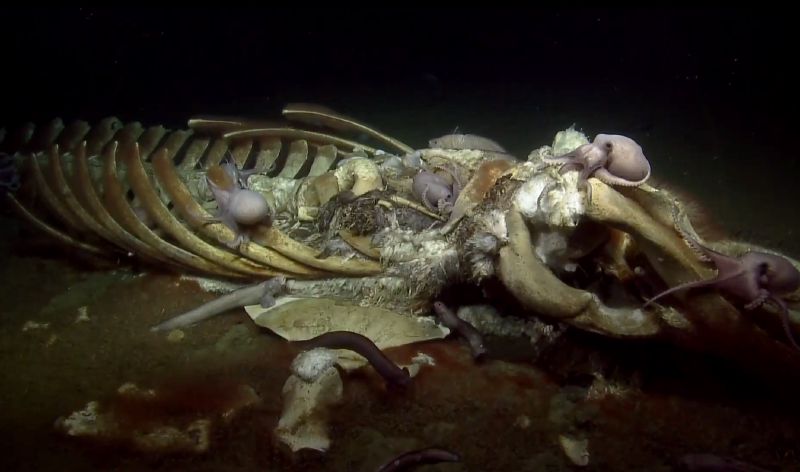
NOAA’s Office of National Marine Sanctuaries has a name for the sunken kind: a whale fall, a sudden and concentrated food source landing in a part of the ocean that is normally short on energy.
What happens in the hours after death
Every dead whale bloats, because it’s a mammal. Once the heart stops, bacteria and enzymes carry on working through the stomach, the intestines and the other organs, breaking them down into gases that include methane, ammonia and hydrogen sulfide. Those gases can lift a carcass weighing dozens of tonnes and keep it near the surface for a time.
From there, three things can happen. The body can wash up on a beach, where it becomes a meal for scavengers on land. It can float long enough for birds, sharks and other fish to feed on it at the surface. Or it can sink. Most whales die scattered along their migration routes in the open ocean, according to Greg Rouse, a curator of benthic invertebrates at the Scripps Institution of Oceanography in San Diego. Their bodies then settle onto the seafloor, where they become a food source.
What happens once the body reaches bottom
A sunken carcass usually arrives on the seafloor largely intact, because scavengers cannot easily tear apart something so large. Deep-sea sharks and hagfish move in first, stripping away the soft tissue. Once that’s gone, a slower resident takes over: a bone-eating worm called Osedax mucofloris slowly works through what remains of the skeleton.
The whole sequence, from the first sharks to the last worm, can take 30 years or more, according to Andrew David Thaler, a marine biologist. A single carcass can support deep-sea life for more than a century after the whale died.
Why a stranded whale can explode
On a beach, the same gases have nowhere to go. Skin and blubber can hold a surprising amount of pressure on their own, Thaler says. What usually tips a carcass past that limit is people: someone climbing onto it, cutting off a souvenir, or a crew trying to haul it away. In the Faroe Islands, a sperm whale carcass exploded when people deliberately tried to release its gas.
Trout River, a small town in Newfoundland, met that problem directly in 2014, when a blue whale weighing 380,000 pounds, or about 170,000 kilograms, stranded on its beach. Nobody knew whether the gas building inside would leak out on its own or split the carcass open first. News of it went viral, complete with a hashtag and a website tracking whether the whale had exploded yet.
Why moving a stranded whale is harder than burying it
Burying a stranded whale where it lies is usually the best option, Thaler says. Towing or hauling one away is harder than it looks. Whales are so heavy that the earth-moving equipment needed to shift a carcass can damage more of the shoreline than leaving the animal to decompose where it landed.
Why some whale bones never reach the deep sea
Off eastern Greenland, the underwater photographer Alex Dawson once dived through a hole cut by hand into about a metre of pack ice. Only five metres beneath the surface, he came upon the remains of around 20 minke whales. “There are so many bones everywhere,” he said afterwards.
That’s not where whale remains are meant to end up. Bones that would ordinarily have drifted down to the deep ocean floor were trapped instead in the shallows, sealed under the ice above.