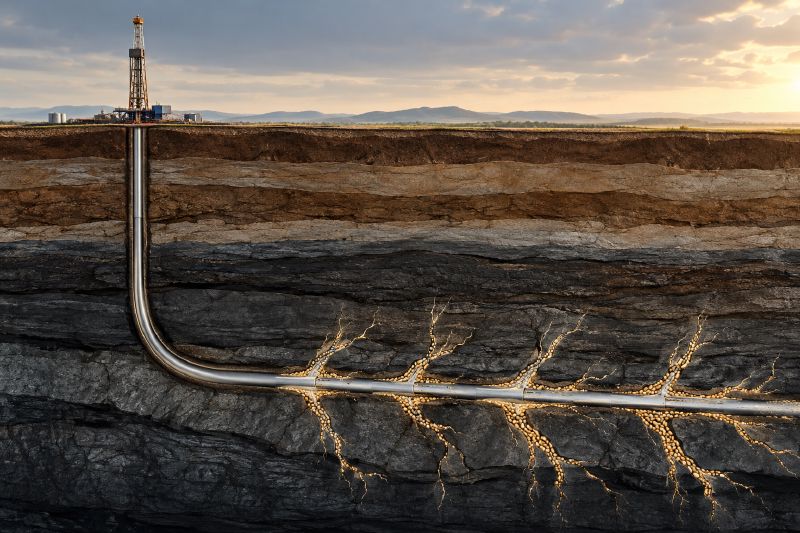
When a well is fracked, fluid pumped down it at high pressure splits the rock around it, and grains of sand hold the new cracks open. Oil and gas then have far more surface to escape from, and they flow back along the cracks to the well and up to the surface.
The fluid is mostly water and sand. The US Department of Energy describes large volumes of both, with small volumes of chemical additives, injected into rock that lets little through.
Drilling comes first
Fracking is a completion technique. The crew does it after the well has been drilled, not instead of drilling.
In modern American wells the drilling itself takes a turn. The bit goes straight down to a set depth, then the path bends until it runs sideways through the rock. That horizontal stretch, called the lateral, can be a few hundred feet long or several miles. The longer it is, the more of the well sits in contact with the rock holding the oil or gas.
A horizontal well usually costs more to drill than a vertical one, because it is longer and harder to steer. It is expected to produce more in return.
What the pressure does
The pump pushes liquid against the rock formation until the rock fractures. The pressure of the pumped fluid is what opens the cracks.
Pressure alone would not keep them open. That job falls to the proppant, small solid particles that ride in with the fluid and wedge into the fractures as they spread. It is usually sand, or a manufactured grain of similar size.
Most of the injected fluid comes back up the wellbore and is pumped out at the surface, the Department of Energy says. What stays behind is the sand, holding the rock apart.
How common it has become
The method is old. Hydraulic fracturing has been used for more than 60 years in more than a million wells, by the Department of Energy’s count. What changed was pairing it with horizontal drilling.
In October 2011 fracked horizontal wells became the main way of developing new US oil and gas, measured by footage drilled. By 2016 they made up 69% of all oil and gas wells drilled in the United States, and 83% of the footage. About 670,000 of the country’s 977,000 producing wells were fracked horizontal wells, according to the US Energy Information Administration.
Public concern grew too. Public worry about drinking water and other environmental damage led Congress in 2010 to direct the Environmental Protection Agency to study fracking’s effect on drinking water and groundwater.