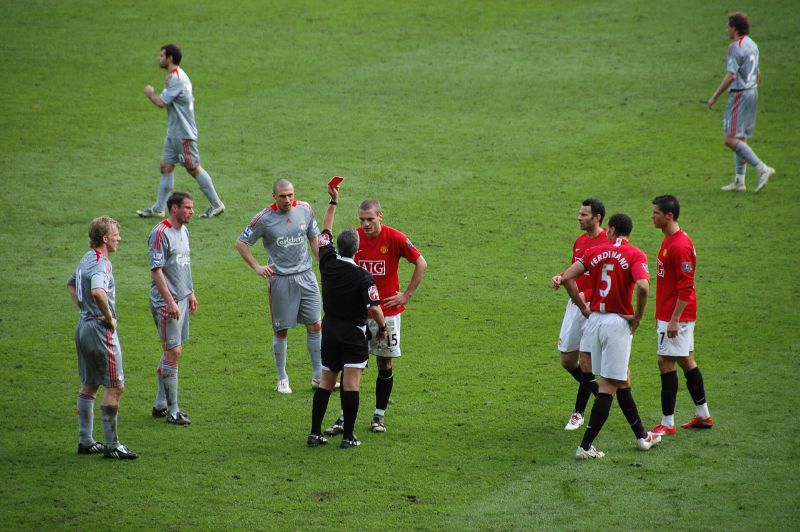
A red card ends a player’s match on the spot and costs them at least the next game as well. At the 2026 World Cup, that one-game ban was automatic and could not be appealed. The only thing a team could contest was extra punishment added on top.
more
What earns a red card
Soccer Blade, a coaching site, lists the usual offences. They are:
- serious foul play, such as a tackle with excessive force or studs showing
- violent conduct, including punching, kicking, biting, and spitting
- a foul or handball that denies an obvious goal-scoring chance
- a second yellow card in the same match
- offensive language or abuse aimed at officials or players
A foul in the penalty area no longer brings a penalty and a red card together unless it would be a red anywhere else on the pitch. The referee’s decision stands unless the video assistant referee asks for a review.
What happens on the pitch
A player shown a red card has to leave the field. They cannot sit in the technical area with the manager and substitutes either.
The professional game has no sin bin for these offences, unlike many other sports. Grassroots youth football in the UK has brought one in.
The ban that follows
The United States found out what the rule means at this summer’s World Cup. Their forward Folarin Balogun was sent off in the 64th minute of a 2-0 win over Bosnia and Herzegovina, which put the US into the last 16. The referee, Raphael Claus, gave a straight red after the video assistant referee advised him to review a tackle on Tarik Muharemovic’s ankle.
That meant Balogun, the team’s leading scorer at the tournament, would miss the match against Belgium. A US Soccer spokesperson told the Guardian that the automatic ban could not be appealed. Balogun could still attend the game in Seattle, but only from the stands, not the bench.
When one game becomes five
Fifa’s disciplinary committee can add games to the automatic ban. A team may appeal against that extra suspension. Even then, it can only argue a two-game ban down to one, never down to zero.
The committee used that power at the same World Cup. Qatar’s Assim Madibo received a red card for a tackle that broke the leg of Canada’s Ismaël Koné. Fifa raised his ban from one game to five. Paraguay’s Miguel Almirón was sent off for covering his mouth in a confrontation, and the committee left his ban at one game.
Leagues set their own suspensions, so the length of a ban varies by competition. The laws that decide when a red card is shown are the same everywhere.
The matches that ran out of players
A ban can carry into the next season. The 2026 final of Brazil’s Mineiro Championship, between Cruzeiro and Atlético Mineiro, ended with 23 red cards after a brawl. Referee Matheus Candaçan showed all 23 after the match had ended, and the players will serve their bans in next year’s competition.
That broke Brazil’s old record of 22 dismissals, set by Portuguesa and Botafogo in 1954. It is still not the world record. On February 27, 2011, referee Damián Rubino showed 36 red cards after a fight between Claypole and Victoriano Arenas, in Argentina’s fifth tier. He dismissed every player on both teams, the substitutes included, and Guinness World Records lists the total.
The trouble in Belo Horizonte began when Atlético’s goalkeeper, Everson, caught the ball and Cruzeiro midfielder Christian tackled him. Everson reacted, and security staff and police had to step in to end the fight between players, substitutes, and coaching staff. Cruzeiro won the match 1-0 with a Kaio Jorge goal in the 60th minute, but the brawl overshadowed the goal.