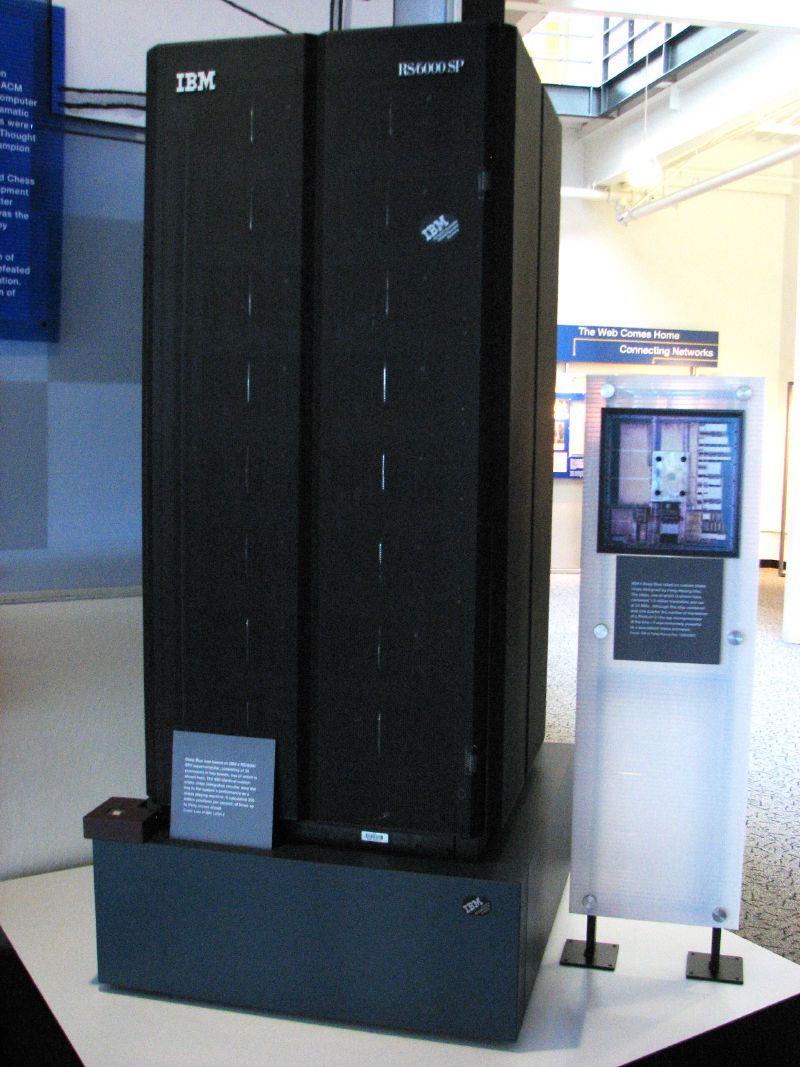
IBM answered its 1996 defeat by upgrading Deep Blue’s hardware and software. Its team designed a new chess chip that judged pawn positions better and doubled the machine’s speed. It also rewrote the program around a plan a grandmaster had shown it. In May 1997 the rebuilt Deep Blue beat Garry Kasparov.
more
What the 1996 loss showed
Kasparov won the first match in Philadelphia in February 1996, four games to two. He lost the opening game of that match, though, and no computer had beaten a reigning world champion under classical time controls before.
The machine he faced was already years in the making. Feng-hsiung Hsu began building a chess machine called ChipTest in 1985, as a graduate student at Carnegie Mellon. He and Murray Campbell joined IBM Research in Yorktown Heights, New York, in 1989, and the pair led the Deep Blue team.
The team knew computers better than chess. So IBM brought in grandmasters, among them Joel Benjamin, who had become the youngest US chess master at 13. They did two jobs. They helped choose the library of opening moves the machine could draw on, and they played against it so the team could find its weak spots.
The faster chip
Campbell has said the team went back to the drawing board after the 1996 match. It built a new chess chip with a stronger grasp of the positions pawns could take. That chip doubled the system’s speed.
The numbers show the scale of the jump. An IBM article puts Deep Blue at up to 100 million chess positions a second. The rebuilt version searched up to 200 million a second, depending on where the pawns stood.
Speed was only half of it. The researchers also let the chip recognise chess concepts, such as positions and lines of attack, and weigh them as it searched. The final machine stood as two towers 2 metres tall, holding more than 500 processors and 216 chess accelerator chips. Software worked out the basic replies to each move, then the chips assessed the outcomes and picked the best.
The idea from a grandmaster
The second change came from the practice games. Training with Benjamin, the team learned that opening a file and sliding a rook onto it was not always the best plan. A file is a column of squares, and an open one gives rooks and queens a clear line of attack. The stronger play was to stack pieces behind the file and choose the moment to open it. The programmers rewrote Deep Blue’s code to play that way.
That plan shaped game two. Deep Blue held the threat of an open file over Kasparov and made him defend on every move. The English grandmaster John Nunn called one of its moves “stunning”. Kasparov called it “human-like”, and the game unsettled him so badly that he walked away from it.
How the rematch ended
Kasparov won the first game in New York, lost the second, then drew three in a row. In the deciding game he confused the moves of the Caro-Kann defence on his seventh move. Deep Blue sacrificed a knight, and 11 moves later Kasparov conceded. Until May 11, 1997, no computer had won a six-game match against a reigning world champion at standard time controls. That day, Deep Blue did. The score was 3½ to 2½.
Kasparov accused IBM of steering the machine with a human grandmaster. IBM denied it. It said the only human changes came between games, to fix bugs, as the rules allowed. It also said it had not tuned the program to Kasparov’s style, and relied on the machine searching vast numbers of moves.
IBM then turned down a rematch and took Deep Blue apart. It held back the machine’s logs until after the dismantling. When analysts did read them, they found that Deep Blue had made several big mistakes of its own.