There is no single best AI. Ask a reviewer to name one and the answer depends on what they were testing: a note-taking gadget, a chatbot you type questions into, or the raw model underneath both.
more
The best AI notetaker
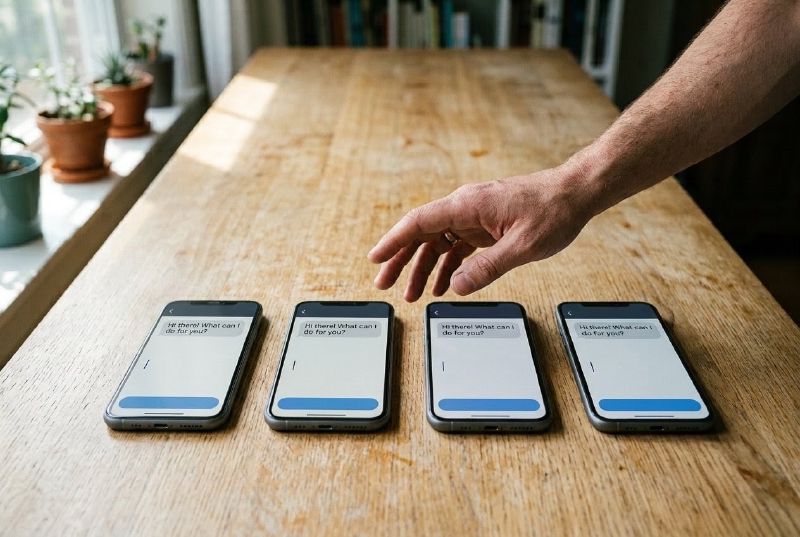
WIRED’s testers ran several AI notetakers through real meetings, interviews, and calls, then judged each on transcription accuracy, the quality of its summaries, speed, and value. Their pick was the Comulytic Note Pro, a 28-gram device that clips to a phone with a magnetic ring and runs for 45 hours on one charge. It processes recordings through both OpenAI’s GPT-5 and Google’s Gemini, and it is one of the few notetakers with a small screen rather than just a blinking light to show it is recording.
It has limits. The device transcribes 113 languages, but only gives a full summary in the language you set, so a foreign recording comes back with a verbatim transcript and a translated gist rather than a complete translation. For a business that wants a permanent record of every meeting in a room, WIRED also flagged the $1,600 Vibe Bot, built to sit through hours of conference calls rather than a single conversation.
The best AI chatbot, on one test’s numbers
Judge “best AI” by chatbot instead of gadget, and the shortlist changes entirely. ZDNET put ChatGPT, Copilot, Grok, Gemini, Perplexity, Claude, DeepSeek, and Meta AI through 112 tests in all, covering summarising, maths, translation, coding, and image generation, scoring each chatbot out of 120 points. ChatGPT came out on top, followed by Copilot and Grok.
The same test found free tiers doing far more than expected. ZDNET’s reviewer hit almost no usage limits across ten back-to-back prompts on each chatbot, and several let them run full tests without creating an account at all.
Put two flagship models head to head, and neither wins outright
A narrower test tells a different story. Ars Technica compared the free versions of ChatGPT and Gemini that most people actually use, rather than the priciest paid tiers. That comparison matters now because it is what a phone assistant like Siri would draw on, after Apple’s deal to run Siri on Google’s Gemini.
Neither model swept the results. Asked for five original jokes, both mostly produced lines already circulating on Reddit, though ChatGPT’s attempts included a couple that held up as new. Asked how many floppy disks a Windows 11 install would fill, Gemini’s estimate landed closer to the real file size and kept its units straight throughout, where ChatGPT’s own calculation tangled itself partway through. Asked for a short story about Abraham Lincoln inventing basketball, ChatGPT’s story earned charm points, while Gemini’s had more lines that made no sense.
Why the ranking won’t hold still
Part of the reason no verdict lasts is the pace behind it. Stanford’s 2026 AI Index, reviewed by IEEE Spectrum, counted 50 notable AI models released by American organisations in 2025, with industry labs behind the vast majority of them rather than universities. Worldwide computing power dedicated to AI has grown more than threefold every year since 2022, and Nvidia’s chips now account for over 60% of it.
That growth carries a cost the leaderboards do not show. The Index estimates that training a frontier model such as xAI’s Grok 4 generated more than 72,000 tons of carbon-equivalent emissions, against roughly 5,184 tons for OpenAI’s GPT-4 a few years earlier. Ray Perrault, who co-directs the Index, cautioned that the Grok figure rests on inferred numbers rather than a figure xAI has confirmed itself.
New models keep arriving on top of that build-out, so a chatbot ranking or a notetaker review is a photograph of one week, not a fixed order. The question worth asking before you pick a tool is not which AI wins in general, but which test in this piece looks most like the job you actually need done.