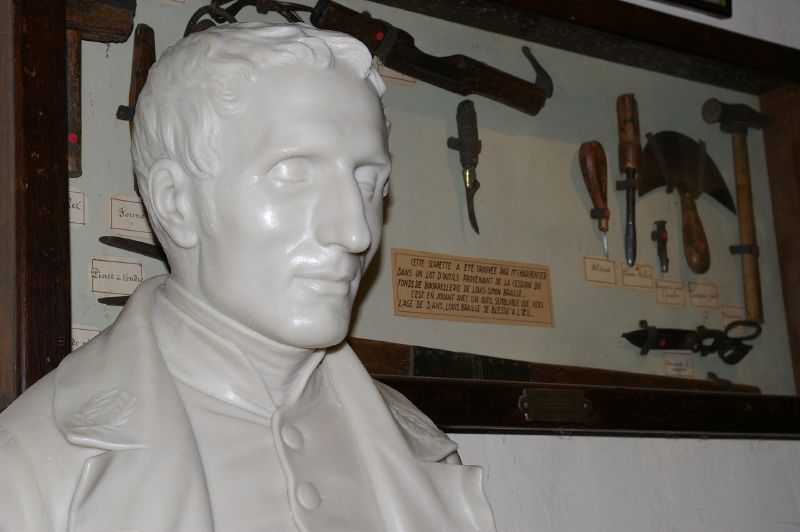
At 15, Louis Braille gave blind people a code they could write as well as read. As a pupil at a school for blind youth in Paris, he built a tactile system out of six raised dots. It handled text, numbers and musical notation equally well, and it still carries his name.
more
The boy from Coupvray
Braille was born on January 4, 1809, in Coupvray, on the edge of Paris. An accident in his father’s workshop, and the infection that followed, left him totally blind by the age of five, according to the Library of Congress. BBC Bitesize puts the loss of his sight at three.
He was a driven student, and he won a place at the Royal Institute for Blind Youth in Paris. BBC Bitesize says he was ten when he arrived.
Where the dots came from
The idea did not start with him. In 1821 a captain in Napoleon’s army showed him a code of raised dots that stood for letters and words. The captain called it “night writing”, and it let soldiers send and receive messages without making a sound.
Braille reworked it. By 1824, aged 15, he had found 63 ways to use a cell of six dots that took up no more space than a fingertip.
How the cell works
The six dots sit in two columns of three. Each pattern stands for a character, and the cell allows 63 combinations. Readers move their fingers from left to right across the page.
The same small set of dots now covers everything from basic letters and numbers to advanced mathematics, according to the Royal National Institute of Blind People (RNIB).
Why it took so long to catch on
Braille did not see his code widely adopted. He spent years teaching at the same institute where he had been a pupil, and died of tuberculosis at 43. He was buried in Coupvray in 1852.
France adopted his code as the official communications system for blind people two years after his death. The Library of Congress says braille transformed literacy for people with visual impairments around the world. His birthday, January 4, is now World Braille Day.
Has technology made braille obsolete?
The RNIB says no: braille still plays a very important role. The RNIB counts around 20,000 braille users in the UK, mostly people who lost their sight at birth or early in life. BBC Bitesize says braille remains essential in childhood, because without it blind children can find it very hard to learn to read and write.
Audiobooks and screen readers do let blind people reach websites and texts without braille. James Bowden, the RNIB’s braille technical officer, told BBC Bitesize the effect of technology cuts both ways. Refreshable braille displays use a row of moving pins to form characters under the reader’s fingers. Many tools that turn text into speech can also send it to such a display.
Paper braille is bulky. An average book runs to five volumes, and the largest book in the RNIB Library, the Viking Opera Guide, fills 94 volumes and 2.5 metres of shelf. Braille also turns up on lift buttons and on medicine boxes from pharmacies.
David Blunkett, blind from birth, was Britain’s first blind cabinet minister. He told BBC Bitesize that braille is what lets someone without sight read a letter through the door, or the label on a tin. In his view, a mix of braille and technology is what lets blind people handle daily life on equal terms.
The Library of Congress says braille is now in its 202nd year. It says braille literacy still matters to people with visual impairment today, two centuries after a 15-year-old devised it.