The Montreal Protocol stopped the world making the chemicals that were thinning the ozone layer, and the layer is now healing. The treaty was adopted on 16 September 1987. A United Nations assessment in 2022 found the ozone layer on course to return to its 1980 state, before the hole appeared, by the middle of this century.
That is the short answer. The longer one is about chlorine, refrigerators, and a second problem the fix created.
What was going wrong
Ozone is a molecule of three oxygen atoms. High in the stratosphere, roughly 7 to 25 miles up, it soaks up part of the Sun’s ultraviolet light before it reaches living things.
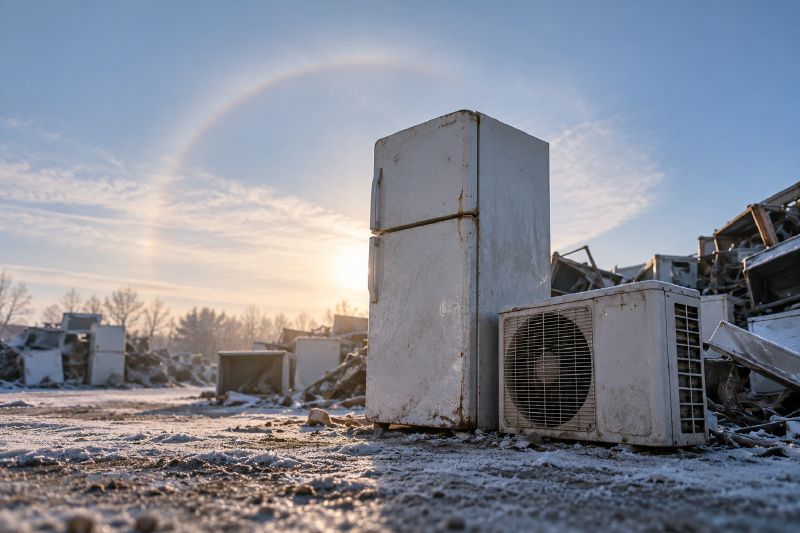
In 1974 the chemists Mario Molina and F. Sherwood Rowland published a study in Nature showing that chlorofluorocarbons, or CFCs, were drifting up into the stratosphere. Those compounds were everywhere: aerosol sprays, fridges, air conditioners, fire extinguishers, and foams.
Then, in 1985, the British Antarctic Survey reported that ozone over Antarctica was falling. The mechanism was chemical. NOAA explains that long-lived compounds carrying chlorine and bromine linger in the stratosphere and act as catalysts, breaking ozone apart again and again.
The exposure mattered to people. A thinner layer lets through more ultraviolet B light, which raises the risk of skin cancer and cataracts.
How fast governments moved
Countries signed the Vienna Convention in 1985, the same year as the Antarctic finding, and it laid the ground for the controls that followed. The Montreal Protocol came two years later and entered into force on 1 January 1989.
It was then amended again and again. Revisions were agreed in London, Copenhagen, Vienna, Montreal, Beijing, Kigali, and Quito, between 1990 and 2018.
Its reach is unusual. The UN Environment Programme describes it as one of the rare treaties that every country has ratified. With 198 parties, counting the European Union, it was the first treaty in UN history to reach that mark.
What the treaty makes countries do
The protocol now controls close to 100 man-made chemicals. Its annexes group them: CFCs and halons in one, carbon tetrachloride and methyl chloroform in another, then HCFCs, methyl bromide, and HFCs.
Each group is cut in steps. Richer countries and developing ones, which the treaty calls “Article 5 countries”, follow separate timetables. Both sides still carry binding targets with dates attached, and every party must license imports and exports and report its data each year.
Money helped poorer countries keep up. The Multilateral Fund, set up in 1991, has backed more than 8,600 projects worth over US$3.9 billion, according to UNEP. UNEP adds that many developing countries beat their reduction targets with that support.
Did it work?
By the measures scientists track, yes. The 2022 assessment found that chlorine entering the stratosphere from ozone-depleting substances had dropped 11.5% from its 1993 peak by 2020. Bromine had fallen 14.5% from its 1999 peak.
About 230 scientists from 30 countries contributed to that report. The World Meteorological Organization, UNEP, NOAA, NASA, and the European Commission led it. Britannica gives 2040 as the year ozone could return to pre-1980 levels if countries keep to the treaty. Over Antarctica the recovery runs later, with projections reaching 2066.
David Fahey, who directs NOAA’s Chemical Sciences Laboratory and co-chaired the assessment panel, called it “one of the most important and successful global environmental treaties ever”.
The climate bonus
CFCs do two kinds of damage. NOAA notes that besides destroying ozone, they trap heat, so banning them removed a greenhouse gas as well. NOAA puts the warming avoided at 0.5 to 1 degree Fahrenheit by 2100.
HCFCs, the stopgap that followed, carry the same double charge. UNEP says the commonest one warms the planet nearly 2,000 times as much as carbon dioxide. In 2007 the parties sped up the HCFC phase-out. Developed countries were due to finish by 2020 and developing ones by 2030.
The problem the fix created
The replacements for CFCs and HCFCs were hydrofluorocarbons, or HFCs. They leave ozone alone, but some trap heat thousands of times more strongly than carbon dioxide. UNEP says HFC emissions were growing by 8% a year.
The US Environmental Protection Agency warned that, left unchecked, rising HFC use could cancel out much of the climate gain from the original phase-out. Most of that demand comes from refrigeration and air conditioning, particularly in developing countries, the EPA says.
So the treaty changed again. On 15 October 2016, in Kigali, Rwanda, 197 countries agreed to cut HFC production and consumption by more than 80% over 30 years. The EPA estimates the Kigali Amendment avoids up to 0.5°C of warming by 2100. Under it, developed countries began cutting in 2019, and most developing countries froze their use in 2024.
What could still slow the recovery
The 2022 assessment named threats that could slow the recovery. Plans to cool the planet by spraying reflective particles into the stratosphere could delay the ozone layer’s repair, NOAA reports. More rocket launches and supersonic flights, which release exhaust straight into the stratosphere, could do the same, the assessment warns.
The chemicals the protocol banned are still leaving the sky. The question now is whether the new ones stay out of it.