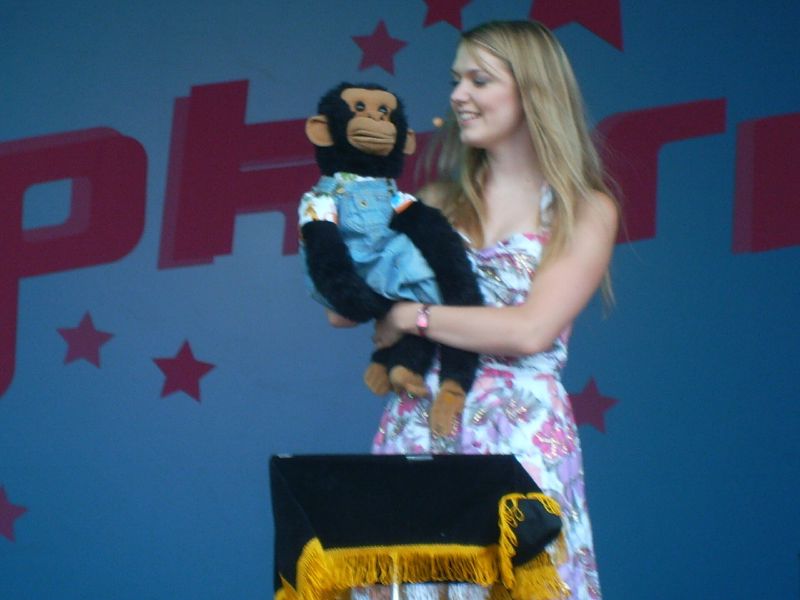
A ventriloquist does not throw a voice anywhere. The sound leaves the performer’s own mouth, and the audience’s brain decides it came from the dummy. A 2011 report in The Paris Review explains that a performer can make the voice seem near, far or muffled inside a box, but the placing is done by the people watching.
more
Why your eyes win the argument
Researchers call it the “ventriloquist effect”. A study first noticed it in the 1890s, and a research team gave it that name in the 1960s. The finding is that what you see biases where you hear a sound coming from.
For locating things in space, human vision is generally stronger than hearing. When a sound and a movement arrive close together in time and place, perception assumes one source caused both, and it picks the source you can see. So a puppet’s mouth flapping in time with a voice becomes the speaker. The brain would rather believe that than accept two unrelated events.
The hard part for the performer is keeping their own face out of it. The BBC invited readers to try saying “bottle of beer” without moving their lips. Twista, the Chicago rapper, told Pitchfork in 2022 that his goal was to speak whole sentences fluently with no mouth movement at all. He said his fast rap cadence made learning it less of a stretch, and that he still wanted a tutor.
A craft that nearly vanished
Ventriloquism became popular stage entertainment in the 18th century. It carries a much older name: the Smithsonian traces early references to Egyptian and Hebrew archaeology, and dates the word to the 16th century and Louis Brabant, valet to King Francis I of France.
In Britain the trade collapsed. Professor Steven Connor of Birkbeck estimated some 400 full-time ventriloquists worked in the UK in the 1950s and 60s, and only 15 by the early 2000s. Keith Harris, who worked with Orville the duck, lost his television slot as the 1990s began.
Who is bringing it back
The Guardian reported a revival in 2025, on stage at the Edinburgh fringe and on TikTok. Max Fulham, then 25, performs some routines with no puppet at all, voicing characters that exist only in the audience’s imagination. The Australian David Salter uses an apple with a face bitten into it.
Performers still describe the act as belief. Roger De Courcey, who appeared on the 1976 Royal Variety Performance with Nookie Bear, told the Guardian you must believe in the bear. Salter called it a shared hallucination between performer and crowd.
That fits the science. The dummy works because the audience agrees, without knowing it, to let their eyes decide. Every July, hundreds of vents gather near the Vent Haven Museum in Kentucky, which holds nearly 1,000 retired dummies.